North Port Tree Removal Pros quotes tree removal in Arcadia against a finding rather than a form, and after twenty-plus years across this service area it is the only city on our map where a homeowner taking a tree out of an existing yard applies to nobody at all.
An absence is harder to stand behind than a rule, so we did not arrive at it by searching and coming up empty. The city’s Unified Land Development Code was read article by article for this page: the general requirements article, the zoning article with its list of districts, and the article headed Natural Resources, which turns out to be flood management from its first section to its last.
That changes what a quote here is about. With no counter in the way, what actually prices an Arcadia removal is the ground a grinder has to cut, a river that floods days after the wind has stopped, and where the debris goes once the tree is down. Florida issues no tree or arborist contractor license of any kind, so instead of printing a word the state never granted, we put the reasoning for anything we recommend removing in writing, dated, before the work is scheduled.
The inland county seat, and a code organized around water
Arcadia is the county seat of DeSoto County, sitting roughly fifty miles from the Gulf on 4.451 square miles of land. It is its own micropolitan statistical area rather than a slice of somebody else’s metro, and it runs its own land development code, its own water, wastewater and reclaimed-water utility, its own police department and a municipal airport.
The National Weather Service says the same thing in a zone name. This address sits in public and fire weather zone FLZ061, named simply DeSoto with no coastal qualifier on it, so fire weather, heat and inland flood products reach it while the marine products that shape a conversation thirty miles west do not.
Reading thirteen articles instead of failing to find a permit
The code runs to thirteen articles prepared for the city by the Central Florida Regional Planning Council, and three of them are where a tree rule would live. Article 3, General Requirements and Nonconformities, runs from Section 3.01.00 to Section 3.15.00 and covers lot size, lots of record, nonconformities, moving buildings, construction trailers, model homes and tents, with nothing on trees in any of it. Article 9, headed Natural Resources, is given entirely to Development in Flood Prone Areas, Section 9.01.00 through Section 9.01.10. Article 4 enumerates twenty zoning districts, and not one of them is a vegetation, height or hazard overlay.
The only tree provisions in the whole code sit in Article 6, at Sec. 6.07.00, Compatibility, Landscaping and Buffering Standards, and they are planting and canopy-coverage rules keyed to development review. Nowhere in the book is there a protected-tree definition, a diameter at breast height threshold, a heritage or grand tree category, a mitigation schedule priced per inch, a tree fund or an after-the-fact penalty for taking a tree down.
Looking for tree-removal closer to Fruitville? See Tree-Removal in Fruitville.
The exemption sentence that ends the question
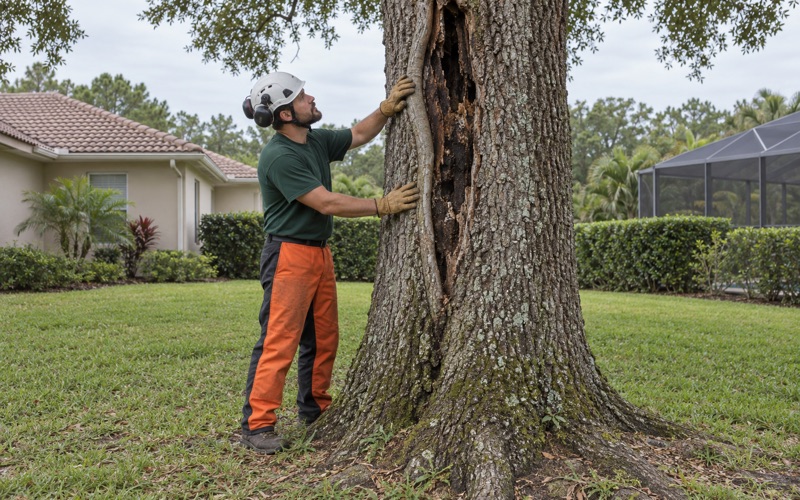
The landscaping article states for itself when it applies. Section 6.07.02.A reaches five things: a new building or improvements requiring off-street parking and other impervious surfaces, an alteration adding usable floor area that brings more parking with it, the construction or expansion of off-street parking and loading areas, the paving of areas that were unpaved, and any change of use to a higher-intensity use. Taking a dead laurel oak out of a back yard is none of those five.
Two trees per lot, and existing trees count toward them
Section 6.07.02.B then exempts three things at the top of its list: the enlargement or repair of a single family or duplex residence, new single family and duplex development on individual residential lots, and bona fide agriculture. The residential exemption is written as exempt from all provisions of this article, except the requirement of two large or medium sized trees per residential lot. Section 6.07.04.11 adds that existing trees may be used to satisfy that requirement, provided they are not listed as an invasive species on the most recent Invasive Plant List of the Florida Exotic Pest Plant Council. So even a new house on a vacant lot reduces to a two-tree planting line that the trees already standing there may cover.
Where the state preemption lands, and where it does not
Most of this coast runs on Florida Statutes section 163.045, which stops a local government from requiring notice, an application, approval, a permit, a fee or mitigation to prune, trim or remove a tree on residential property where an arborist certified by the International Society of Arboriculture or a Florida licensed landscape architect documents that the tree presents an unacceptable risk under the ISA Best Management Practices. The statute exists to override a local tree ordinance, and this city has none for it to override, so what it does here is cap what a future ordinance could ask of Arcadia’s detached houses rather than clear today’s work.
Florida Statutes section 163.211 preempts local occupational licensing as well, and no state tree or arborist contractor license exists to hold. That is why our pruning specifications cite ANSI A300 and our crews work to ANSI Z133 rather than to a number on a wall.
What the code still governs on a development site
Inside development review the same article turns strict, which matters before a commercial job starts. Section 6.07.04.02 lists seven preservation methods, among them hand labor to clear inside the drip line, an undisturbed drip line with no materials, machinery or soil placed in it, and visible barricades at the drip line and no closer than ten feet to the trunk. The one that reaches a removal crew directly is the requirement that all felled material be promptly and carefully removed from the site rather than stacked and left. Canopy coverage over vehicular use areas is set at fifty percent, waivable by the city administrator in four named districts.
County ground past the city limits, where agriculture is in the rules
Cross the city line and the book changes. DeSoto County’s land development regulations are Chapter 20 of its Code of Ordinances, administered from the county offices on East Oak Street in Arcadia, and they govern the groves, the pasture and the river frontage above and below town. The city’s own code keeps pointing at the same economy: bona fide agriculture is exempt from the landscaping article outright, and agriculture is excluded by name from the buffer-yard planting rates along arterial and collector roadways.
The classification behind that phrase is the agricultural assessment provision of Florida Statutes section 193.461, administered by the DeSoto County Property Appraiser. It exempts landscape standards and nothing else: the city’s flood provisions in Article 9 and the county’s own Chapter 20 still apply on their own terms.
Grove, pasture and fence-line trees are quoted differently
Fence-line clearing, grove and pasture edge work, windrow removal, clearing around agricultural structures and storm cleanup along ranch access roads are a different job from a residential removal, and they price differently. Access comes through a gate and down a drive rather than between two houses, the drop zones are open, and the haul is counted in trips rather than in feet of rope, which on a pasture job can put more of the day into driving than into cutting.
Two electric utilities, and no published line between them
DeSoto County names exactly two electric providers, Florida Power & Light and Peace River Electric Cooperative, divided by a territorial agreement the Florida Public Service Commission approved for this county and three of its neighbors. Neither the county nor the city publishes where that line runs, so on a tree inside falling distance of a conductor we read the meter or the bill before anyone asks for a clearance. The vegetation practice, the request route and the outage number differ between an investor-owned utility and a cooperative.
What the ground, the river and the gate do to the work
A hardpan inside the cut rather than rock beneath it
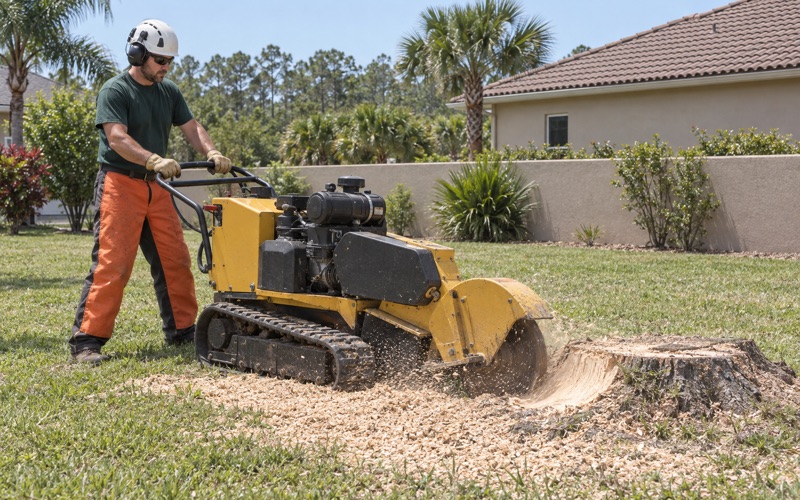
The soil mapped at the city’s own internal point is Smyrna fine sand, a poorly drained spodosol whose spodic horizon begins under twenty inches, with the cemented layer starting around thirteen inches down. Set that against a stump grinder’s rated cut of roughly 12 to 25 inches below grade and the hardpan sits inside the machine’s working depth rather than below it. It is soil and not stone, dark sand cemented with organic matter and aluminum, so the wheel cuts it, but it comes out denser, wetter and stickier than the loose sand above, and the spoil is the part a homeowner comments on. Nothing in this profile meets bedrock.
The water is the second constraint and it behaves differently. The series record puts the water table less than eighteen inches down for one to four months in most years, which makes saturation a traction and rutting problem on the approach while the cemented layer is a cutting and spoil-handling problem in the hole. On most of this coast a seasonal high water table stops a grinder long before any hardpan does; Arcadia is the address where both are in play.
The flood arrives after the storm has left
Hurricane Ian reached this city as an inland event in September 2022, with the National Weather Service issuing an extreme wind warning over areas including Arcadia, and the water arrived separately. The Peace River gauge at State Road 70 recorded the highest measurement in over 91 years of record, cresting two days after the storm crossed the state, and a county official described the flooding as an event expected roughly once in 500 years. A river flood in this basin comes on a delay measured in days and recedes over weeks, which is why root plates stay saturated long after the sky clears and a tree that stood through the wind can fail in still air four days later. We will not put a canopy-loss figure on that storm, because no published report we have read carries one.
The curb is closed to this work twice over
County yard waste may not exceed four feet in length or four inches in diameter, has to be bundled in four-foot lengths under forty pounds a bundle, and is limited to two bundles or cans per household per month, collected inside the city on the third Wednesday. The same program excludes yard debris generated by paid landscaping or yard maintenance services by name. A trunk is not four inches and our work is paid work, so every removal here makes material that goes to the gate instead.
The gate is the DeSoto County Landfill, in Arcadia, which publishes yard debris as its own line at $42 a ton in county, a sorted mixed load at the same rate and an unsorted one at $84. The scales weigh in twenty-pound increments, so a light, bulky chip load is billed at what it actually weighs rather than rounded up to a ton. That number sits on its own line of our quote, because the tipping rate changes at every county line we cross.
What we will not do, whatever the code allows
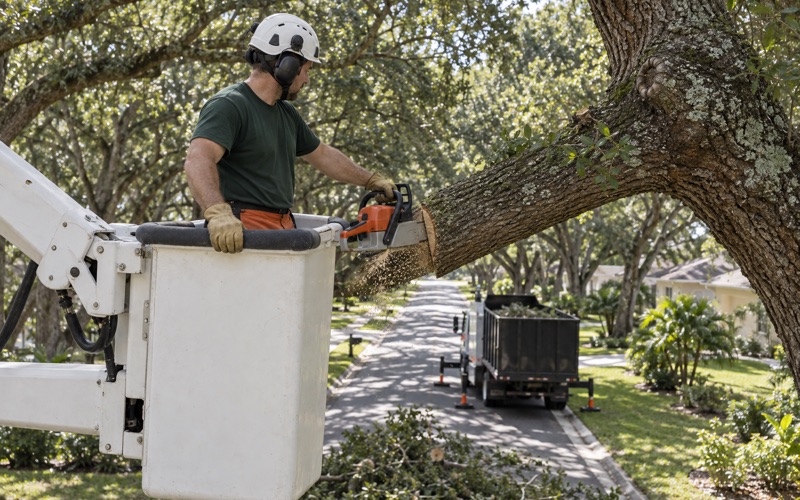
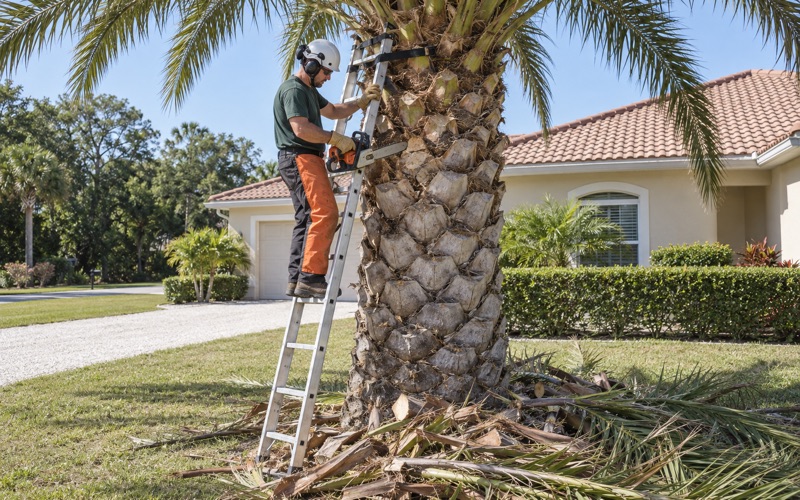
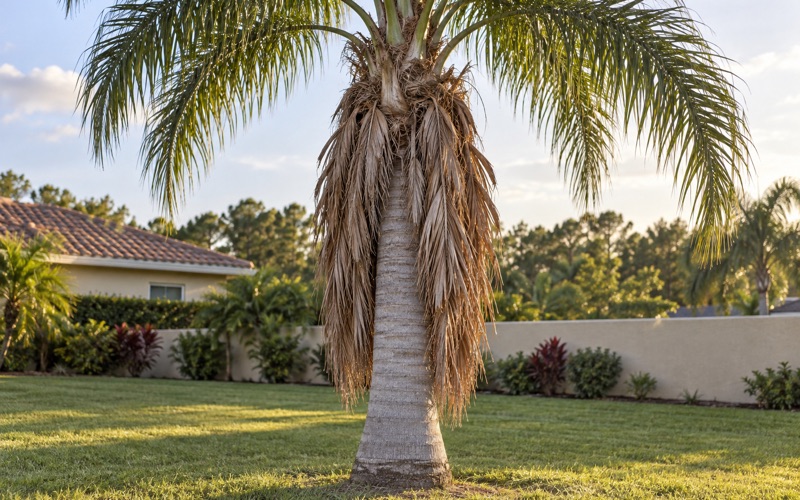
Renter-occupied units outnumber owner-occupied ones in this city, so the first question on an inbound call here is more often whether the caller owns the property. Once the owner is on the line, an absent ordinance does not widen what we will cut: hurricane cuts, hat racking and topping are refused on oaks and on palms, however the job is asked for. A palm is quoted as a palm, with one growing point, no branch collar and a trunk that will never add another inch, and where a tree should stay we quote the pruning or the cable instead.
- 20+ Years on This Coast
- Free Written Estimates
- Dated Condition Reports