North Port Tree Removal Pros handles invasive tree removal in North Port, FL and has for 20+ years, serving surrounding cities including Port Charlotte, Plantation, Englewood, Rotonda, Punta Gorda. This is the one category of removal where the code is usually on your side, and it is also the one where the cheap version of the job reliably fails, because the plants in question are defined by their ability to come straight back.
The regulatory part is genuinely simpler. North Port’s own land development code exempts the Florida Exotic Pest Plant Council category list from its tree removal permit and then names the worst offenders individually, so taking a Brazilian pepper out of a back yard is not a permit conversation the way taking a protected live oak out of the same yard would be. Several neighboring jurisdictions publish comparable lists.
The part that needs actual planning is everything after the cut. These species resprout from stumps, carry seed banks in the soil, and recolonize bare ground faster than anything you would plant on purpose. A clearing with no plan for the second season is a clearing you pay for twice, so we quote the follow-up alongside the work rather than letting it arrive as a surprise.
The Species This Code Names
Brazilian Pepper
Brazilian pepper is the most common invasive we remove here and the most persistent. It forms dense multi-stemmed thickets, shades out everything beneath it, fruits heavily and is spread by birds into every neglected edge and fence line in the region. The wood is soft and the cutting is fast, which misleads people about the job: the difficulty is entirely in the stumps and the seed already in the ground.
Melaleuca and Australian Pine
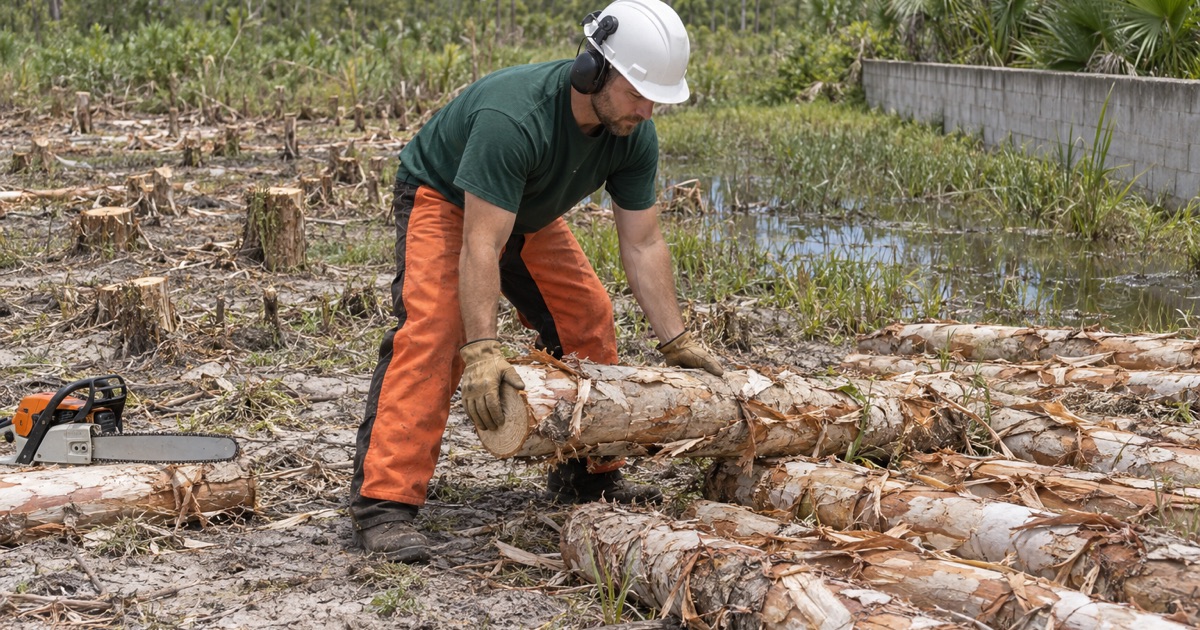
Melaleuca, the punk tree, has papery bark and a habit of taking over wet ground, and a single mature specimen releases an enormous quantity of seed when stressed or cut, which is exactly why the disposal matters. Australian pine grows tall and fast on shallow roots, drops litter that suppresses other plants, and is notorious for failing in wind, which makes it a hazard removal as often as a clearing one.
Carrotwood, Chinese Tallow and Earleaf Acacia
Carrotwood arrived as a landscape tree and is now a named invasive, and it turns up in established yards rather than only in wild edges. Chinese tallow spreads readily and colors up in fall, which keeps people reluctant to remove it. Earleaf acacia grows very fast, fails in wind at a modest size, and fills cleared ground quickly. All three sit on the exempt lists for the same reason.
Why Removal Is Usually Easier Here
The Exempt Species Lists
The exemptions run off published lists rather than off a crew’s opinion, which is what makes this straightforward. North Port’s code points at the current Florida Exotic Pest Plant Council category list and then names a set of species directly. Where a plant is on the list that applies to your address, the removal generally needs no permit, no mitigation points and no replacement tree.
What the Exemption Does Not Cover
An exempt species is not an exempt location, and that distinction catches people out. Work inside a conservation or preservation area, a canopy road zone, a right-of-way, a platted drainage easement or an area covered by an approved landscape plan still runs under those rules whatever the species is. Clearing a whole lot is also a different application from removing a tree, and we establish which you are in before quoting.
Removal That Does Not Grow Back
Cut Stumps That Resprout
A cut pepper or acacia stump responds by sending up a dozen shoots where there was one trunk, so the plant is denser a year later than before the work. Holding the ground means dealing with the stump rather than only the top: grinding it out, or a cut-stump treatment applied promptly by somebody licensed to apply it, and that distinction is written into the quote rather than implied.
Seed Banks and the Second Season
Even with every stump handled, seed already in the soil germinates once light reaches the ground, and a cleared area is the ideal nursery for it. The seedlings are trivial to pull in their first season and a real job in their third. So the honest scope includes a return visit the following season, and saying that up front is the difference between a clearing that holds and one that has to be repeated.
Disposal Without Spreading It
How the material leaves matters with these species in a way it does not with a native oak, because fruit, seed and viable cuttings travel with the load. Material goes out covered, to a permitted facility at the horticultural waste gate rate we itemize, rather than being mulched and spread where the seed is just being relocated across your own property.
Replanting, and What Goes Back
Native Replacements That Do the Same Job
The question behind most invasive removals is what the plant was doing for you, and the answer is almost always shade or screening. Live oak and slash pine give shade and hold up in wind when they are structurally sound; cabbage palm suits tight spots and is native; a mixed screen of appropriate shrubs beats a single-species hedge for both resilience and coverage. We price the replanting with the removal so the ground does not sit bare.
Timing a Clearing Around the Wet Season
The best window for this work on this coast is the drier, cooler part of the year, when the ground carries equipment, the saturated flats are workable, and seedling pressure is at its lowest for the follow-up. Clearing in the middle of the wet season is possible and it costs more in machine time and ground damage, so where the work can wait a few weeks we will tell you it should.
- 20+ Years on This Coast
- Free Written Estimates
- Dated Condition Reports