North Port Tree Removal Pros brings crane assisted tree removal to North Port, FL, backed by 20+ years on this coast, serving surrounding cities including Port Charlotte, Plantation, Englewood, Rotonda, Punta Gorda. A crane is not a luxury method and it is not always the right one. It is the answer to a specific problem: a tree whose wood cannot safely travel the route between where it is and where it needs to land.
On an ordinary removal the wood comes down through the tree, lowered on ropes past everything in the way, and a climber spends the day in the canopy above whatever is underneath. Where what is underneath is a screen cage, a tile roof, a pool or a neighbor’s lanai, each of those lowers is a separate chance to get it wrong, and the hours add up as the crew slows down to match the consequence.
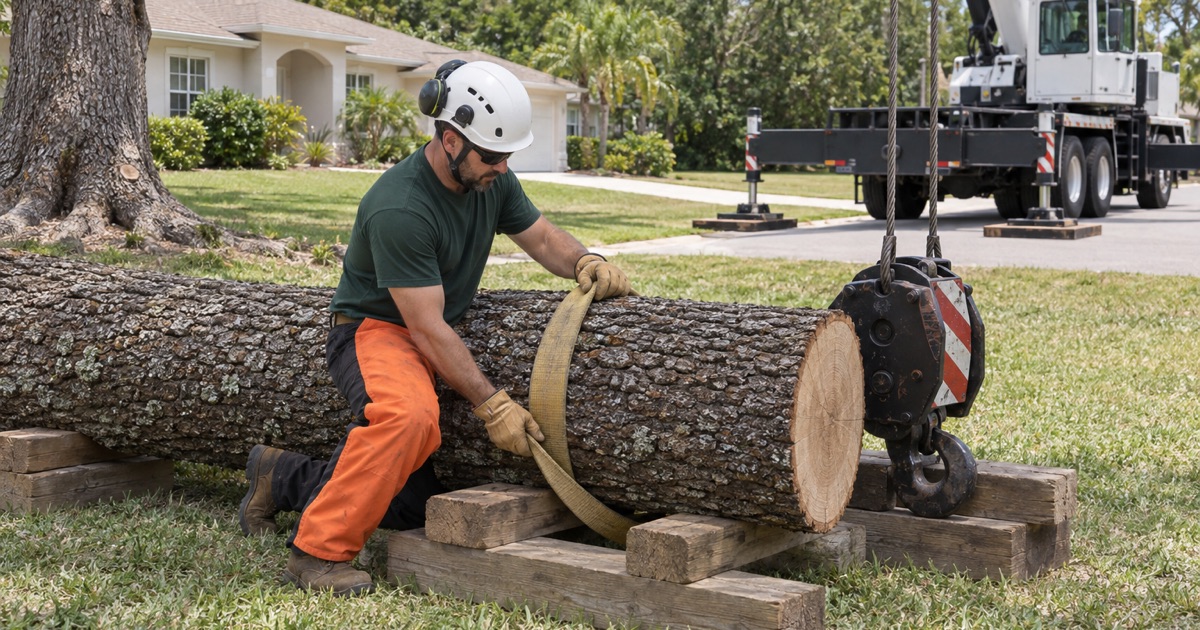
A crane changes the geometry. The section is attached, cut, and lifted clear in one movement to a landing area away from the structure, with the load taken before the cut is complete. Fewer movements, a shorter day, a smaller crew in the tree, and the wood never passes over the thing you are trying to protect. That is the whole argument, and it holds on some trees and not others.
When a Crane Is the Cheaper Answer
Trees Over a Roof or a Pool Cage
A screen enclosure is the most common reason we bring a crane to a residential address here, because an aluminum cage will not take a dropped limb and is frequently the part of the property an insurance policy covers least. Tile roofs are a close second: tile breaks under a rope bag, never mind a section of oak. Picking the wood straight up and away removes the risk instead of managing it.
No Access for a Chipper or a Bucket
Some lots simply cannot be worked conventionally. A back yard behind a narrow side gate with no equipment access means every piece is carried by hand, which is slow and expensive. A bucket truck needs somewhere to set up with a clear reach, and a tight rear setback denies it. A crane reaching over the house from the street solves an access problem rather than a rigging one.
Dead and Decayed Trees Nobody Should Climb
A tree with advanced decay, a hollow trunk, a failing union or storm damage is exactly the tree a climber should not be tied into, because the anchor points cannot be trusted. Where the trunk can still hold a pick point, a crane lets the whole job happen with the crew on the ground. That is a safety decision that frequently also turns out to be the cheaper one.
What a Crane Pick Actually Involves
The Setup, the Radius and the Load Chart
Capacity falls away as the boom reaches further out, so the real question is never how much the crane can lift, it is how much it can lift at the distance your tree sits. Every pick is planned against the load chart at that radius, with the section sized to it. That is why we measure the setback, the reach and the obstacles before quoting rather than after the machine is on site.
Sectioning From the Top Down
The climber or aerial lift sets a rigging point, the section is attached, the cut is made with the load already taken, and the piece swings clear. Work proceeds down the tree, sections getting larger as the reach comes in and capacity increases. Nothing is cut before the crane has the weight, which is the difference between a controlled lift and a falling limb on a rope.
The Landing Zone and Where the Wood Goes
A crane needs somewhere to put the wood, and that landing area is part of the plan rather than an afterthought. Sections are lowered to a clear area, cut down there where it is safe to work, and loaded out. Brush chips on site and trunk wood goes out as loads to a permitted facility at a gate rate we itemize, because that figure changes at every county line we cross.
Access and Site Protection
Mats, Outrigger Pads and Saturated Ground
Outriggers concentrate enormous load into four small footprints, so they go onto pads that spread it, and the ground underneath has to be capable of taking it. Across much of this ring the soil is poorly drained fine sand with a seasonal high water table close to the surface, which is a real constraint in a wet month rather than a theoretical one. Where the ground will not carry the setup, we reschedule or change method instead of finding out the hard way.
Overhead Lines, Setbacks and the Street
Every crane plan starts with what is overhead, because a boom and a suspended load have to clear conductors by the distances in ANSI Z133 through the whole arc, not just at rest. Service drops, streetlights and communication lines all feature. Where the setup occupies part of the roadway we arrange that with the jurisdiction in advance, which is paperwork rather than a surprise on the morning.
Cost, Scheduling and the Alternative
Why a Crane Day Is Priced Differently
A crane carries a day rate, an operator, mobilization and setup time, and that cost exists whether the picks take three hours or eight. The practical consequence is that efficiency comes from filling the setup: two or three trees in one visit, or a removal and the adjacent pruning together. We will tell you when waiting to combine work is worth more than getting one tree down this week.
When We Will Talk You Out of It
If your tree stands over open lawn with room to drop wood and clear access for a chipper, a crane is money spent on nothing and we will say so. The same goes for a tree small enough to take down conventionally in a morning. Recommending the biggest machine on every job is how this trade gets its reputation, and the assessment is supposed to answer the question honestly in both directions.
- 20+ Years on This Coast
- Free Written Estimates
- Dated Condition Reports