North Port Tree Removal Pros provides tree disease treatment in North Port, FL and has for 20+ years, serving surrounding cities including Port Charlotte, Plantation, Englewood, Rotonda, Punta Gorda. The first and most valuable thing we do here is tell you which category your problem is in, because on this coast roughly half of what gets called a disease is a nutrient deficiency that can be corrected and a good share of the rest is a rot that cannot be treated at all.
That split is not a technicality, it is the whole bill. A manganese shortage in a queen palm is a soil correction and the palm recovers. A conk at the base of the same palm means the trunk is already gone and no product changes it. Anyone willing to sell a treatment without establishing which one you have is selling the product rather than the outcome.
So we diagnose first and quote second, and where the finding is that nothing can be done we say it plainly and price the removal instead. Where laboratory testing is what separates two possibilities with very different costs, we recommend the test rather than guessing on your behalf, because a palm removed on a wrong guess is a permanent decision.
Diagnosis Before Treatment
Symptoms That Have More Than One Cause
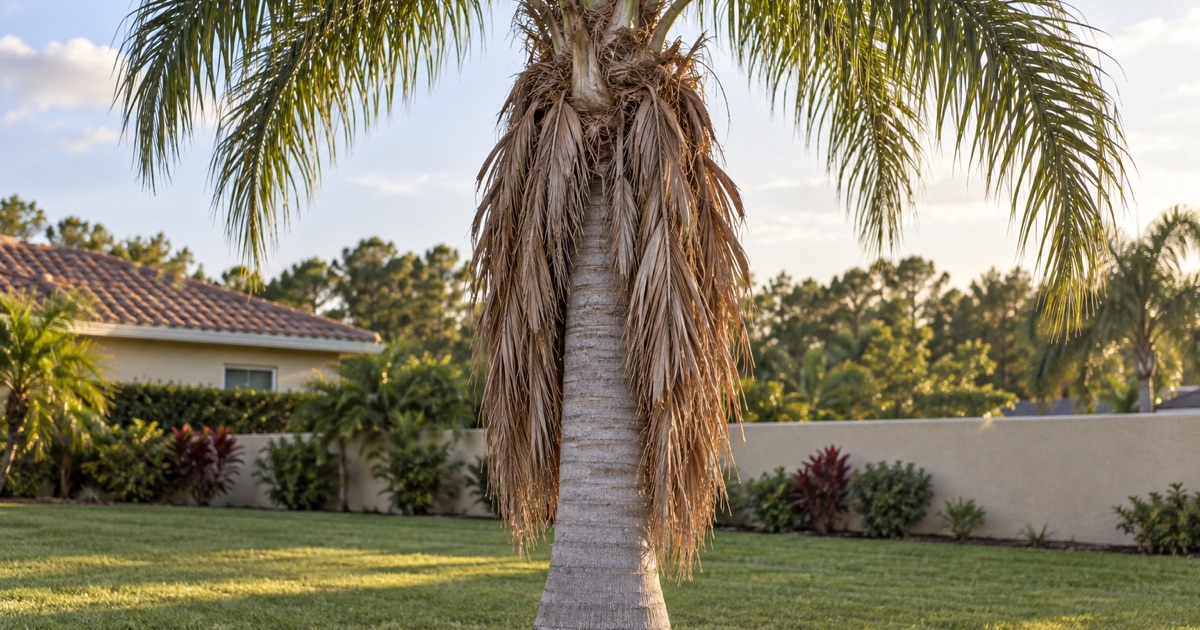
Yellowing fronds, thinning crowns, early leaf drop and dieback at the tips are each produced by several unrelated causes, and the common ones here are not diseases at all: drought, a saturated root zone, a grade change, salt, mechanical root damage or a deficiency. A symptom list narrows the field and never settles it, which is why we look at the site before reaching for a treatment.
Laboratory Testing, and When It Is Worth It
Testing earns its cost when two candidates have very different consequences. Lethal bronzing and a manganese deficiency can look alike early, and one means removal while the other means a soil amendment, so a trunk tissue test is cheap against the mistake. Where the visible evidence already settles the question, we skip the test and say so rather than adding a line to the invoice.
What a Site Walk Tells Us That a Photo Cannot
Photographs are useful for triage and poor for diagnosis, because the causes here are usually around the tree rather than on it: irrigation heads spraying the trunk, soil or mulch mounded against the root collar, a new driveway over the root zone, standing water, or a grade that was raised when the house was built. None of that shows up in a picture of a yellow frond.
Deficiencies, Which Are Fixable
Manganese and Frizzle Top
Frizzle top is the common name for manganese deficiency, and on queen and royal palms it is the single most frequent call we get. New fronds emerge small, frizzled and scorched, progressively worse, and if the bud dies the palm is finished. Caught with the bud alive it is correctable through the soil, and the palm grows out of it, though the penciled section of trunk stays as a record.
Potassium, Magnesium and Frond Color
Older fronds turning yellow or orange from the tips, or showing broad yellow bands with a green center stripe, generally point to potassium or magnesium rather than to an infection, and these are common on sandy soils that hold little. The correction is a slow-release amendment on a schedule rather than a single application, and cutting off the discolored fronds makes it worse by removing the reserves the palm is drawing on.
Soil pH, Compaction and Root Function
A nutrient can be present in the soil and unavailable to the plant, which is why a correction sometimes means changing conditions rather than adding product. Compaction from construction traffic, a raised grade, or irrigation that keeps a root zone saturated all shut down fine root function. Soil decompaction and getting water right fixes more declining trees here than any spray ever has.
Diseases and Rots, Which Mostly Are Not
Lethal Bronzing
Lethal bronzing is a phytoplasma disease that works up a palm from the lower fronds, commonly drops fruit prematurely, and ends with the spear leaf collapsing. It is not curable once symptoms are visible, it spreads, and the sensible response is confirmation by test and then prompt removal. Preventive injections exist in the industry for high-value palms in known outbreak areas, and we will discuss that honestly rather than as a default.
Ganoderma Butt Rot and Thielaviopsis Trunk Rot
Ganoderma zonatum produces a shelf conk at the base, by which point the lower trunk is decayed, and the fungus stays in the soil afterward. Thielaviopsis trunk rot works higher up and can drop a crown or fold a trunk with very little visible warning from the ground. Neither has a treatment. Both make the palm a hazard rather than a patient, and that is how we report them.
Laurel Wilt, and What It Does Not Take
Laurel wilt is a vascular disease of the laurel family carried by an ambrosia beetle, and it kills redbay and swamp bay quickly, with rapid wilting and dark vascular streaking. It does not affect laurel oak, which is an oak. Where we do find it, the handling of the wood matters as much as the removal, because moving infested wood is how the beetle travels.
Plant Health Care on the Root Zone
Soil Decompaction and the Air Spade
Most of what we can genuinely improve is below ground. An air spade lets us open the root collar without cutting roots, which both reveals decay and relieves a trunk that has been buried by mulch or fill. The same tool is used to fracture compacted soil over a root zone and work in amendments, which gives a declining tree room to put out new fine roots.
Mulch, Irrigation and What We Will Not Sell You
Mulch helps at two to three inches and kept off the trunk, and actively harms as a volcano piled against the bark. Irrigation set for turf drowns trees and set for trees starves turf. Those two corrections are free to you and they resolve a surprising share of calls, which is why they come before any paid treatment plan we would write.
- 20+ Years on This Coast
- Free Written Estimates
- Dated Condition Reports