North Port Tree Removal Pros has handled tree trimming in North Port, FL for 20+ years, serving surrounding cities including Port Charlotte, Plantation, Englewood, Rotonda, Punta Gorda. Pruning is the part of this trade where the difference between a good crew and a cheap one shows up years later, in a tree that either carried its own weight or came apart at a cut somebody made in a hurry.
Every cut we make follows ANSI A300, and the crew works to ANSI Z133 for its own safety, which between them rule out most of what gets sold as trimming on this coast. No topping, no hat racking, and no flush cuts into the branch collar. No lion’s tailing either, which strips the interior foliage and leaves all the weight at the ends of bare limbs.
What we do instead is named and priced: crown cleaning, crown raising, selective thinning, reduction cuts back to a suitable lateral, and cabling and bracing where a union is worth keeping rather than cutting. And where a tree genuinely should come down we say that too, because recommending endless pruning on a failing tree is the same dishonesty pointed the other way.
Pruning to ANSI A300, and What That Rules Out
Crown Cleaning, Raising, Reduction and Thinning
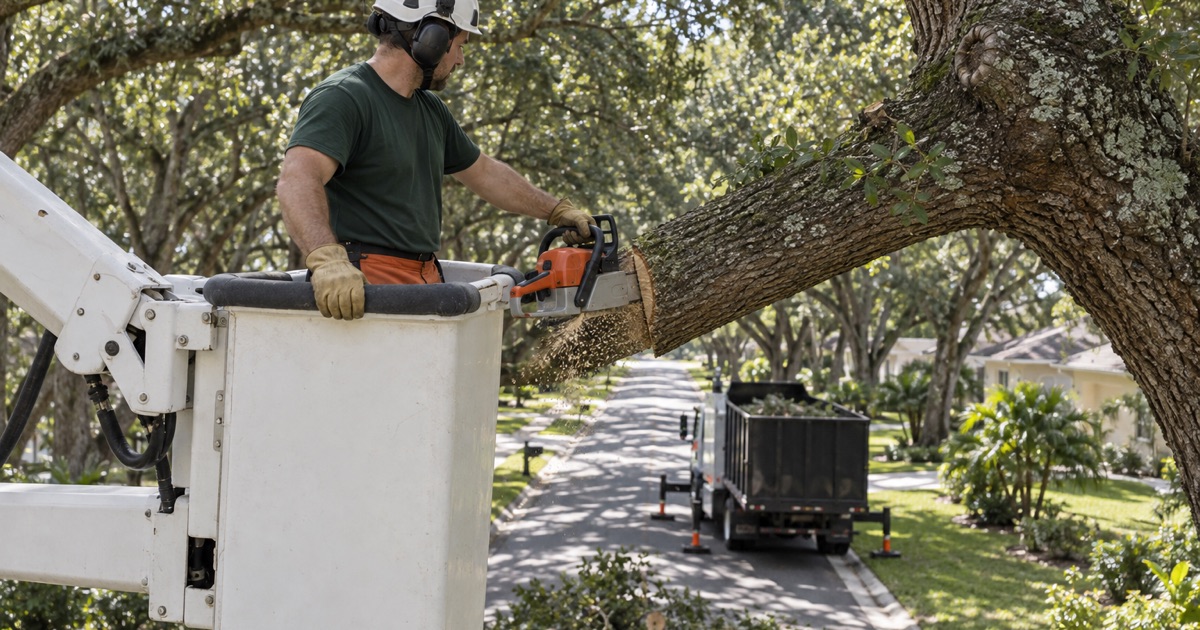
These four are the actual vocabulary, and they do different jobs. Cleaning removes dead, dying, broken and crossing wood and nothing else, while raising lifts the lower canopy for clearance over a drive or a walk. Thinning opens the interior selectively to reduce density without changing the outline, and reduction shortens specific limbs back to a lateral large enough to take over. We name which ones your quote covers so you know what is coming off.
No Topping, No Lion’s Tailing, No Flush Cuts
Topping cuts a leader or limb at an arbitrary point with no lateral to assume dominance, so the tree responds with dense weak shoots and the wound decays inward behind them. Lion’s tailing strips the inner foliage and loads every limb at its tip, which is how a limb fails on a calm afternoon. A flush cut removes the branch collar and destroys the tree’s only mechanism for sealing the wound. All three are refused here.
How Much Live Canopy Can Come Off at Once
Leaves are the tree’s food supply, so the real constraint on any pruning visit is how much live foliage the tree can lose and still run itself. A vigorous mature tree tolerates around a quarter in a season; a stressed, storm-damaged or older tree tolerates considerably less. Where a job needs more than that, the right answer is two visits a season or more apart, and we schedule it that way instead of taking it all at once.
Structural Pruning on Oaks and Pines
Co-Dominant Stems and Included Bark
The most common structural defect we find on live oak and laurel oak is two stems of similar size rising from one union with bark folded inward between them. No real wood connection forms inside that union, so it splits under a wet canopy or a gust. Caught early, a reduction cut on the weaker stem lets the stronger one take over; caught late, the choices narrow to a cable or a removal.
End-Weighted Limbs Over Driveways and Pool Cages
Long horizontal limbs that have been stripped of interior foliage carry all their mass at the tip, and on live oak that geometry drops limbs in dead calm during the hottest part of the year. Where one of those reaches over a pool cage, a car or a walkway, we reduce end weight back to laterals along the limb rather than removing the whole limb, which keeps the shade and removes the lever.
Cabling and Bracing Instead of Cutting
Sometimes the right answer is hardware rather than a saw. A dynamic cable installed high in a co-dominant union shares the load between the stems and limits how far they can move apart, which can buy a valuable tree decades. It is not a substitute for pruning and it needs inspecting, so we install it with a reduction cut where one helps and tell you when to have it looked at again.
Clearance Trimming, and Who Owns the Rules
Roof, Gutter and Chimney Clearance
Limbs over a roof abrade shingles, pack gutters and give rodents a bridge, and the usual request is to cut everything back to the fascia. That is rarely the right cut. We take specific limbs and reduce others to laterals so the clearance holds for years, rather than shearing a hedge shape into a tree that will push soft regrowth straight back at the roof inside two seasons.
Sight Lines, Sidewalks and the Right-of-Way
Clearance over a public sidewalk or street has standards attached, and a tree in the right-of-way is frequently not yours to cut at all. We check where your line actually runs before trimming anything street-side, because the same limb can be routine maintenance on one side of a survey line and an unpermitted removal on the other.
Canopy Road Zones and Utility Line Clearance
North Port designates canopy road zones, and inside one the ordinary allowance for pruning a private tree does not apply. Utility line clearance in a canopy road also carries its own duties, including advance notice to the city and an ISA-certified arborist directing the work. Any tree touching a conductor is the utility’s call first in every case, and no quote of ours overrides the approach distances in ANSI Z133.
Timing, Season and Disease Pressure
When to Prune, and When to Wait
Structure is easiest to read and safest to cut in the cooler, drier part of the year, and that is when we schedule reduction and thinning work that can wait. Dead wood, hanging limbs and anything rated a real hazard come off on discovery regardless of the calendar, because a deferred hazard is not a seasonal decision.
Pruning Wounds and What Finds Them
Fresh cuts are an entry point, and in a warm, humid climate they stay attractive to insects and decay organisms longer than they would further north. That is part of why we make fewer, better-placed cuts rather than many small ones, leave the branch collar intact so the tree can seal, and skip wound paints, which hold moisture against the wood instead of protecting it.
Pruning a Protected or Heritage Tree
On a North Port lot, pruning a heritage tree has to meet the city’s standards, and the status survives the work: neither canopy nor root pruning declassifies a heritage tree. Root pruning inside the drip line has its own depth requirements, and trenching through a root zone is expected to give way to boring. We read those before quoting so the job does not become a fine measured by the inch.
Residential and Commercial Tree Trimming
Residential Yards and Deed-Restricted Lots
On a house lot the work is usually a handful of trees, a clearance problem, and an HOA document in the background. In a deed-restricted community we ask for the declaration first, because an architectural review committee that meets monthly can add weeks to a morning’s work, and some of those documents have more to say about canopy than the county does.
Community Associations and Community Development Districts
Associations and community development districts need pruning as a program rather than an incident: the common area walked, the hazards prioritized, a multi-year cycle that spreads cost instead of spiking it, and records a board can show residents. We quote by zone with a written scope per zone, so what was done this year and what is due next is legible to the next board.
Commercial Frontage, Parking Lots and Easements
Commercial work is mostly clearance and liability: sight lines at entrances, canopy over parking and walkways, signage visibility, and limbs over lighting. Most of it has to happen outside business hours, so we schedule around the tenant rather than the crew, and we keep drive aisles open in stages instead of closing a lot for a day.
- 20+ Years on This Coast
- Free Written Estimates
- Dated Condition Reports