North Port Tree Removal Pros takes on hedge trimming in North Port, FL alongside shrub and brush work, and has for 20+ years, serving surrounding cities including Port Charlotte, Plantation, Englewood, Rotonda, Punta Gorda. It is the part of the trade most often done with the wrong tool, because a hedge trimmer is fast and a pair of hand pruners is not, and the difference shows up as a screen that is green outside and hollow within.
A long growing season changes the arithmetic here. Plants put on more growth in a year than they would further north, which means a hedge cut once a season has to be cut hard, and hard cuts on the wrong species leave holes that never fill. Lighter work more often is both cheaper over five years and the only route to a screen that stays dense to the ground.
The other half of this work is what leaves the property. Curbside collection is closed to contractor-generated debris across this service area, and the size limits would exclude a hedge renovation even if it were not. So haul-away sits on its own line, at a gate rate that changes by county, rather than being quietly absorbed or quietly left behind your fence.
Hedges, and What a Shear Actually Does
Shearing Against Hand Pruning
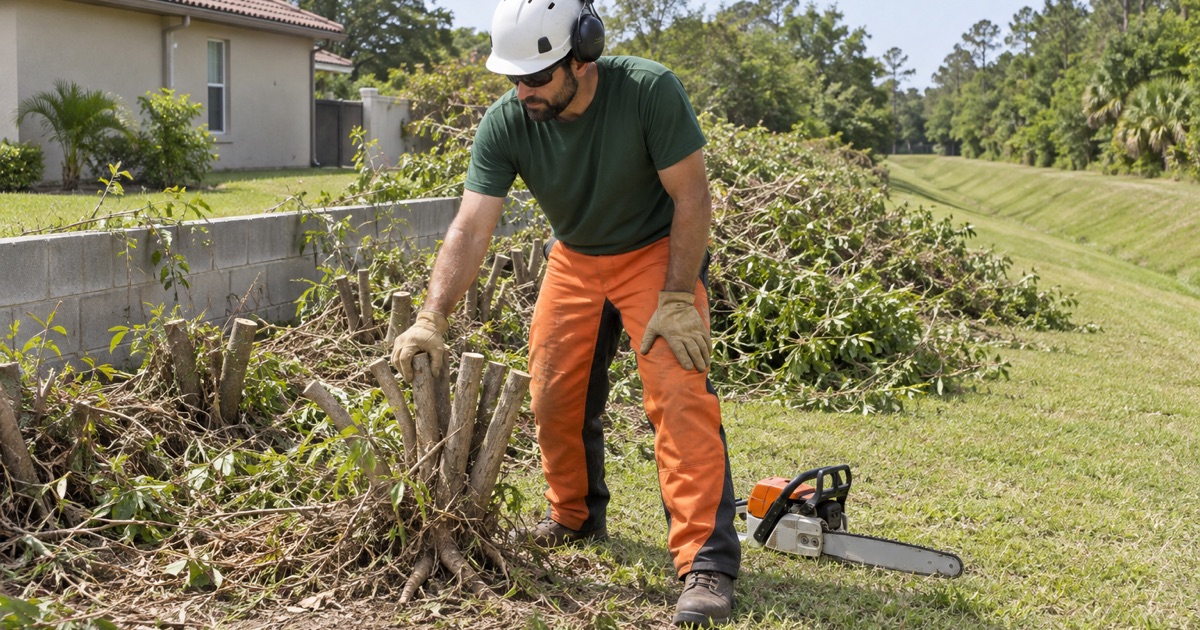
Shearing cuts every shoot at the same plane, which is what produces a crisp face and also what produces a dense outer shell that shades out everything behind it. Hand pruning reaches inside and takes whole stems back to a junction, which keeps light in the interior. A good hedge visit is mostly shear with enough hand work to keep the inside alive, and the proportion is a judgment rather than a setting on a machine.
Renovating an Overgrown Hedge
An overgrown hedge is usually fixable, in stages. The approach is to reduce height and width over two or three seasons rather than in one cut, letting the plant respond before the next reduction, and to open the interior so the new growth has light to come into. What we will not do is take a hedge back to bare wood in a single visit on a species that cannot sprout from it.
Species That Will Not Take a Hard Cut
This is the distinction that matters most and the one most often missed. Many broadleaf screening plants resprout readily from old wood; several popular conifers and needled plants do not sprout from bare wood at all, so anything cut past the green stays brown permanently. We identify the planting before proposing a renovation, and where the species rules it out we say so and price a replacement instead.
Shrub Beds and Foundation Planting
Clearance From Walls, Roofs and Equipment
Foundation shrubs planted at nursery size end up against the wall, under the eave and over the air conditioning unit, and the consequences are damp walls, blocked airflow and a hiding place for everything that wants into a house. We set clearance as part of the trim rather than as a separate conversation: air around the equipment, daylight at the wall, and the roofline kept clear.
Removing a Shrub Against Cutting It Back
Sometimes the honest recommendation is removal. A plant that has outgrown its spot by a factor of three is going to be fought every year, and replacing it with something sized to the bed costs less over five years than the annual battle. We will say which of your shrubs is in that category, and which is simply overdue for a proper cut.
Root Balls and Replanting the Same Bed
How a shrub comes out depends on what it is next to. In open bed we pull the ball and backfill with clean soil. Against a slab, a walk, a pool deck or irrigation we cut low and grind, because levering a ball out beside concrete lifts the concrete. Either way the hole gets fill rather than the old root mass if something is going back into it.
Brush, Undergrowth and Fence Lines
Clearing Undergrowth Without Losing the Trees
Most undergrowth clearing happens under trees the owner wants kept, which makes protecting the root zone the actual job. We work by hand and with small equipment inside the drip line, keep machines and spoil piles off the root area, do not change the soil level at the base, and cut rather than pull anything growing tight against a buttress root.
Fence Lines and Easements
Fence line work has a survey question attached before it has a cutting question, because the growth is frequently on the other side of the line or inside a utility or drainage easement with its own restrictions. We establish whose vegetation it is and what the easement allows, then clear to a width that can actually be maintained rather than to the fence and no further.
Invasive Thickets That Resprout
Brazilian pepper, melaleuca and earleaf acacia form the thickets that fill neglected edges here, and all of them come back from cut stumps and from seed already in the ground. Clearing them is usually cheap and exempt, which is the good news. The plan for the regrowth is the part that decides whether the work holds, so we schedule a follow-up rather than leaving you to discover it.
Debris, Disposal and Scheduling
Why the Curb Is Closed to a Contractor
North Port’s yard waste program caps lengths at four feet, bundles at two feet across and thirty-five pounds, and it names tree companies, arborists and landscapers as people who must haul their own debris. Neighboring jurisdictions publish their own versions with their own caps. Taken together there is no version of this work where the material legitimately stays at the street.
How Often the Work Should Recur
We would rather set a realistic interval than sell a big annual visit. A formal hedge wants three or four lighter cuts a year, an informal screen one or two, shrub beds a spring and a late-summer pass, and a cleared fence line a check each season until the regrowth gives up. Written that way, the yearly cost is lower and the planting stays in better shape.
- 20+ Years on This Coast
- Free Written Estimates
- Dated Condition Reports