
North Port Tree Removal Pros has run land clearing in North Port, FL for 20+ years, serving surrounding cities including Port Charlotte, Plantation, Englewood, Rotonda, Punta Gorda. Clearing is the service where the cheapest quote is most often the most expensive outcome, because what goes wrong on a lot is rarely the machine work and almost always what was never checked before the machine arrived.
So we start with paper. The survey says where your lines actually are and what easements cross the parcel. The zoning and the code say whether this is a vegetation removal question, a site work question, or a tree removal permit, and those are different submittals with different timelines. Three counties and five city halls sit on this service map, and they do not answer the same way.
Then we scope the work itself: which trees stay and how their root zones get protected, what is mulched in place against what is hauled, whether the stumps come out or stay ground, and where the material actually goes. Haul-away and gate fees are itemized on their own line, because the tipping rate changes at every county line and this city has no inbound gate of its own.
What Lot Clearing Actually Covers
Selective Clearing Against Clear and Grub
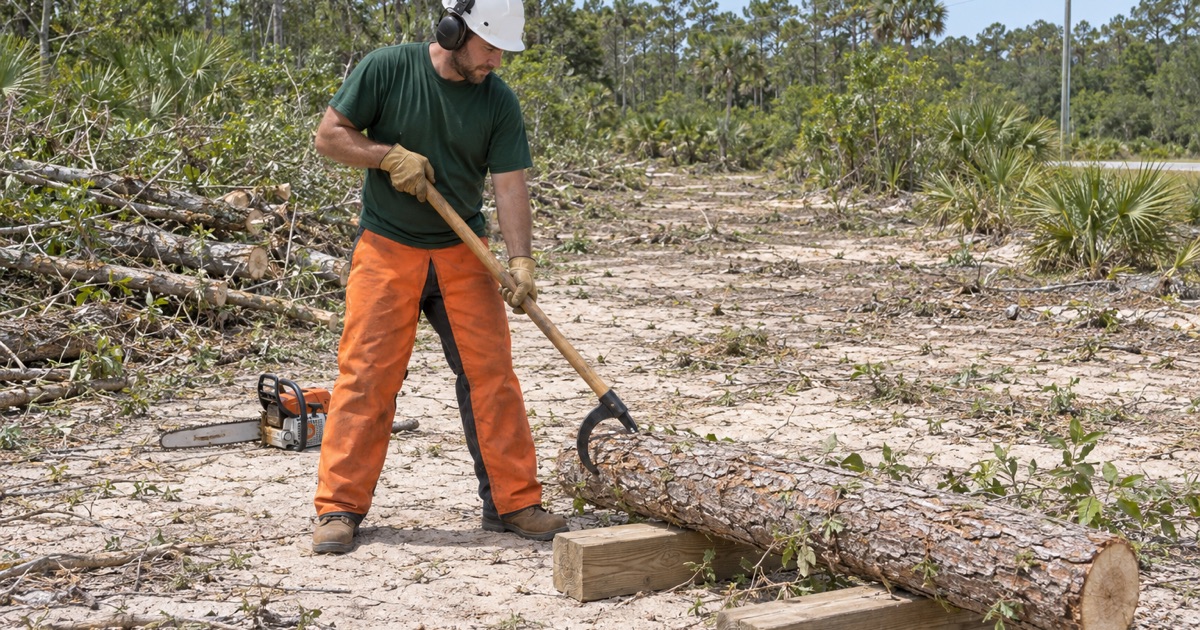
Selective clearing removes specified vegetation and keeps named trees, with their root zones fenced before any equipment moves. Clear and grub takes everything, including stumps and root mats, down to workable ground. Most residential and builder lots should be the former, because a mature live oak left standing is worth more to the finished property than the hour it costs to work around, and the fencing is what keeps it alive.
Mulching in Place and Forestry Mowing
A forestry mulcher processes standing brush and small trees into a layer on the ground in one pass, which is fast, cheap and avoids haul costs entirely. It suits pasture, fence lines, trail access and knocking back an invasive thicket. What it does not suit is anything under a building pad or a slab, because a mulch layer is organic material that will compress and decay, and a pad wants mineral soil.
Hauling, Grinding and the Gate
Where material has to leave, the cost is trucks and the gate rather than the cutting. Brush chips to a permitted facility, trunk wood goes out as loads, and the gate rate varies by county and by material. Open burning has its own authorizations and is not something we assume, so the quote says which route this parcel uses and what that route costs before the first load moves.
Permits Come Before Machines
Vegetation Removal Is Not a Tree Removal Permit
A single dangerous tree at a house and a cleared half-acre are different applications even when the same saw does the cutting. Clearing is generally reviewed as vegetation removal or as part of site work, with its own drawings, its own tree survey in many cases, and its own review clock. Treating it as a tree removal permit is how a project discovers in week three that nothing has been applied for.
The Exemption a Vacant Lot Does Not Get
Inside North Port the broad residential exemption runs on an owner-occupied lot with a dwelling on it, and it opens only after a year has passed since the certificate of occupancy issued. A vacant lot is outside it from the start, and so is a lot where the existing dwelling is coming down to be rebuilt. That single distinction changes the permit path on a large share of the clearing work here.
Protection Zones, Conservation Areas and Easements
Some exemptions are disapplied by location rather than by what you are doing: conservation and preservation areas, trees credited under a prior permit, trees in an approved landscape plan, canopy road zones, and the Myakka River Protection Zone, which is defined by a measured distance from the bank. Platted drainage and utility easements add their own restrictions. We read these for your parcel, because the neighboring lot’s answer is not evidence.
Residential and Commercial Clearing
Homesites, Driveways and Pad Access
On a residential build the clearing scope is really three scopes: the pad footprint, the driveway and equipment access, and the trees being kept. Access is the one people underestimate, because a concrete truck needs more room than a pickup and the route has to exist before the pad is poured. We lay the access out with the kept trees in mind so the route does not run through the root zone you paid to fence.
Builder Lots and Spec Homes
Builders need predictability more than they need the lowest number, so we scope to the plot plan, flag what the tree survey will likely require, and sequence clearing, stumping and rough grade so the next trade is not waiting. Where a lot carries protected or heritage trees, that is a design conversation before it is a clearing conversation, since mitigation priced by the inch is a real line on a spec budget.
Commercial Sites, Fence Lines and Easements
Commercial clearing is usually phased around an operating business or a construction schedule, with staged access, dust and debris control, and sight lines kept open at entrances. Fence line and easement clearing is its own recurring category: utility and drainage easements that have grown in, boundary lines a survey has just re-established, and perimeter work a tenant needs done outside trading hours.
Ground Conditions That Set the Schedule
Saturated Flats and Machine Choice
Much of this ring is poorly drained fine sand with a seasonal high water table close to the surface for months, and that decides machine selection more than acreage does. Tracked equipment floats where a rubber-tired machine ruts, mats protect a route that has to be reused, and there are weeks where the honest answer is that the ground will not carry the work yet. Saying that up front is cheaper than restoring a rutted parcel.
Invasive Thickets: Brazilian Pepper and Melaleuca
Brazilian pepper and melaleuca form dense stands that look like a bigger job than they are, and both are on the exempt species lists that make them cheaper to remove than a native of the same size. They also resprout aggressively from cut stumps, so clearing without a plan for the regrowth buys a thicket again within two seasons. We scope the follow-up rather than leaving it as your surprise.
Stumps, Root Mats and What the Pad Needs
Whether stumps come out is a structural question, not a preference. Ground stumps are fine under pasture, mulch, a fence line or a lawn. Under fill, a slab, a driveway or a footing, the stump and root mat have to be removed, because decaying wood beneath compacted fill leaves voids and voids show up as settlement cracks in somebody’s finished floor two years later.
Our Step-by-Step Land Clearing Process
1. Survey, Zoning and Scope on Paper
We read the survey, the zoning and the applicable code for the parcel, identify which permit path applies, and mark what stays. Nothing is quoted as machine hours until that is settled.
2. Locates, Protection Fencing and Access
Utilities located, root protection fencing installed around kept trees, the access route chosen and matted where needed, and erosion and debris controls set before any cutting starts. The fencing goes up before the first machine moves, because a root zone crossed once is damage you already paid to prevent.
3. Clear, Mulch or Haul
The clearing runs to the marked scope, with material either mulched in place or loaded out to a permitted facility at the itemized gate rate. Kept trees are worked around rather than driven past.
4. Stumps, Rough Grade and Handover
Stumps ground or extracted according to what the ground is going to carry, the parcel raked to a clean rough grade, protection fencing removed last, and a short written record of what was cleared and what was retained.
- 20+ Years on This Coast
- Free Written Estimates
- Dated Condition Reports