North Port Tree Removal Pros handles emergency tree removal in North Port, FL and has for 20+ years, serving surrounding cities including Port Charlotte, Plantation, Englewood, Rotonda, Punta Gorda. The phone call that starts this work is usually made from a hallway, looking at something that was not there an hour ago, so the first thing we do is sort what is genuinely dangerous from what merely looks terrible.
Two decades of storm seasons on this coast has also taught us what the sequence has to be, and the sequence is not negotiable. Power lines belong to the utility before they belong to any tree company. Nobody climbs in a named wind. And a hazard gets stabilized before it gets tidied, because the photograph an adjuster needs and the cleanup a homeowner wants are not the same job.
What we bring to it is a plain account of what happened to the tree. Wind failures and saturated root plates look similar from a doorway and need different responses, and in this basin a tree that stood through the wind can still go over in still air days later when the ground finally lets go. Saying which one you have is most of the value.
What Counts as an Emergency, and What Can Wait
A Tree on the House or Across the Drive
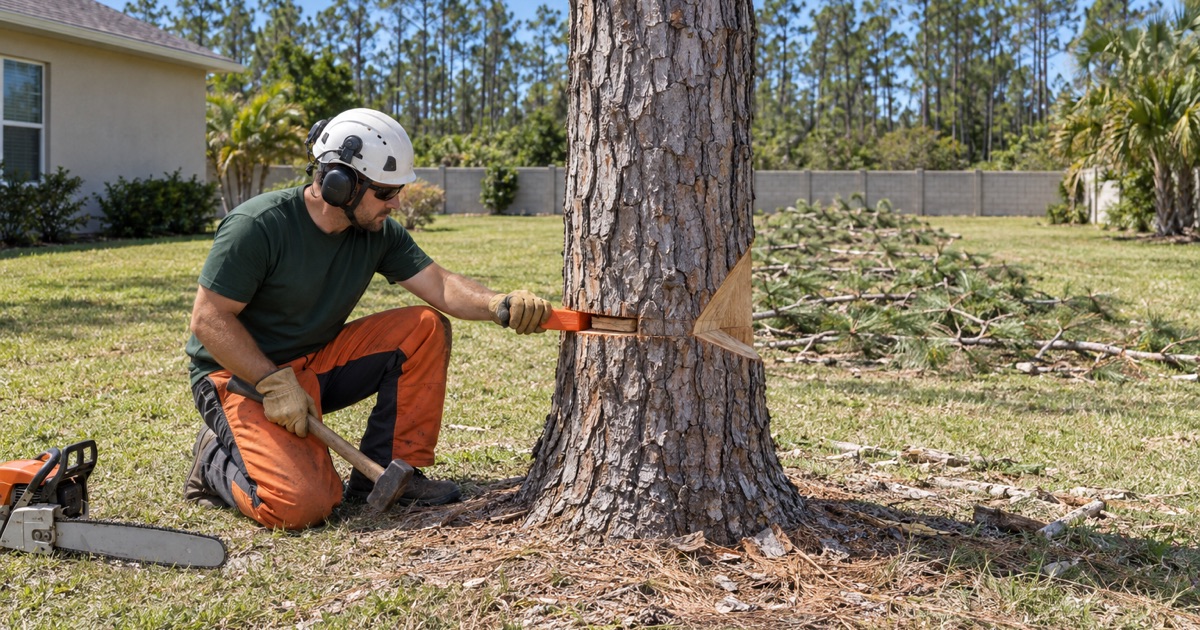
A tree resting on a structure is an emergency whether or not it has stopped moving, because the load path is unknown and cutting in the wrong order can drop the rest of it. We stabilize before we cut, work from the ends back toward the bearing point, and keep people out of the interior rooms underneath until the weight is off. A tree across the only driveway is urgent for a different reason, which is access for everything that follows.
A Limb Hung Up in the Canopy
A broken limb lodged overhead is the hazard people most often underestimate, because it has already failed and is being held by nothing reliable. It can come down in no wind at all, at night, onto whatever is beneath it. That is a same-day job, and it is one of the few where we will work a small scope and leave the rest of the tree for a scheduled visit.
A Lean That Appeared Overnight
A lean nobody remembers seeing last week is an anchorage question, and the evidence is at the ground rather than in the crown: soil mounded or cracked on the side away from the lean, turf torn at the root collar, a root plate that moves when the trunk is pushed. We probe it, and the answer is either that it can be scheduled or that it comes down today.
Power Lines Come First, and Not to Us
Why the Utility Gets the First Call
Any tree or limb touching a conductor is the utility’s to make safe, and until they have cleared or de-energized it there is no lawful or survivable way for a crew to work it. This is the one part of an emergency where calling a tree company first actually slows things down, because we will tell you to call them and then wait for the release.
Approach Distances Under ANSI Z133
ANSI Z133 sets minimum approach distances to energized conductors by voltage, and they apply to equipment and falling wood as much as to a climber’s hands. A service drop to a house is not a safe exception to that. It is also why we plan the drop zone around overhead lines on every job, not only the ones where a line is already involved.
What the Utility Will and Will Not Do
A franchised utility will clear a tree out of its own conductors to its line-clearance standard, at no cost to you, and it will restore the service drop. It will not haul your debris, will not remove a tree that threatens only your house, and will not tidy the yard afterward. Knowing that division saves a day of waiting for somebody who was never coming.
Storm Response on This Coast
Wind Failures Against Saturated Root Plates
Pine snaps and hardwood uproots, broadly, and the difference tells you what the repair is. A snapped stem is a removal decided that week. An uprooted or partly lifted tree is an anchorage loss, and even where it can be stood back up the odds are poor on a mature specimen, so we are honest about whether that is worth paying for.
Why a Named Storm Stops the Crew
While a named system is over this coast, no climber goes up, no bucket goes out and no crane sets up. The work resumes when the wind does not. We keep taking calls through it, because the queue we build during the storm is what makes the first clear morning productive instead of chaotic.
The Trees That Fall Four Days Later
In this basin the water arrives on a delay and leaves on a longer one, so the ground stays soft well after the sky clears. That produces failures with no weather attached: a tree that held through the gusts and went over in calm air once the soil let go. It is also why a post-storm walk a week later is worth more than one the morning after.
Insurance, Documentation and the Bill
What a Debris Sublimit Covers
Most Florida homeowner policies respond to tree debris only after the tree has damaged covered property, and then within a sublimit rather than at full cost. A tree that falls in the yard and hits nothing is commonly the owner’s expense entirely. We say that at the quote rather than letting you discover it from a carrier two weeks later.
Photographs, Scope and the Adjuster
Before anything is cut we photograph the position, the contact points and the damage, and the scope we write separates the covered work from the rest. That costs us ten minutes and regularly decides whether a claim is straightforward. If your carrier wants a cause-of-failure opinion, that is an arborist assessment and we write it as its own document rather than as a line on an invoice.
- 20+ Years on This Coast
- Free Written Estimates
- Dated Condition Reports