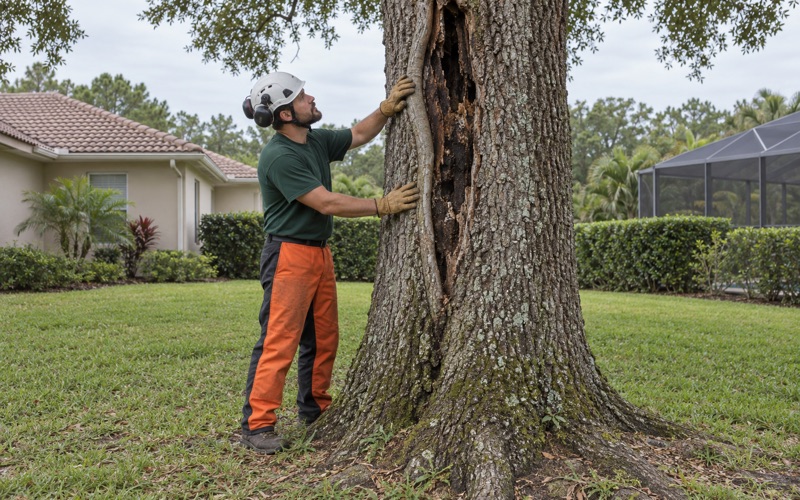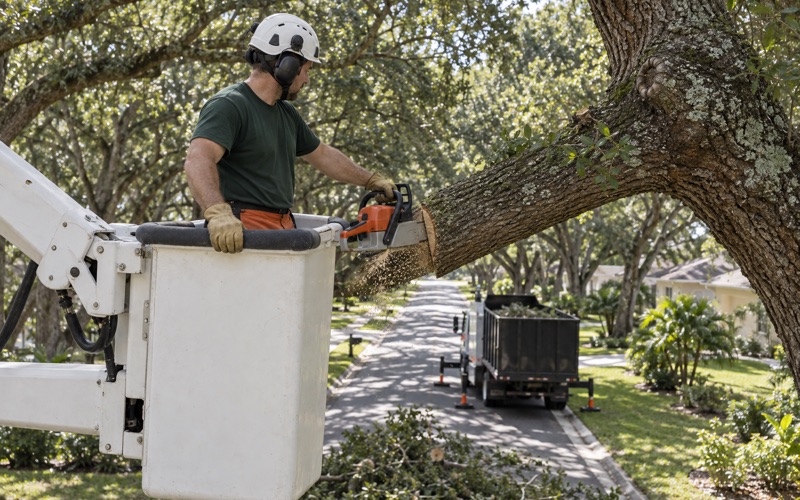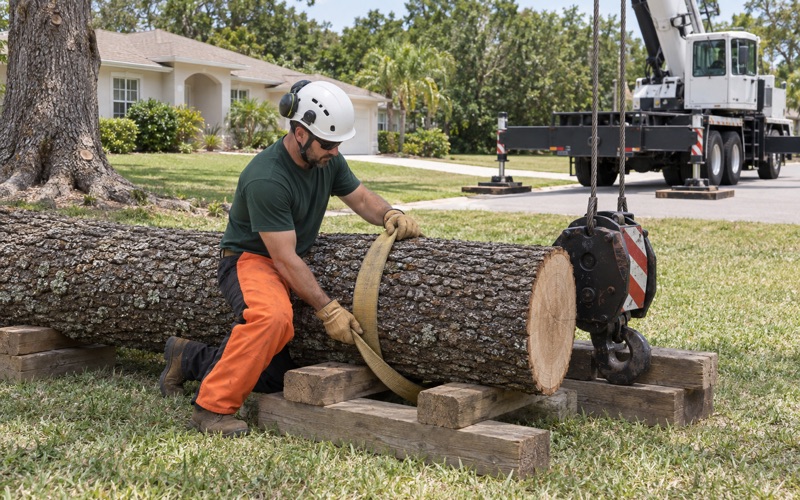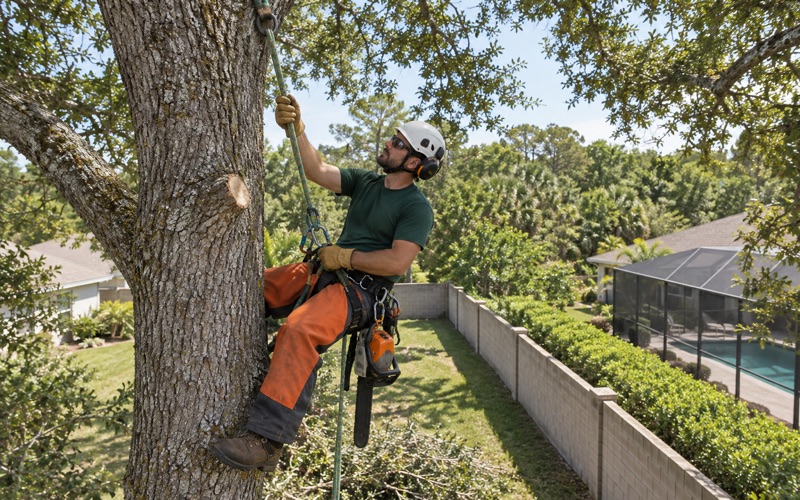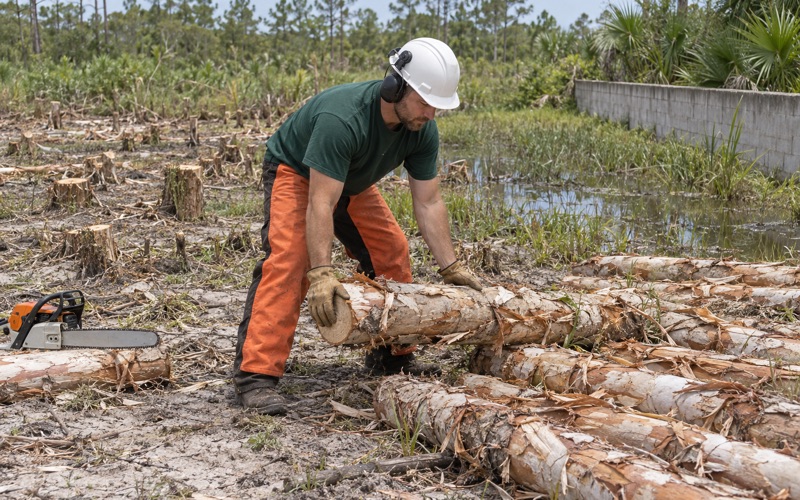
North Port Tree Removal Pros has handled tree removal in Englewood for more than twenty years, and every estimate here opens with a question most crews skip: which county is the trunk standing in?
Englewood is unincorporated from one end of it to the other. There is no city hall here, no municipal arborist and no town tree ordinance, so the government with authority over your tree is a county — and the community sits in two of them. The line runs straight through it, and nothing you can see from the driveway, and nothing in the mailing address, marks where.
That one fact decides the permit trigger, the height at which your trunk gets measured, what a mistake costs per inch, what the curbside program will take, and what we pay at the gate to get the wood off your property. We settle which side the tree is on before we put a number on the work, and the answer goes out in writing with the quote.
One place name, two counties, and a split that was measured
The split is not anecdotal and it is not a mailing quirk. The Census Bureau’s parent-geography relationship for Englewood CDP, place 16000US1220825 in TIGER 2024, records 78.402280 percent of the place inside Sarasota County and 21.597717 percent inside Charlotte County. The place polygon crosses a county boundary, and because Englewood is unincorporated on both sides of that boundary, a tree question lands on a county commission either way.
Which commission is the whole problem. A quote that confidently names one county’s rule for an Englewood address carries a roughly one-in-five chance of naming the wrong one, and the homeowner has no way to catch the error.
How we pin an address to a side
Parcel records answer it, because there is no single roll that covers this community. A parcel on one side of the line appears with the Sarasota County Property Appraiser and a parcel on the other side with the Charlotte County Property Appraiser — two separate offices, two separate rolls, one place name. We read the parcel record before quoting rather than inferring the jurisdiction from a zip code.
Neither permitting counter is in Englewood
The Sarasota-side review sits with county environmental permitting staff. The Charlotte-side review sits with Charlotte County Growth Management on Murdock Circle, which publishes a tree permit review time of one to five days depending on complexity. Anyone quoting a permit timeline in this community is quoting a drive as well as a review. The one government body actually headquartered here is the independent Englewood Area Fire Control District, which spans the same county line that splits the tree codes and does not issue tree permits at all.
Looking for tree-removal closer to Rotonda? See Tree-Removal in Rotonda.
Two ordinance chapters that do not measure the tree at the same height
On the Sarasota share, Chapter 54, Article XVIII reaches the property directly: Sec. 54-583(6) makes the article effective throughout the unincorporated area of the county, with no interlocal agreement anywhere in the chain. Sec. 54-582 defines diameter at breast height as the trunk measured 54 inches above the ground, and protects any stem that reaches four and one-half inches DBH.
Charlotte County’s Chapter 3-9 counts in different units. Its trigger is a caliper of four inches or greater, measured twelve inches from grade, or a palm with a clear trunk of six feet or greater, and compliance is accounted for in tree points rather than in trees. Forty-two inches of trunk separate those two measuring points, which is enough to put one tapered or buttressed trunk on opposite sides of two thresholds that look nearly identical written down.
Palms and scrub are trees here, whatever the botany says
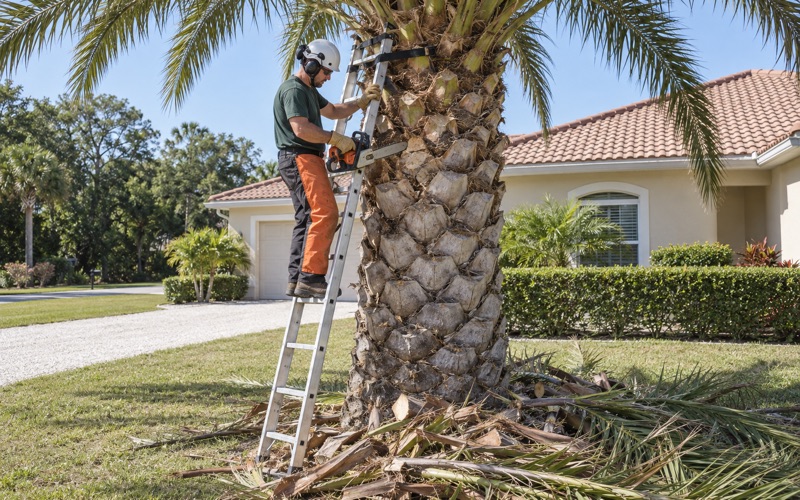
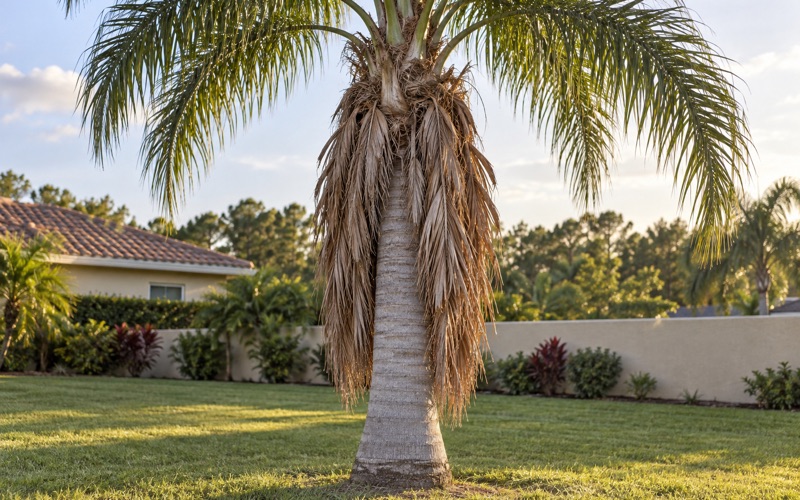
The Sarasota definition sweeps in every rooted mangrove regardless of size, the scrub oak group at two inches DBH, and any palm carrying more than four and one-half feet of clear trunk; Charlotte County sets its palm line at six feet of clear trunk, measured the same way. We price palms as palms on either side of the line — one growing point, no branch collar, and a trunk that will never put on another inch — because clear trunk feet is the number the ordinance asks for and because the cut bears no resemblance to a hardwood removal.
The exemption that decides most Englewood removals
Sec. 54-585(1)(e) is the most useful sentence in the Sarasota article. On an owner-occupied residential lot of five acres or smaller, once a certificate of occupancy has been issued for the dwelling, the prohibitions do not apply.
It asks for no arborist report and no hazard finding, which makes it broader than Florida Statutes section 163.045 — narrowed in 2021 to single-family detached buildings and amended in 2022 to the unacceptable risk standard in the ISA Best Management Practices. The carve-outs are stated: conservation or preservation areas, trees planted or relocated under a permit, a demolition and reconstruction, a canopy road protection zone, and any Grand Tree.
So on that side the live question is usually whether the tree is a Grand Tree, and that is arithmetic we can run in the yard: one point per inch of DBH, one point per foot of height, one point for every four feet of average canopy spread, scored against a species threshold and a condition classification of 70 percent or better. The penalty side is priced per inch. An unauthorized removal is mitigated at $200.00 per diameter inch and a Grand Tree at $500.00 per DBH, while Charlotte County protects a heritage tree — cypress, oak or pine at a 30-inch DBH — and charges $150.00 per DBH inch not replanted.
Topping is prohibited on both sides, and refused by us anyway
Sarasota County makes topping a violation outright, requires pruning to conform to current ANSI A300 standards under ISA certified supervision, and names flush cuts, stub cuts and lion’s-tailing as defects. Charlotte County arrives at the same prohibition by its own route, barring topping and lollipopping and pointing at National Arborist Association standards. Hurricane cuts and hat racking are refused here on oaks and on palms, however the job is asked for. Where a tree should stay, we quote the pruning or the cabling and bracing instead of the removal, and a written, dated condition report sits behind the recommendation before the saw does.
The shoreline, the curb and the gate fork at the same line
The sharpest reversal inside the place name is the mangrove answer. FDEP delegated mangrove trimming authority to Sarasota County in 2016, limited to the unincorporated area — which is what Englewood is — so the county administers it under Chapter 54, Article XXXV with a professional mangrove trimmer required for permitted trimming or alteration. Charlotte County holds no such delegation, so the identical job on a Lemon Bay shoreline a short distance south is administered by the state under the Mangrove Trimming and Preservation Act. Seagrape and dune vegetation waterward of the Coastal Construction Control Line answers to neither tree code, routing instead to the Beach and Shore Preservation Act.
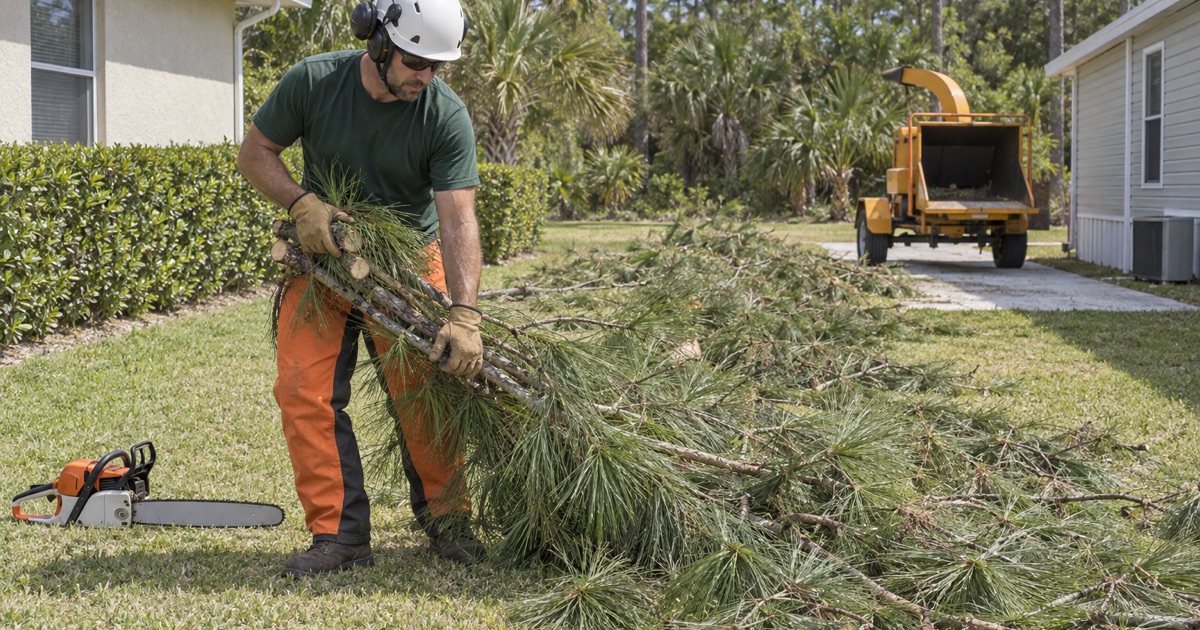
Residential curbside limits fork too, which is why neighbors compare notes and disagree. Sarasota County takes yard waste bagged, containerized or bundled and tied, at four feet or less in length, sixteen inches or less in diameter and forty pounds or less per bag, can or bundle, and will not pick up material left in cardboard boxes, wheelbarrows or recycling containers. Charlotte County publishes limbs no longer than six feet, limbs not exceeding ten inches in diameter, bundles under forty pounds, and nothing collected in plastic bags. A twelve-inch trunk section is legal at one Englewood curb and refused at another, and neither program is a route for contractor debris in the first place.
What the gate costs, and why it sits on its own line of the quote
Charlotte County publishes $48.90 per ton for waste generated in county and $97.78 per ton for waste generated out of county, plus an $11.55 scale usage fee, and publishes no separate vegetative or horticultural rate — tree debris pays the general per-ton rate. The Sarasota gate, the complex on Knights Trail Road, accepts yard waste at standard landfill disposal rates and serves the unincorporated county. Material generated on the Sarasota share of Englewood is not material generated in Charlotte County, so the geographically convenient gate can be the expensive one, and the origin question belongs at the scale house rather than in an assumption. We itemize haul-away and gate fees on their own line for that reason: the tipping rate changes at every county line we cross.
What the ground and the canopy do on both sides of the line
The soil ignores the boundary even though the survey does not. The Sarasota-side sample maps as EauGallie and Myakka fine sands and the Charlotte-side sample as Myakka fine sand, both poorly drained flatwoods spodosols on marine terraces, both with no bedrock recorded and a minimum annual depth to water around twelve inches. The series descriptions put the spodic horizon at roughly 20 to 36 inches below grade, at or just under the bottom of a stump grinder’s below-grade cut.
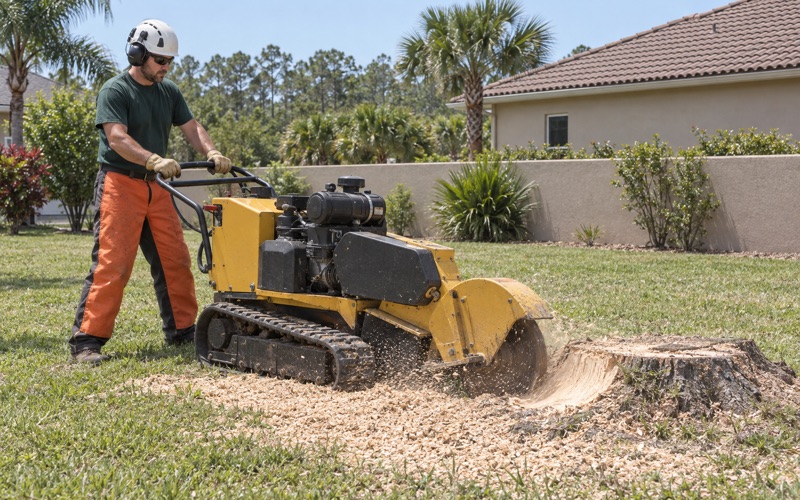
So nothing down there stops the machine. Water does. For one to four months a year the working ground is saturated within six to eighteen inches of the surface, which turns rutting, traction and spoil handling into the real constraint on a finished lawn. Twenty-plus years on this coast is mostly twenty years of reading that seasonal high water table, and it is why we sequence grinding and crane setups around it instead of promising a date and wrecking a yard to keep it.
The canopy here is a cohort rather than a collection. More than half the housing stock went up between 1970 and 1989, and the landscape planted with it is now forty-five to fifty-five years old: slash pines at or past their useful urban life, laurel oaks well past theirs, and cabbage palms carrying fifty years of boot. Failures arrive in groups for that reason, because one wind event finds the same species at the same age on the same street.
About one unit in five is held for seasonal, recreational or occasional use, which changes the paperwork as much as the scheduling. The owner is often not the person who sees the tree fail, so a signature comes from somewhere else and crane access gets arranged rather than assumed. Manufactured housing is close to a quarter of the stock, and because section 163.045 reaches only single-family detached buildings, that share draws nothing from the state preemption — a gap that bites harder on the Charlotte side, where no blanket residential exemption parallels the Sarasota one.
The storm record in this community is a wind record rather than a surge record. Most of the sensors placed along this stretch of coast for Hurricane Ian in 2022 stayed dry and measured no surge while an Extreme Wind Warning covered Englewood, and Hurricane Milton came ashore on this coast as a Category 3 in October 2024. Wind and saturated ground fail a canopy by uprooting and stem failure rather than by salt kill. Two National Weather Service forecast zones also cover the one place name, Coastal Sarasota and Coastal Charlotte, so a wind advisory can be issued for half of Englewood and not the other half.
No state license exists in this trade, and we would rather say so
Florida issues no arborist or tree contractor license, and section 163.211 preempts local occupational licensing, so a company printing that word at an Englewood homeowner is printing nothing. What can actually be checked is ISA certification and current general liability and workers’ compensation coverage, read off the certificates themselves. We would rather explain that than borrow a credential the state never issued, in a community where the genuinely hard question is which county’s rule your address sits under.
- 20+ Years on This Coast
- Free Written Estimates
- Dated Condition Reports