North Port Tree Removal Pros books tree removal in Fruitville the way this community itself was built, in cohorts. Twenty-plus years of tree work in this county has taught us that when a subdivision goes up across a single stretch of years, the trees planted alongside it come due across a single stretch of years as well. A single street can produce four quotes in a season, and none of the four is a coincidence.
That shape changes what an estimate here owes you. Which trees are the same age as the house, which are genuinely at the end of a useful life rather than merely untidy, and which should be pruned or cabled for another decade instead of taken down.
The other half of the job is jurisdiction, and this address carries a particular trap in it that we settle before a number goes on paper. Three counties and five city halls sit inside the area we cover, so our estimate names the government whose tree rule actually reaches the lot. Anything we recommend removing leaves with a dated written report of what we saw and why it points at a saw rather than at a cable.
Farm Fields First, Subdivision Second, and Both Still Underfoot
Fruitville began as farm country rather than as a suburb, and the order matters because the farming left more behind than the houses did. Charles Reaves established the community in 1876, during the citrus boom that followed the Civil War, and by 1895 he was serving as postmaster to roughly 115 residents.
The drainage district that made the ground farmable
A drainage district formed here in 1923, and it converted approximately 8,000 acres of wetland into farmland. Celery became a major crop on the ground it drained, and through the 1960s and 1970s a migrant labor camp supplied the workers who cut it. The district is the most consequential piece of engineering under this community, because it did not merely dry fields out. It rearranged where water goes.
Some of that work is still legible as canals and ditches, and a later conversion turned a stretch of the old celery ground into a county stormwater facility at the Celery Fields, southeast of the Fruitville Road corridor. Between the original district and that project, a good deal of what lies under this community is engineered rather than intact. So we treat the published soil survey as a starting point on a lot here, not as a description of it.
What drained ground does to a root plate and to a grinder
A soil point query inside this community returns map unit 10, EauGallie and Myakka fine sands, with EauGallie as the primary component. It is a spodosol, very poorly to poorly drained, and the series description puts its cemented spodic horizon between 22 and 35 inches below grade. The same description records the water table rising within 6 to 18 inches of the surface for periods of 1 to 4 months, and sitting within 40 inches for more than 6 months of most years.
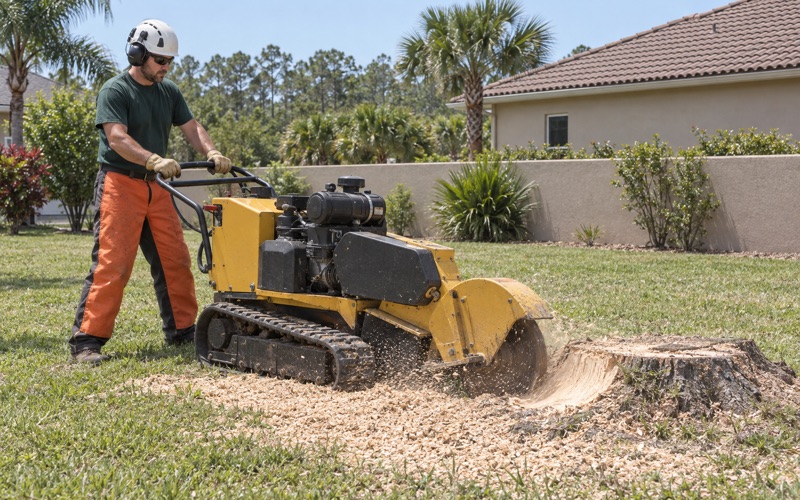
Both of those figures land inside the working band of a stump grinder, whose below-grade cut commonly runs 12 to 25 inches. Which of them binds first is a question about the specific machine and the specific week rather than a general rule, and on this profile the hardpan sits at the deep end of that range instead of clearly past it. What we will not do is promise a finished grind depth off a map.
Drainage history shows up in the root plate too. A tree grown over a seasonally saturated layer roots wide and shallow rather than deep, so the plate is broader and flatter than the crown suggests, and a lean that appeared after a wet season is usually telling you about soil rather than about wood. That is an argument for opening the ground around a root collar before the quote.
Looking for tree-removal closer to Siesta Key? See Tree-Removal Services in Siesta Key.
Two Decades of Building, and a Canopy That Matures Together
The houses here arrived late and fast. The 2024 five-year American Community Survey counts 2,759 of this community’s housing units built in the 1980s and another 1,751 built in the 1990s, out of 7,868 units in all. Only 1,191 of them, 15.1 percent, predate 1980.
A stock that concentrated produces something visible on the ground rather than in a table. Most of the yards on a Fruitville street were landscaped within a few years of each other, out of similar nursery stock, at similar spacing.
Trees planted with the houses reach removal size together
A slash pine set beside a new house in 1987 is now at or past its useful life in a yard, and a laurel oak of the same vintage is further past its own. Live oaks planted on that same schedule are nowhere near the end of theirs, which is exactly why a street gets confusing. Three trees of similar size and identical age can carry three different recommendations.
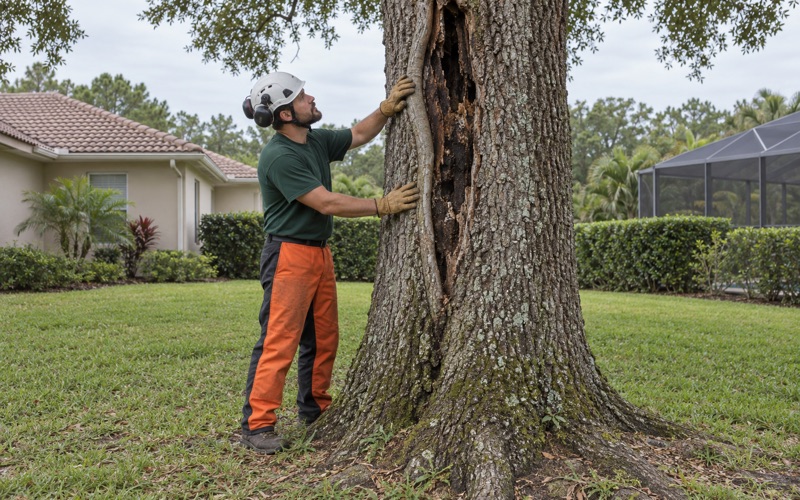
The defects run in cohorts as well. Stock of that era was commonly planted close to drives and foundations and was rarely structurally pruned young, so co-dominant stems with included bark at the first union are the most common finding we write up here. That union is decades old, the bark seam inside it has been widening the whole time, and it gives way in a storm rather than in a drought.
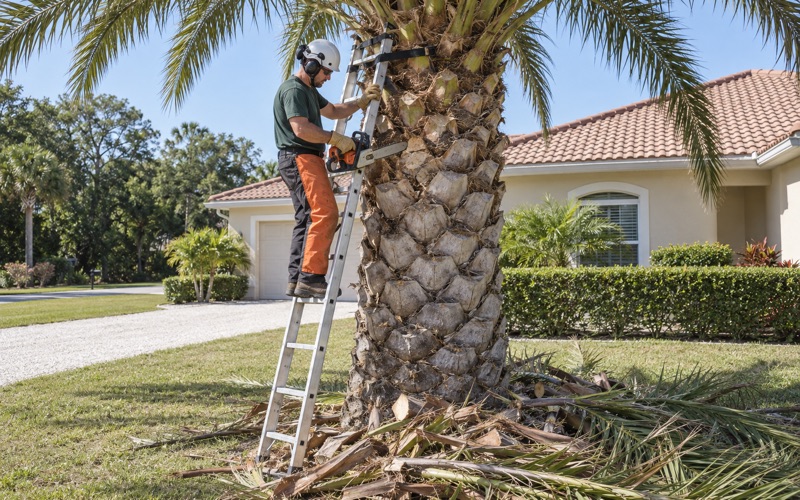
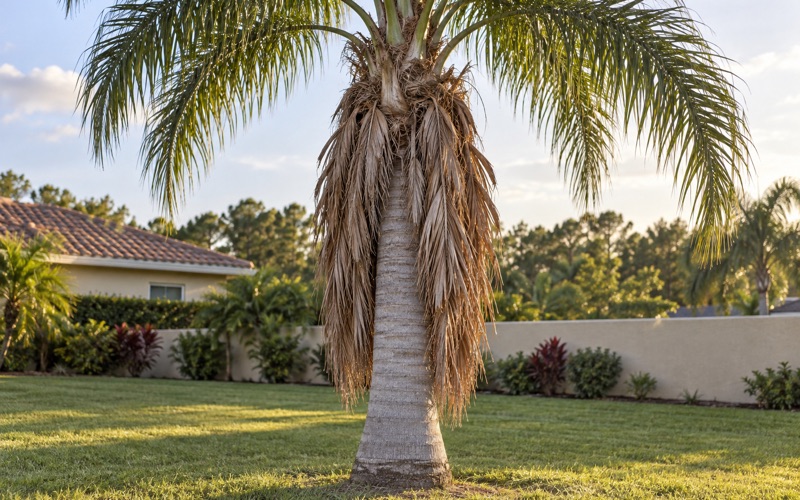
A cohort is also an argument against clearing everything at once. Where a stem union can be cabled and braced, or a crown brought back by reduction, we quote that work and say plainly that the tree should stay. Palms are quoted on their own basis: a single growing point, no branch collar anywhere to cut back to, and a trunk already at its final diameter, so clear trunk feet and access build the figure rather than a diameter class.
The County’s Point-Based Grand Tree Schedule, and How Points Are Counted
Sarasota County’s tree article does not settle a Grand Tree with a tape. It scores one. Schedule A assigns points by species, Schedule B adds points for diameter at breast height, for height and for average canopy spread, and the totals are read together against the threshold set for that species.
A condition floor sits underneath the arithmetic. A tree has to carry a condition classification of 70 percent or greater to be designated, so a large, declining specimen can clear the size points and still fail the second test. That is why we run the measurement in the yard before quoting, rather than after a permit question arrives.
Why a 1980s lot can trigger a duty the original plat never did
The permitting criteria sit at Section 54-586, most recently amended by Ordinance 2008-041, and they require a tree permit before any construction activity or removal of native vegetation within the dripline of a tree on any lot. The same section directs that development applications submitted after 30 October 2002 shall be designed to protect Grand Trees, with exceptions only for safety reasons or where setting aside the space needed to protect one would unreasonably prevent the development of a lot.
Read those dates against this community’s building history and the consequence is specific. The subdivisions here were platted and built largely before that design-protection date, so the original construction never answered to it, while an addition, a pool, a driveway widening or a teardown on one of those same lots today does. The trees that were saplings when the house went up are the mature ones a fresh permit now has to be designed around.
The exemptions, including one this farming history keeps alive
The exemption list at Section 54-585 covers Florida Exotic Pest Plant Council Category I invasive species outright, which is how Brazilian pepper, melaleuca, Australian pine and carrotwood come out of a hedge line without the permit question. It carries a declared-emergency exemption for governmental personnel. And it carries a bona fide agricultural exemption for land the County Property Appraiser classifies as agricultural, where the removal is for agricultural or silvicultural purposes.
That last one is no dead letter on ground with this much recent farming behind it. A parcel still carrying an agricultural classification is a different permitting question from the house next door to it, and the classification is worth reading off the appraiser’s record rather than assuming the subdivision’s answer covers a whole street.
Florida Statutes section 163.045 runs alongside the county rule as state law. Where the owner of a detached single-family house already holds signed documentation from an ISA-certified arborist or a Florida licensed landscape architect that the tree poses an unacceptable risk to persons or property, assessed under the ISA Best Management Practices Tree Risk Assessment Second Edition 2017, the county may not require notice, approval, permit, fee or mitigation, and no replanting may be required. Our own report is a different instrument with a different author, and we say which of the two a job relies on.
Its reach here is narrower than it sounds. The statute covers detached single-family use, 3,687 of the units counted, and does nothing for the roughly 21 percent of units sitting in buildings of 20 or more, nor for a vacant or agriculturally classified lot.
A Sarasota Mailing Address That the City’s Own Code Never Reaches
Mail to this community carries a Sarasota city name, and that is a postal convention rather than a jurisdictional one. Fruitville is not inside the City of Sarasota, and the city’s zoning code, its tree provisions and its permit counter reach no address here. This is unincorporated county ground, so the Sarasota County Board of County Commissioners answers the zoning question, the tree question, the land-clearing question and the code-enforcement question together.
The practical consequence is a search problem. A homeowner who looks up a Sarasota tree permit lands on the city’s material, which is complete, confidently written and about a different government. The document that governs this lot is the Sarasota County tree ordinance at Chapter 54, Article XVIII, and any permit tied to construction, a subdivision or a site plan is reviewed under the county’s land development regulations at Chapter 74. Our estimate names the book before it names a price, which is the least interesting line on it and the one that keeps a job from being quoted against the wrong rule.
Debris leaves on our truck
County code defines yard trash as vegetative matter resulting from landscaping maintenance and land clearing operations, then excludes material collected by a commercial lawn service from that definition for the purposes of the collection agreement. Contractor-generated debris sits outside the residential curbside program by design, whatever its size.
What we cut goes to the county’s Central County Solid Waste Disposal Complex at Nokomis, and haul-away and any gate charge are itemized on their own line of the estimate instead of folded into the removal price. Disposal is priced by the gate a truck arrives at, and we cross enough county lines in a week that we would rather show you the figure than average it.
The word Florida does not issue
No state license exists for tree work or arboriculture in Florida, and Florida Statutes section 163.211 keeps the county from inventing one, so a company printing that word at a Fruitville homeowner is pointing at nothing. What can be checked instead is current general liability and workers’ compensation coverage, read off the certificates, together with the written standards the work is held to: ANSI A300 for the pruning specification and ANSI Z133 for how a crew operates around a drop zone.
Two requests we turn down here however they are phrased, on a live oak and on a cabbage palm alike, are topping and hat racking, the hurricane cut included. Topping an oak buys a tidy outline now and a structural problem in five years, and a palm cut back past the fronds it drops by itself loses the reserves it was living on.
- 20+ Years on This Coast
- Free Written Estimates
- Dated Condition Reports