North Port Tree Removal Pros has run tree removal crews in Kensington Park for over twenty years, and the most common mistake we see here gets made before anyone picks up the phone. A homeowner looks up the tree rules for the city printed on their own mail, reads them closely, and ends up with a complete, confident, entirely inapplicable answer.
The mail reads Sarasota. The yard does not belong to the City of Sarasota, and the city’s zoning code has no authority over a tree standing on this ground. Permit steps, protected species lists and a department phone number found that way all describe a jurisdiction that stops well short of this neighborhood.
So we settle which rulebook applies before we price anything, and we name it in the estimate rather than leaving you to go find it. Everything we recommend removing carries a written, dated condition report, so the reasoning exists on paper before a saw exists on site. Where the tree is worth keeping, the estimate prices the pruning or the cable and says why.
The envelope says one thing, the tree code says another
Kensington Park is an unincorporated community in Sarasota County, a census-designated place with no council, no mayor and no municipal arborist of its own. Every question that sounds municipal at an address here, from zoning to tree removal to land clearing to code enforcement, is answered by the Sarasota County Board of County Commissioners. The city name on a piece of mail is a postal convention for sorting, and it carries no legal weight over a tree.
That gap between the postal name and the governing authority is the whole trap. The city runs its own tree rules for land inside its limits, and none of them reach across the line onto this ground.
The code that does reach a lot here is the Sarasota County Code of Ordinances, Chapter 54, Article XVIII, Trees. Where tree work is tied to construction, a subdivision or a site plan, the permit is reviewed under the county’s Chapter 74 land development regulations rather than any city process.
Why the wrong answer is the easier one to find
Search engines index by place name, and the place name on the mail here is the city’s. A homeowner typing their own mailing city into a search box gets the city’s material first, and it is not garbled or out of date, it is accurate, well written and about somewhere else.
Contractors make the same error, which is worth knowing while you are comparing estimates. A crew quoting a city permit fee, a city review timeline or a city protected-tree standard at this address has priced a procedure that does not exist on this street, and the figure is wrong twice over: the fee buys nothing, and whatever actually governs the job never got checked.
We work across three counties and five city halls on one service map, and most of that map is county ground. Telling a caller which rule set their own street sits under is the first useful thing we do, and on these lots the answer is the county every time.
Looking for tree-removal closer to Lakewood Ranch? See Tree-Removal in Lakewood Ranch.
Built to a single plan from 1956, and aging on one schedule
This neighborhood did not grow, it was built. In 1955 the Paver Construction Company, founded by Martin Paver and his two sons, bought more than 400 acres here from a local dairy farmer named Charles Schmid, and construction began in 1956. The company named the subdivision for the family’s former home of Great Neck, New York, and when it was finished it held 1,400 homes.
The housing numbers still show that cohort plainly. Of 1,501 housing units, 633 date from the 1960s and 488 from the 1950s, and 82.0 percent of the stock predates 1980.
One cohort of trees, one set of defects
That history matters to tree work more than it sounds. Yard trees here went in within a few years of each other, on lots laid out to the same plan with the same setbacks, which means they reach full size, reach the wires and start failing at roughly the same time.
Trees planted together and left to grow together tend to share their problems too. What we find on these streets is co-dominant stems with included bark where a young tree was never structurally pruned, crowns grown into each other over a shared lot line, and root plates boxed in by driveways and slabs poured to the original layout.
That argues for looking at the street, not the single tree. Once an oak on a block has failed, the ones beside it are the same age and species under the same load, and the question becomes which is next.
The wires overhead, and whose tree they are
Florida Power and Light owns the distribution running over most of these lots, and its published line clearing program draws the dividing line plainly: it is the customer’s responsibility to have the other trees trimmed by a qualified tree trimmer if they are within 10 feet of a power line. The utility’s own method is directional pruning, which removes entire branches and limbs up to the main trunk rather than shortening them.
The same program states that after a tree is trimmed or removed, the remaining debris is collected before the end of the next day, except during restoration efforts immediately following a storm. We promise no trim interval, no free service drop disconnect and no utility removal of a repeat offender, because nothing the utility publishes commits it to any of those.
Storms are the other reason a single-age canopy deserves attention here. Radar put the eye of Hurricane Milton ashore near Siesta Key in Sarasota County on the evening of 9 October 2024, an extremely dangerous Category 3 hurricane with maximum sustained winds of 120 mph, a few miles from these streets. The official post-storm report for this forecast office carries no canopy-loss figure of any kind, so we quote none. On a street of same-age trees, damage tends to arrive all at once.
The pipes under a yard of this age, and who owns them now
One of the things that made this subdivision unusual is also a hazard to anyone grinding a stump in it. Buyers here helped fund the neighborhood’s own independent sewer and water systems, which went into service in 1958 at rates below those charged in the City of Sarasota.
That arrangement has been superseded. Sarasota County Public Utilities, through its Water Division, supplies drinking water and wastewater service at this address now as an unincorporated-county customer, and the county names this community as an example of an unincorporated area on county water.
So the founding history is exactly the wrong guide to what is in the ground. Anyone who treats that original system as current is reading records that no longer govern anything, and the connection that matters is the present county one. We verify it before a grinder goes anywhere near a lateral.
Locating before the wheel turns
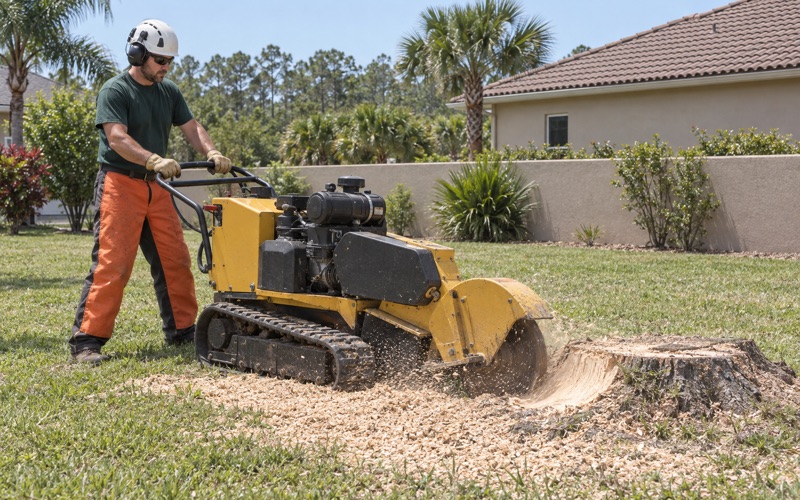
Service lines of this vintage are shallow and not always where a drawing puts them. A stump sitting over one is the most expensive object on the lot, so we locate first, grind to a depth we have a reason for, and note on the estimate when a stump is taken shallow and why.
Very poorly drained ground, and what stops a grind
The soil mapped under this subdivision is Holopaw fine sand, depressional, classed very poorly drained. Its published series description puts the seasonal high water table 6 to 12 inches below the surface for 2 to 6 months of the year, deeper through the rest of it, with ponding frequently for very long duration, 6 to 9 months in the depressional phase.
The loamy horizon in that profile sits 45 to 58 inches down, well past anything a stump machine reaches, since a rated below-grade cut commonly runs 12 to 25 inches. The machine’s own depth is therefore the binding limit here rather than a cemented layer, and what actually stops a grind on this ground is standing water and saturation in the wet season. Twenty-plus years on this coast is largely twenty years of reading a water table, and this map unit is one of the wetter answers we get.
Where the debris goes
What a removal produces does not belong at the curb. County solid waste rules define yard trash around landscaping and land-clearing material but exclude what a commercial lawn service collects, which puts contractor-generated debris outside the residential program by definition.
Our material leaves on our own truck and goes to the county disposal complex in Nokomis. Haul-away and the gate charge sit on their own line of the estimate, because the tipping rate changes at every county line we cross.
Section 54-585, and the exemption most of these lots already hold
For an ordinary removal at a house here, the county article largely steps out of the way. Section 54-585(e) lifts the tree prohibitions for owner-occupied residential lots of five acres or smaller, once a certificate of occupancy has been issued for the residential dwelling on that lot.
Both conditions are met across practically the whole neighborhood. Lots platted in the original subdivision are a small fraction of five acres and their certificates were issued decades ago, so the exemption is the normal state of affairs rather than something a homeowner applies for.
What the exemption does not cover
The exemption publishes its own limits, and that is where the care goes. It does not apply to a Grand Tree on any property, it does not apply inside a conservation or preservation area, and it does not apply to a tree planted or relocated under an earlier tree permit.
Grand Tree status is not something a tape settles in the driveway. The county scores it as a point total that varies by species, and a condition classification of 70 percent or greater is required on top of the points.
The other thing the exemption never touches is the tree you are keeping. Dragging across a root plate or regrading over it injures a tree nobody permitted anything about, and on lots this size the access route usually runs over somebody’s roots. We plan that route before the day of the work rather than during it.
The state route the county’s own list does not name
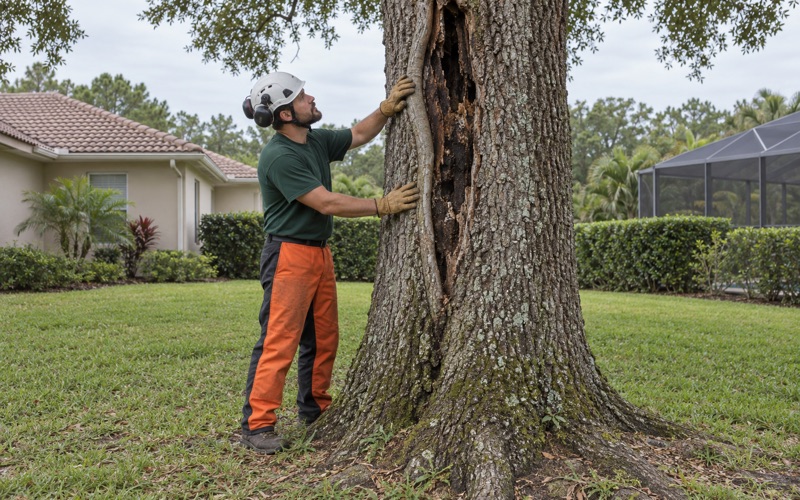
Florida Statutes section 163.045 is easy to miss at an address here, because the county’s exemption section does not mention it. It applies anyway, as state law: for a detached single-family building on a lot in residential use, a local government may not require notice, an application, approval, a permit, a fee or mitigation to prune or remove a tree where the owner holds signed documentation that the tree poses an unacceptable risk to persons or property, assessed under the ISA Best Management Practices for Tree Risk Assessment, Second Edition. That documentation has to come from an ISA-certified arborist or a Florida licensed landscape architect, and no replanting can be required either. It is not the same paper as the condition report we write, so we say plainly which one you are holding and who has to sign the other for the statute to do any work.
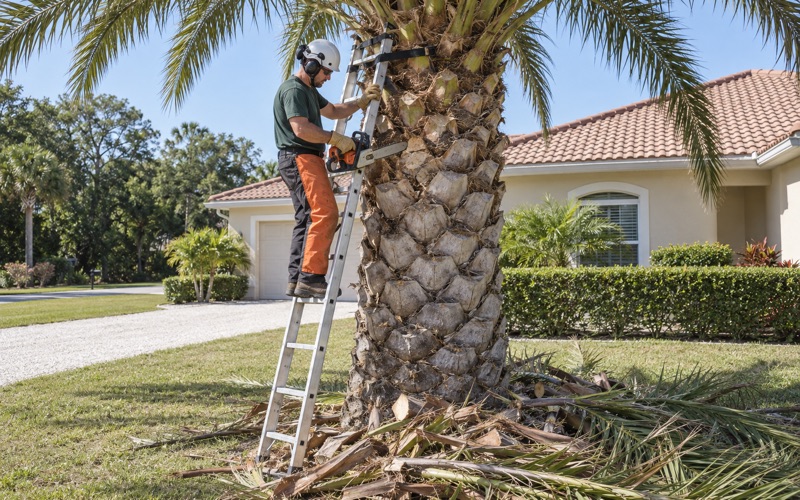
One last thing, because it comes up on nearly every quote. Florida issues no tree or arborist contractor license at all, and Florida Statutes section 163.211 keeps a county or a city from inventing one, so there is no such credential for anyone working this street to hold. What can actually be checked is current general liability and workers’ compensation coverage, along with the written standards the work is held to, ANSI A300 for the cuts and ANSI Z133 for how a crew works beneath them. Hurricane cuts, hat racking and topping are refused here, on oaks and on palms, however the request is phrased.
- 20+ Years on This Coast
- Free Written Estimates
- Dated Condition Reports