North Port Tree Removal Pros has quoted tree removal in Lakewood Ranch for more than twenty years, and the answer a homeowner here needs usually has very little to do with the county. It has to do with the district.
That catches people out, because everywhere else the question takes a familiar shape. A homeowner asks which government issues the tree permit and what the trunk has to measure to need one. Here the better question is which board the tree belongs to, and whether the homeowner controls it at all.
We settle that before a number goes on paper, because the order cannot be reversed once a crew is standing in the yard. An approval from the wrong body does exactly the work of no approval, and a job that discovers this on the morning of the work ends with the tree still up and a truck going home. So our estimate names the body that has to agree, says who we spoke to, and says what is still outstanding.
A county line runs through the middle of a single community
Most of Lakewood Ranch sits in Manatee County, and the newer villages at its southern end, Waterside among them, sit in Sarasota County. Local sources describing the area are consistent and blunt about it: the community straddles both counties, with the majority of it on the Manatee side. A new-construction guide for Waterside spells out what rides on that line, naming school assignment, the property tax rate and some county services as things that depend on which side an address falls on.
Tree work divides the same way. No city hall exists anywhere inside this community and there is no municipal arborist to call, so the government behind the background land development code is a county government, and which county is a question about the street rather than about the name printed on the mail. On the northern side that is Manatee County Development Services. On the southern end it is Sarasota County.
A fire station that straddles the same line
East Manatee Fire Rescue District states its own boundaries as the Manatee River to the north and Sarasota County to the south, the Braden River to the west and County Line Road to the east, across roughly 100 square miles. It is an independent special fire control district rather than a county department, and five of its ten fire stations stand inside the Lakewood Ranch community itself. Station 7, on Covenant Way, is shared outright with the Sarasota County Fire Department.
That last detail is the plainest picture of this place we know of. A single building, staffed across a jurisdictional boundary, because the boundary runs through the neighborhood it protects instead of around it.
Two forecast zones over one development
The division is not only administrative, and we did not take it on faith. A National Weather Service point query at the center of the community returns the Inland Manatee public forecast zone, FLZ255, with Manatee as the county. The same query run against a Waterside address returns FLZ260 and Sarasota.
For a tree crew that governs scheduling rather than paperwork. Wind and storm-timing products are issued by zone, so reading a single forecast across this whole community is how a rigging day gets planned against numbers that describe somewhere else.
The wood leaves across that line too
Disposal is the other thing the boundary moves. Haul-away and any gate charge sit on their own line of our estimate rather than buried in a lump sum, because the horticultural waste gate rate changes every time we cross a county line, and in this community the line can fall between two addresses a short drive apart. You should be able to see what the wood cost to get rid of, separately from what the tree cost to take down.
Looking for tree-removal closer to Sarasota? See Tree-Removal Services in Sarasota.
Five community development districts, each with its own five-member board
Lakewood Ranch’s own resident materials name them. There are five Community Development Districts in Phase I, CDD1, CDD2, CDD4, CDD5 and CDD6, and each one is governed by a five-member board. Later phases carry districts of their own, and Windward at Lakewood Ranch Community Development District, in the Sarasota County portion, describes itself in its own words as a local, special-purpose government entity authorized by Chapter 190 of the Florida Statutes.
So there is no single tree authority here wearing the community’s name. There are several, their boundaries follow phases and villages rather than anything a visitor reads off the road, and the first thing we establish at an address is which of them the property sits inside.
What Chapter 190 actually hands a district
The community’s own resident portal summarizes the powers without decoration: under Chapter 190, Florida Statutes, a district’s main powers are to plan, finance, construct, operate and maintain community-wide infrastructure and services. Streetscape and common-area landscaping live inside that sentence. It is why street trees, entry-feature plantings and right-of-way vegetation across most of this community answer to a district board rather than to a county counter.
These are real local governments, created for a purpose and confined to it. A five-member board meets, adopts a budget, contracts the maintenance and decides what happens to the trees the district holds.
Why the county tree rule matters less here than it looks
This is unincorporated ground, so the Manatee or the Sarasota land development code does sit in the background exactly as it would anywhere else in either county. It is rarely the rule a homeowner here actually meets. The community was built out under those districts and layered with private homeowners’ association and condominium declarations, and in most villages one of those two instruments is what decides whether a tree comes down.
We say that at the estimate rather than after it. A customer who has spent an evening reading a county tree ordinance has usually been reading carefully about somebody else’s problem, and the hour is better spent finding out which board and which declaration reach the tree in question.
Where Florida Statutes section 163.045 stops
The state preemption is real, and it is narrower than its reputation. Florida Statutes section 163.045 bars a local government from demanding a permit, a fee or mitigation to remove a tree on residential property, on documentation the statute itself specifies and that we do not issue. The word carrying the weight in that sentence is government.
A Chapter 190 district is a government, but the trees in question are the district’s own, standing in common areas, entry features, rights of way and easements the district maintains rather than on land a homeowner holds. The statute reaches a local government permitting a homeowner’s tree. It gives nobody new authority over a district’s own landscape, and it does not touch a private covenant that tells a homeowner what may be done to a tree on a platted lot.
Three trees on one street, three different answers
The oak in the district’s right of way is the district’s tree and the district’s decision. The palms at a village entrance belong to whoever maintains that common area, which is usually the district and sometimes the association. The tree in the middle of a fenced back yard is the homeowner’s, subject to whatever the declaration for that village has to say about it.
We work the question in that order at every address here, and it is quicker than it sounds. It is also the difference between a quote that survives contact with a board and a quote that has to be written twice.
Who we ask for, and who is actually home
The useful contact is rarely the owner by themselves. A community association manager holds the declaration, knows which committee reviews a landscape change and knows roughly how long that review runs, so we ask for that name early rather than discovering it late.
Of 3,161 vacant units recorded in this community, 1,677 are held for seasonal, recreational or occasional use. That is a large enough share that the owner of a failing tree is frequently out of state when we find it, so we write a recommendation to be readable at a distance: photographs, what we saw, where on the tree we saw it, and what we propose to do about it.
The youngest tree stock on our service map
Of 21,049 housing units counted here, 4,344 went up in 2020 or later and another 10,057 during the 2010s. That is 68.4 percent of the stock since 2010, against 1.36 percent of it predating 1980. Nothing else on our service map reads anything like that.
The result is a canopy with a single age. Nearly every tree a crew meets here arrived as part of a builder’s landscape package inside the last fifteen years or so, and it is growing in imported fill over compacted subgrade rather than in an intact soil profile. Young, actively growing root systems on engineered ground behave differently from old roots in native sand, and that is what shapes the work.
What young stock changes, and what it does not
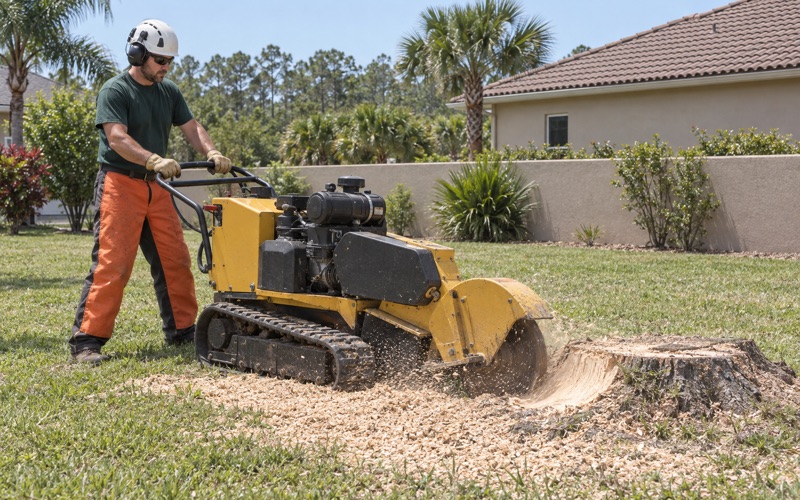
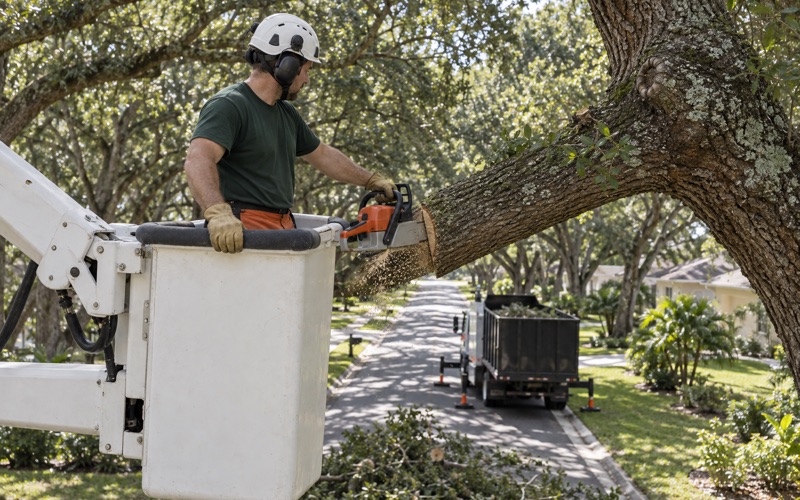
Crane reach is usually not the binding constraint here the way it is on a mature street in an older part of either county. Access is generally good and the trees are not yet large. The hazards that matter are underground: builder-installed irrigation, drainage and low-voltage wiring run close to the trunks they were installed alongside, and that is what decides where a stump grinder can take a below-grade cut.
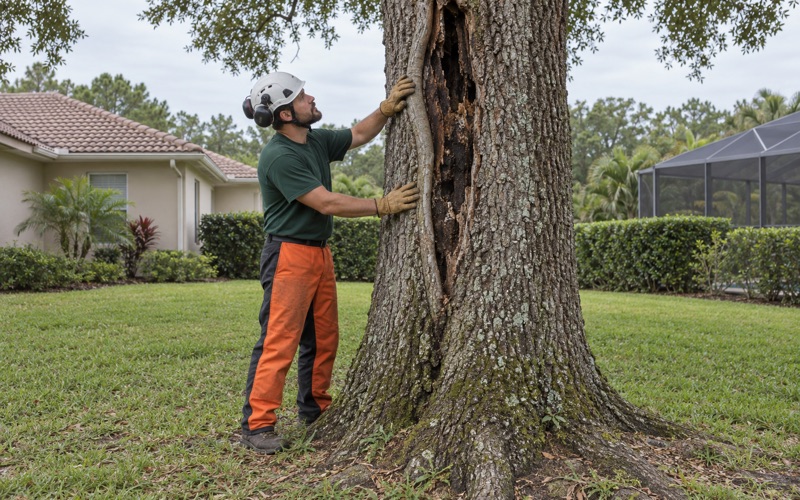
So we locate before the wheel turns, and where a root collar has been buried under fill we open it with an air spade instead of guessing. A young tree that fails at the root plate is almost always a planting-depth or soil-compaction story, and it is worth knowing which one before a replacement goes into the same hole.
The wires over most of these streets are Florida Power and Light’s, with Peace River Electric Cooperative present in parts of the area as well. The easement those conductors sit in is not the homeowner’s to clear, so we settle whose tree and whose line we are dealing with before any price attaches to a tree growing up into a conductor.
The cuts we refuse, and a word that does not exist in Florida
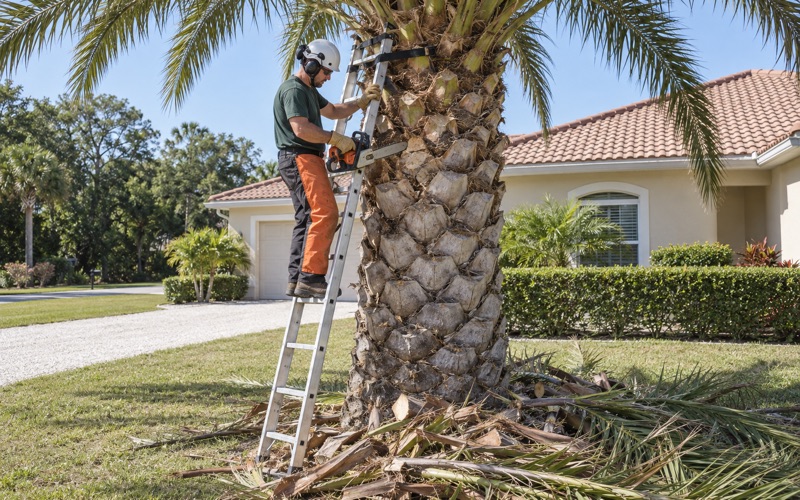
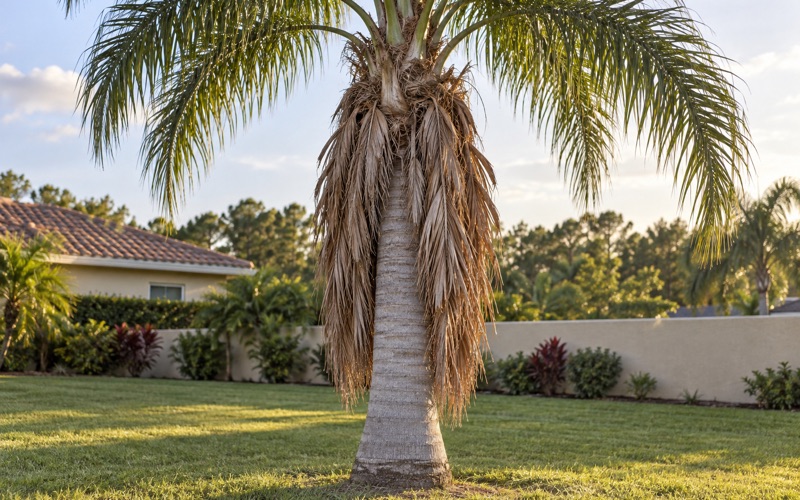
Hat racking and topping are refused here, on oaks and on palms, however the job is asked for and whoever is asking. They are not a cheaper grade of pruning, they are a different outcome with a shorter life. Where a tree is worth keeping we quote directional pruning, a crown reduction inside ANSI A300, or cabling and bracing, and we say so even when the call came in asking for a removal. Palms get their own line on the estimate, because a single growing point and a trunk that has finished thickening make that job nothing like felling a young oak beside it.
We also will not print the word licensed. Florida issues no arborist or tree contractor license at all, and Florida Statutes section 163.211 preempts local occupational licensing in this trade, so a company advertising one here is describing a credential that does not exist in this state. What we put in writing instead is a dated condition report on anything we recommend taking down, and rigging and pruning work carried out to ANSI Z133 and ANSI A300.
- 20+ Years on This Coast
- Free Written Estimates
- Dated Condition Reports