North Port Tree Removal Pros has handled tree removal in Nokomis for more than twenty years, and the first thing we settle here is usually not the size of the trunk. It is the species. On this stretch of the coast, whether a tree is protected often has nothing to do with how thick it has grown.
Most tree codes in this state run on a diameter. Measure the trunk, compare the number to a threshold, and you know whether the work needs a permit. The code that reaches an address here does that too, and then it turns around and names a short list of species that are protected whatever they measure.
That second clause is what catches people on waterfront ground, because the species it names are the ones that grow along the water. We tell a homeowner which clause their tree falls under before we put a price on the work, and everything we recommend taking down is backed by a written, dated condition report that exists before any equipment does.
County ground, with no city hall anywhere in the chain
Nokomis is an unincorporated town in Sarasota County and a census-designated place along the Gulf Coast, with access to the water through Nokomis Public Beach and Casey Key. Its population was 3,217 at the 2020 census, up from 3,167 in 2010, inside the Sarasota metropolitan area. There is no council here, no municipal arborist, and no town tree chapter to look up.
The clause that carries the county article onto this address
The governing text is the Sarasota County tree ordinance: Chapter 54, Article XVIII, Trees, consolidated under Ordinance 2011-023 and amended since. Its jurisdiction provision at Section 54-583(6) says where the article lands. It is effective throughout the unincorporated area of Sarasota County, and effective inside an incorporated municipality only where that municipality adopts the same provisions and provides for county enforcement by interlocal agreement.
Both halves of that provision matter, and only the first half applies here. A Nokomis parcel sits in the unincorporated area, so the county article reaches it directly with nothing in between. We cross three counties and five city halls on a single service map, and the plainest thing we can hand a caller is which of those rule sets their own address sits under.
A permit question that was never a city question
Because there is no municipal code to find, a homeowner searching for a Nokomis tree permit turns up nothing and reasonably concludes no rule exists. The rule does exist. It is filed under the county rather than under the place name, which is also why the county answers the zoning, the mangroves and the debris at this address.
Looking for tree-removal closer to Osprey? See Tree-Removal Services in Osprey.
Four and a half inches, and the species that threshold does not reach
Section 54-582 builds its definition in two moves. The first is conventional: a tree is a living, woody, self-supporting plant that will reach ten feet or more in height at maturity, with a main stem or cluster of main stems, and any single stem measuring four and one-half inches diameter at breast height. Measured only that way, a great deal of what grows on a coastal lot here would not be a regulated tree at all.
The second move is what makes this county unusual. The same section declares that all rooted species of mangrove, and scrub oak at two inches diameter at breast height, are trees protected by the article regardless of the general threshold, and it names them one by one.
The eight species the code names by hand
On the mangrove side the list reads red mangrove, white mangrove, black mangrove and buttonwood. On the scrub oak side it reads sand live oak, myrtle oak, bluejack oak and chapman oak.
Buttonwood is the one worth pausing over, because it does not look like a mangrove and gets treated as an overgrown shrub. The code puts it in the protected class by name. For the scrub oaks the floor drops to a stem you can close a hand around, and for a rooted mangrove the clause states no size floor at all, because the protection attaches to the species rather than to the diameter.
Casey Key frontage, where the smallest stems carry the most protection
Casey Key and the Intracoastal frontage are where this stops being a technicality. Shoreline along Blackburn Bay and Shakett Creek carries mangrove stems well under four and a half inches, and every one of them is a protected tree under the species clause, while a thicker ornamental twenty feet up the slope may not be. The usual intuition, that bigger means regulated, runs backward here.
Mangrove trimming and alteration also answers to the county rather than to the state directly. The Florida Department of Environmental Protection has delegated that authority to only seven local governments in Florida, and Sarasota County is one of them, administering it under Chapter 54, Article XXXV, Mangrove Trimming and Preservation. Reporting on the county’s 2016 delegation describes its scope as the unincorporated county, which is exactly what this community is.
That is permitted work under a program we are not the permit holder for, and we do not pretend otherwise. What we will do is say plainly that the stems on your shoreline sit inside it, and keep our own scope on the upland trees.
Palms are trees at four and a half feet of clear trunk
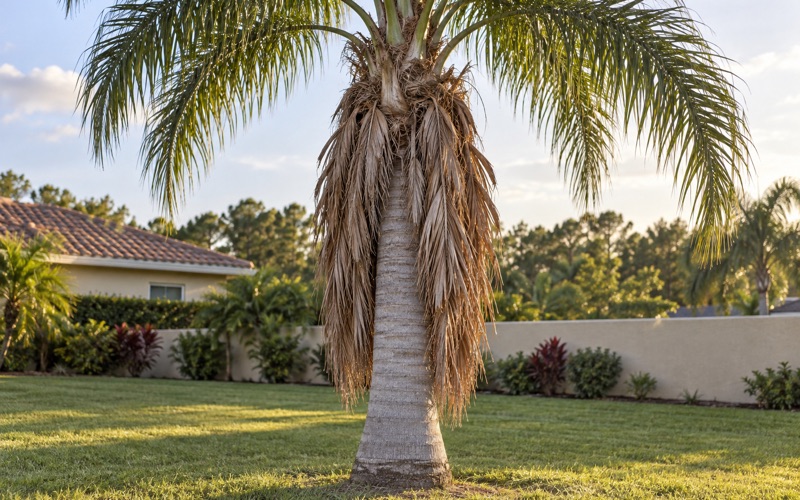
The section reaches palms through a third measurement entirely: every palm carrying more than four and a half feet of clear trunk is declared a tree and protected. Clear trunk is the bare stem under the crown, so the figure has little to do with how tall the palm looks from the street, and a mature sabal palmetto along a lot line is a protected tree on that basis alone.
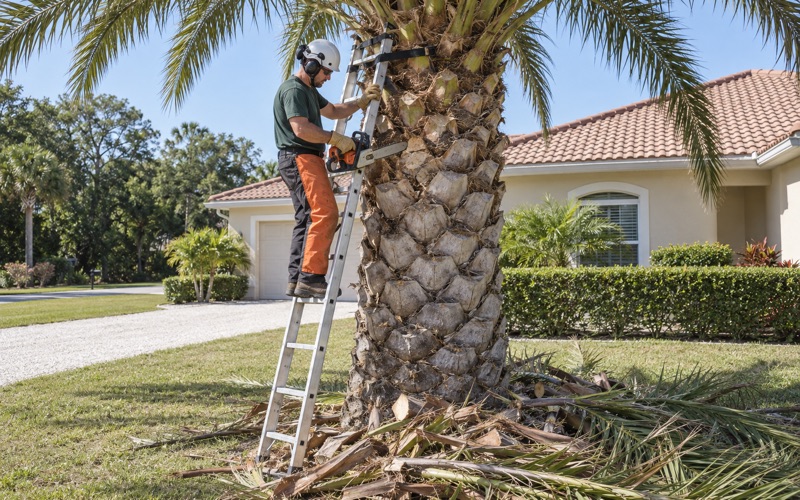
We quote palms on their own terms regardless of the ordinance. A palm gains height from a single terminal bud and never gains girth, there is no branch collar anywhere on it to cut back to, and the trunk standing today is the trunk it will have for good. Clear trunk feet and access build the number, not diameter.
Section 54-585(e), the five-acre exemption, and what it leaves standing
The most useful sentence in the whole article for an ordinary homeowner here is Section 54-585(e), Certain Residential Lots. The prohibitions lift for “owner-occupied residential Lots of five acres or smaller, after a certificate of occupancy has been issued” for the dwelling on that lot.
Read it for what it never asks. No arborist letter, no hazard finding, no documentation of any kind, and no waiting period once that certificate of occupancy is in hand. Residential lots in this community are a small fraction of five acres, so in practice the exemption covers all of them.
Florida Statutes section 163.045 can set aside a local permit for a dangerous tree at a detached single-family home, but only where an ISA-certified arborist or a Florida licensed landscape architect has documented unacceptable risk. The county has already stepped aside without asking for paper, which leaves the statute as a fallback here rather than the route anyone needs.
The carve-outs that survive the exemption
The exemption publishes its own limits, and on this ground they matter more than the exemption does. It does not apply in a conservation or preservation area. It does not apply to a tree planted or relocated under an earlier tree permit. It does not reach a lot where the dwelling is coming down to be rebuilt.
Two more are flat. The exemption “does not apply to any Grand Tree on all properties,” and it does not apply to trees inside a Canopy Road Protection Zone. Every other exemption category in the article pulls Grand Trees back out the same way, so a homeowner told that a small lot needs no permit is right only if the tree is not a Grand Tree and is not standing inside a protection zone. Whether a designated canopy road segment runs through this community is something we check rather than assume.
Grand Tree is a scored total, not a diameter
Grand Tree status is decided on points, which is why a tape in the driveway does not settle it. Trunk diameter contributes a point for each inch, height a point for each foot, and average canopy spread a point for every four feet of spread.
Minimum totals run by species. American elm, bald cypress, hickory, live oak, pine and sweetgum each need 100 points, while sand live oak and southern magnolia need 80. Section 54-586(4) sets a floor underneath all of it: every Grand Tree also has to carry a condition classification of 70 percent or greater.
Sand live oak is the name to watch on coastal ground, because the code reaches it from both ends. It is protected from two inches of trunk, and it is designated at the lowest point total on the schedule. The same species can be regulated at the bottom of the size range and designated at the top of it.
What actually changes about the work here
Sand the whole way down, and a grinder that meets no hardpan
A soil point query at this community’s own internal coordinates returns a Tavares fine sand map unit, taxonomic order Entisols, dominant component 85 percent Tavares, on slopes of 0 to 2 percent. The series description is the part that matters to a stump: no spodic horizon, no restrictive layer of any kind, and an ochric epipedon over a plain sandy sequence running past 99 inches.
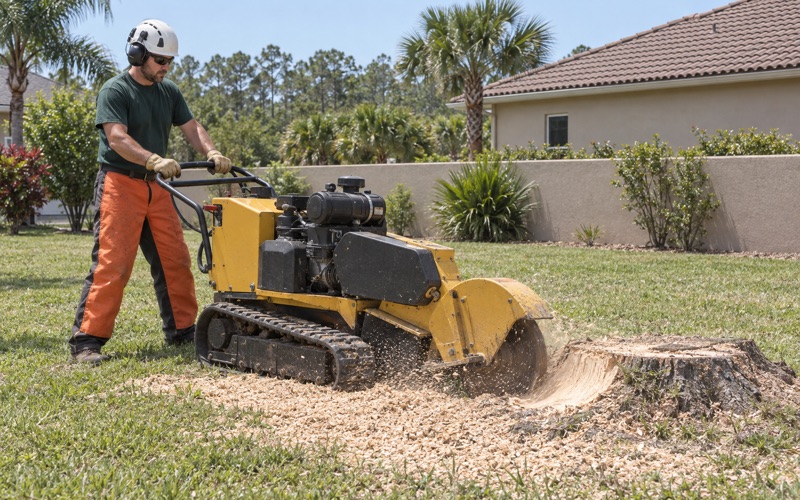
That is an uncommon answer on this coast. A stump grinder’s below-grade cut meets loose, well-drained sand through its entire working depth here, so what stops the wheel is the machine’s own mechanical limit rather than a cemented layer.
Water is not the binding constraint either. Drainage is classed moderately well drained in hydrologic group A, the most freely draining group there is, with the seasonal high water table between 42 and 72 inches for most of the year and receding deeper in drought. Twenty-plus years on this coast is largely twenty years of reading a water table, and this is one of the few map units where we barely have to.
The overhead lines, and where not to replant
Florida Power and Light owns most of the overhead distribution serving this community, and its own vegetation brochure states the cycle: main power lines cleared every three years and neighborhood lines every six years on average, by directional pruning that takes limbs back to the trunk.
The same brochure gives the setbacks worth knowing before a removed tree gets replaced: a minimum of 50 feet for a large tree at maturity, 30 feet for a medium one, and for a large palm the maximum frond length plus 20 feet.
The cuts we refuse, and the word Florida does not issue
Topping, hat racking and so-called hurricane cuts are not work we will take on, on a live oak or on a palm, however the request is phrased. Where a tree should stay, the estimate says so and prices the crown reduction, the directional pruning or the cabling and bracing instead. Haul-away and the gate at the county’s Central County Solid Waste Disposal Complex sit on their own line of that estimate, because what a load costs to tip is a county-by-county figure rather than a fixed one.
A word on credentials, since it always comes up. Florida issues no tree or arborist contractor license of any kind, and Florida Statutes section 163.211 keeps the county from creating one, so there is nothing here for a tree company to be licensed by. What you can verify instead is current general liability and workers’ compensation coverage, alongside the written standards the work is held to, which are ANSI A300 for the pruning specification and ANSI Z133 for how a crew works around the drop zone.
- 20+ Years on This Coast
- Free Written Estimates
- Dated Condition Reports