North Port Tree Removal Pros has quoted tree removal in Osprey for more than twenty years, and the first thing we establish at an address here is what stands on the other side of the property line. Protected ground is threaded through this community rather than parked at the edge of it. The same declining oak is a straightforward removal in the middle of a yard and a slow, hand-rigged job when its crown leans over a boundary nobody is allowed to disturb.
There is no city hall to call here and no municipal tree ordinance to look up. Sarasota County answers the tree question at this address directly, along with the debris question and the shoreline question, and we name the governing code section in the estimate rather than leaving you to go find it.
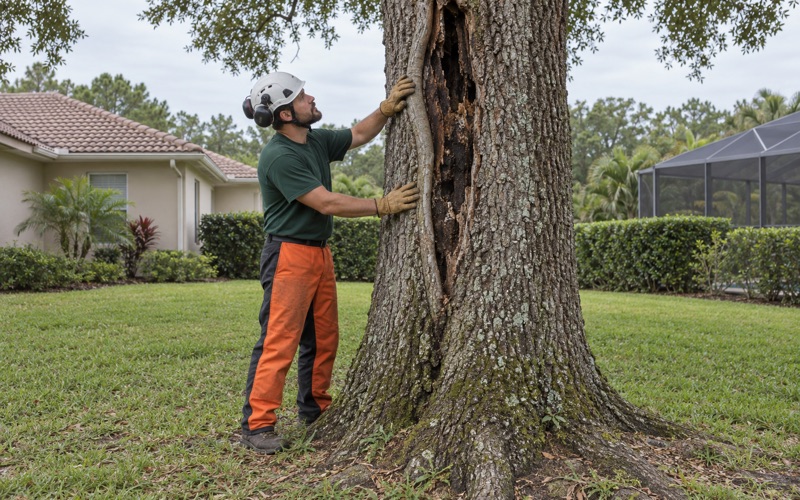
Anything we recommend taking down carries a written, dated condition report, so the reasoning exists on paper before a saw exists on site. Where the tree should stay, the estimate quotes the crown reduction or the cabling instead, and haul-away and gate fees sit on their own line because the tipping rate changes at every county line we cross. Hurricane cuts, hat racking and topping are refused on oaks and on palms alike, however the job is asked for.
Five thousand years on this bay shore, and the canopy over it
Osprey sits on Little Sarasota Bay, and the ground along that shore has been occupied for a very long time. Historic Spanish Point is a 30-acre preserve on the bay listed on the National Register of Historic Places, inhabited by Native Americans for roughly 5,000 years, homesteaded by John Greene Webb’s family in 1867, and bought in 1910 by Bertha Honore Palmer of Chicago as part of her Osprey Point estate.
Protected ground did not stop there. Bay Preserve at Osprey was purchased from the Matson family in 2006 with a Florida Communities Trust grant and now headquarters the Big Waters Land Trust. Oscar Scherer State Park opened in 1956, covers more than 1,300 acres, is known for its Florida scrub-jay population, and has the Legacy Trail running through it.
So the practical question on a quote here is rarely only which tree. It is what the tree is standing next to, and whether a crew has room to work without putting a boot, a tire or a limb onto ground that is preserved. We do not work inside preserve boundaries, and we plan the job so that nothing we drop or drag ends up there either.
Why the neighbor decides the method
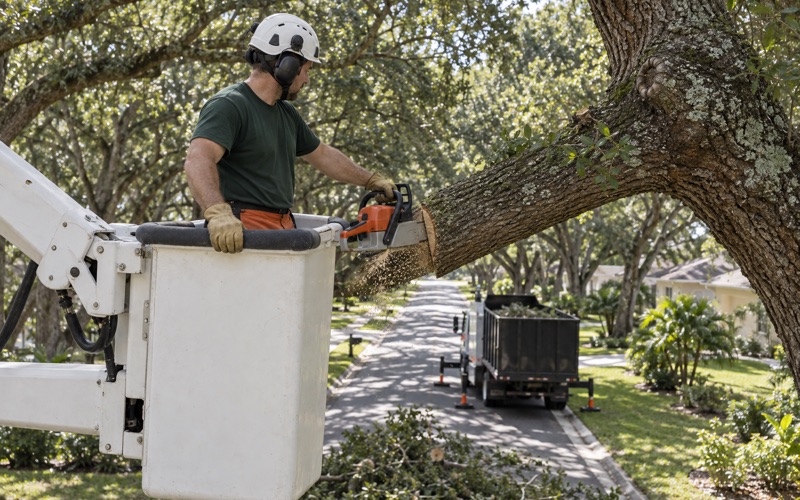
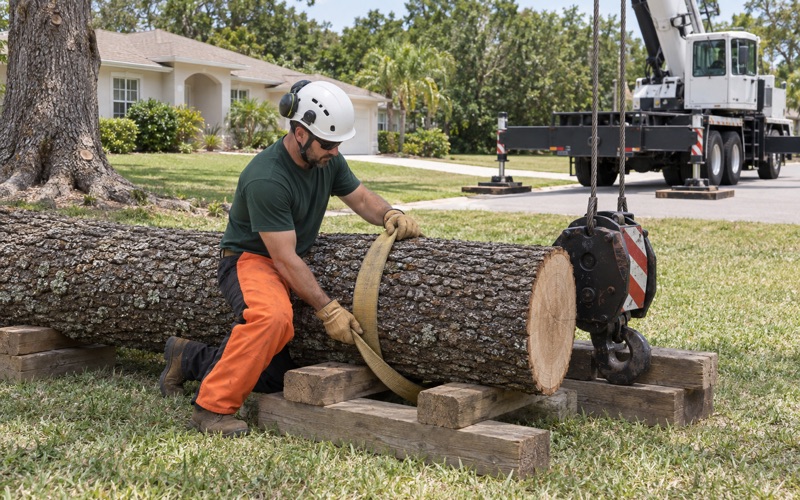
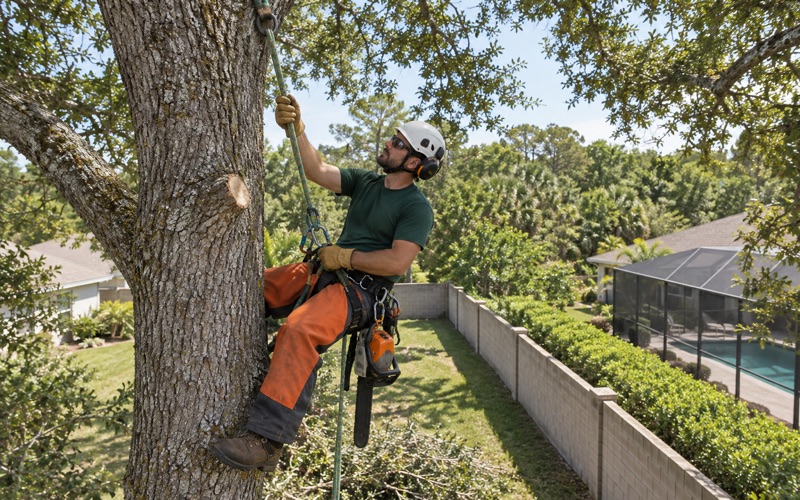
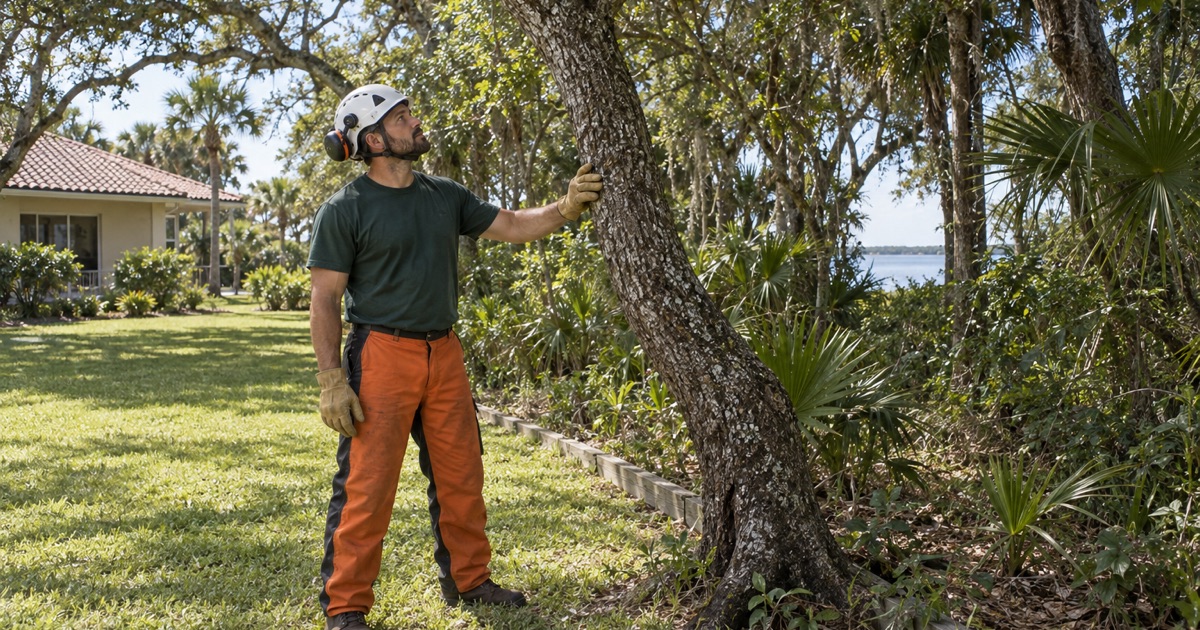
Old coastal hammock behaves nothing like a planted yard. The canopy is continuous, the understory is intact, the soil beneath it has never been graded, and there is usually no clean drop zone anywhere inside the crown. Taking a failing tree off that edge means rigging pieces out rather than felling them, and it often means a spider lift where the ground will not take a bucket truck’s outriggers. Shoreline vegetation on the bay answers to a separate county program from the tree article, and we keep that off a yard-tree quote rather than guess at it.
Looking for tree-removal closer to Arcadia? See Arcadia Tree-Removal.
County ground, and the article that states its own reach
Osprey is an unincorporated place with no government of its own, which is why there is no separate municipal tree code anywhere to find. The authority is the Sarasota County Board of County Commissioners, and the text is the Sarasota County Code of Ordinances, Chapter 54, Article XVIII, Trees, adopted as Ordinance 2011-023 and amended since.
The article states where it applies in its own words. Section 54-583(6) reads, ‘The provisions of this article shall be effective throughout the unincorporated area of Sarasota County, Florida.’ That sentence is the whole jurisdictional answer at an Osprey address: the county article reaches the lot directly, and nothing else has to be adopted for it to apply.
The definition that catches more than people expect
Section 54-582 defines a tree as a living, woody, self-supporting plant that will reach ten feet or more at maturity, with a stem measuring four and one-half inches diameter at breast height. Two extensions to that definition do most of the surprising work. Sand live oak and myrtle oak are protected from two inches DBH, which matters on a lot that kept remnant scrub instead of planting shade, and every palm carrying more than four and one-half feet of clear trunk is a protected tree in its own right.
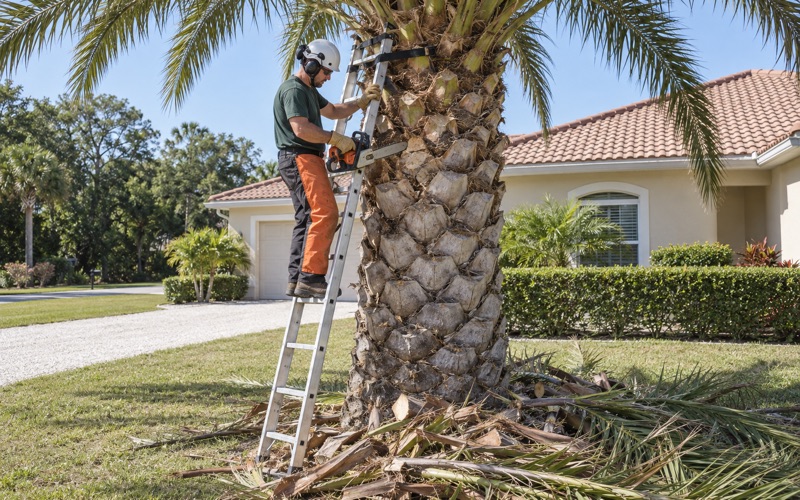
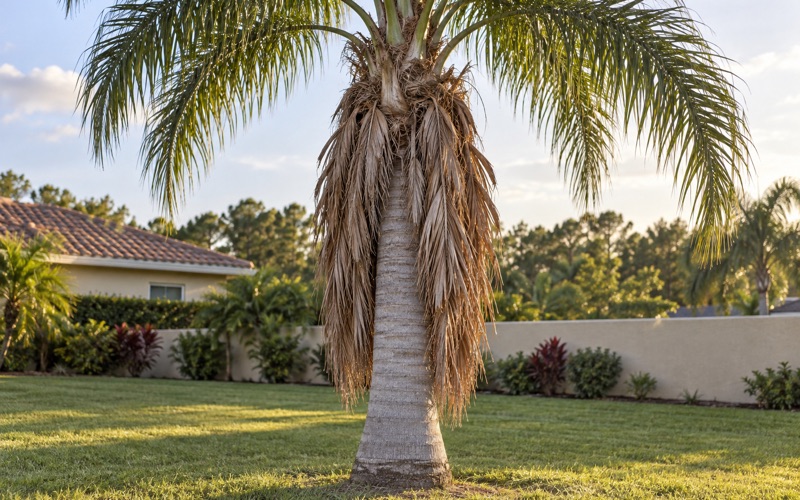
That last clause reaches a great deal of frontage here, because a cabbage palm clears four and one-half feet of trunk early in its life. We price palms as palms for reasons beyond the code as well: a single growing point at the top, no branch collar to cut back to, and a trunk diameter that is already final. Clear trunk feet and access are what the number is built from, not a diameter class.
What the county cannot do
Florida issues no tree or arborist contractor license at all, and Florida Statutes section 163.211 preempts local occupational licensing, so the county has no route to create one either. We would rather explain that than print a word with nothing behind it. What is checkable instead is ISA certification on whoever assesses the tree, general liability and workers’ compensation certificates read off the paper, and the standards the work is written to: ANSI A300 for the cuts and ANSI Z133 for the crew.
Remnant hammock against planted landscape, and why the pricing differs
The housing stock here is mostly newer than the canopy people picture. Of 3,722 housing units, 617 were built before 1980, about 16.6 percent of the total, while 1,154 went up between 2000 and 2009, per the 2024 five-year American Community Survey. The tree that worries a homeowner in Osprey is therefore frequently older than the house it threatens.
That produces two different jobs on the same street. A planted live oak in a 2000s yard has a root plate of known extent, graded soil, a driveway to set a machine on and a predictable crown. A remnant oak left standing when the lot around it was cleared has a root plate of unknown extent, often co-dominant stems with included bark, and decades of growth into whatever was built beside it.
We price those separately, and we say which one we believe we are looking at. The second is where a root collar excavation or an air spade earns the time it takes, because what the base of the trunk is doing decides whether the recommendation is a removal or a cable.
The Grand Tree arithmetic, and why it gets run in the yard
A mature remnant tree is also where Grand Tree status becomes a live question, and that status is a points total rather than a diameter. The county publishes the formula itself: diameter plus height plus a quarter of the average canopy spread. Diameter comes from the circumference measured at 4.5 feet above the ground divided by 3.14, height is taken base to top, and average spread is two perpendicular drip-line measurements averaged and then divided by four.
The threshold moves by species. Live oak, pine, bald cypress, hickory, American elm and sweetgum each need 100 points; sugarberry needs 95; southern red cedar and sweetbay need 90; red bay needs 85; sand live oak and southern magnolia need 80. Section 54-586(4) adds a condition floor on top of the points, requiring a condition classification of 70 percent or greater, so a declining specimen can clear the arithmetic and still fail the second test.
We run that measurement before quoting, because the answer decides whether the county is involved at all. A tape and a few minutes cost nothing, and finding out afterwards is expensive.
Three boundaries on the same lot, and the exemption that does not clear them
The most useful sentence in the county article for an ordinary homeowner is Section 54-585(e). It reads, ‘The prohibitions in Section 54-584(1) shall not apply to owner-occupied residential Lots of five acres or smaller, after a certificate of occupancy has been issued for the residential dwelling(s) on that Lot.’ No arborist letter, no hazard finding and no documentation of any kind is asked for, and nearly every owner-occupied detached house in Osprey, 1,984 of them by that same survey, sits on a lot far under the acreage ceiling.
On a larger lot the exemption narrows rather than disappearing: above five acres, no tree permit is required where the tree is within 150 feet of the residential dwelling once the certificate of occupancy is issued. Past that radius the article applies again.
What the exemption does not reach is the part that matters most here. It does not apply in a conservation or preservation area, it does not apply to any Grand Tree on any property, it does not apply inside a Canopy Road Protection Zone, and it does not apply to a tree planted or relocated under a tree permit or on a lot where the dwelling is to be demolished and rebuilt.
The first of those carve-outs is why we locate the boundary before relying on the exemption. A parcel that backs onto protected ground sometimes carries a platted conservation tract inside its own lines, and in that case ‘my lot is under five acres’ is a correct answer about the wrong part of the yard.
Florida Statutes section 163.045 sits on the far side of those carve-outs, and it does want documentation from an ISA-certified arborist or a Florida licensed landscape architect showing an unacceptable risk under the ISA Best Management Practices. That is a different document from our condition report, and we say which one we are handing you.
The canopy road zone is a mapped designation, not a figure of speech
Canopy Roads are designated by the county and carry a protection zone extending up to 15 feet laterally from the right-of-way onto adjacent private property. Inside that strip, unauthorized pruning or irreparable injury to a tree is a prohibited act in itself, independent of any permit question. Designation takes at least 660 feet of travelway with 50 percent overhead coverage, and across the 24 miles designated countywide the average segment runs 1,764 feet, so these zones are short and specific rather than continuous.
We do not name a road from memory. Whether a designated segment touches a particular Osprey address is a question for the county’s current map, and we check it rather than assume either answer.
The third boundary is overhead
Florida Power and Light owns most of the overhead distribution serving these streets, and its own vegetation brochure states the cycle: clearing main power lines every three years and neighborhood lines every six years, on average, by directional pruning that takes branches back to the trunk. A tree inside that envelope gets cut to the conductor’s needs rather than to the crown’s shape, which is often why a homeowner calls us about a tree that has already been pruned twice.
The same brochure publishes setbacks worth knowing before a replacement goes in: 50 feet minimum for a large tree at maturity, 30 feet for a medium one, and for a large palm the maximum frond length plus 20 feet. A transformer cabinet wants 8 feet of clearance in front and 3 feet at the back and sides. We do not assume the utility will remove a repeat offender or pull a service drop for our crew, because nothing it publishes commits it to either.
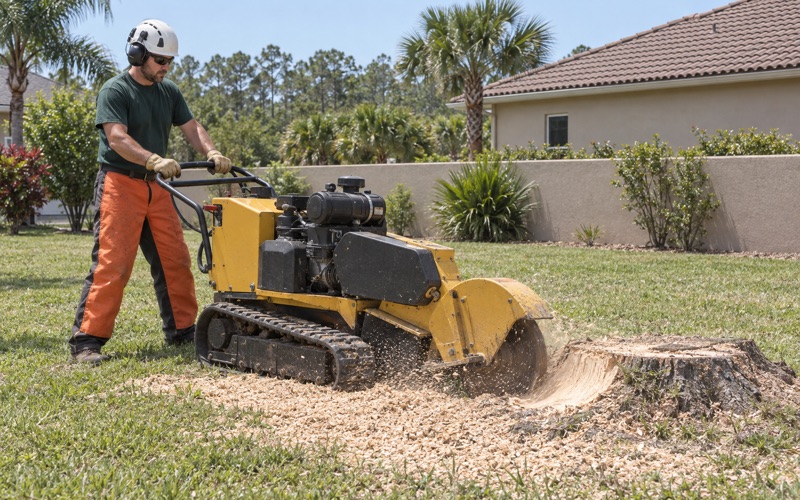
Debris leaves on our truck rather than going to the curb. Collection here runs under a county franchise rather than a municipal crew, and the volume a removal produces is not what a residential yard-waste program is built for, so the material goes to the county’s own disposal complex and the gate fee is itemized on its own line of the estimate.
- 20+ Years on This Coast
- Free Written Estimates
- Dated Condition Reports