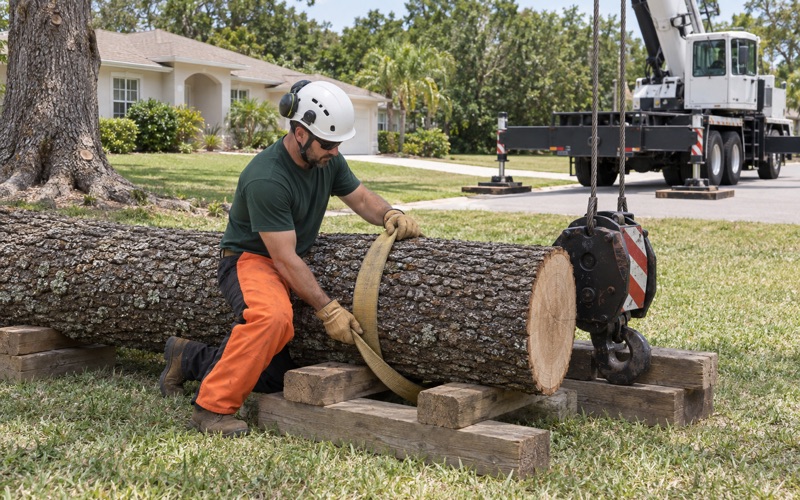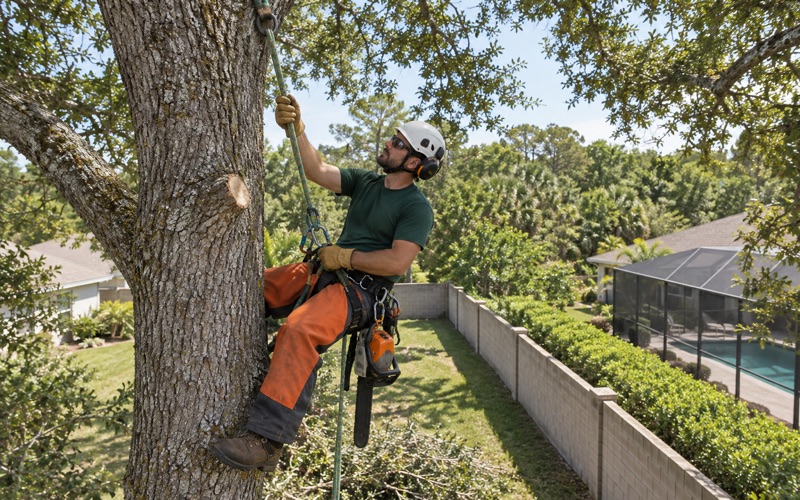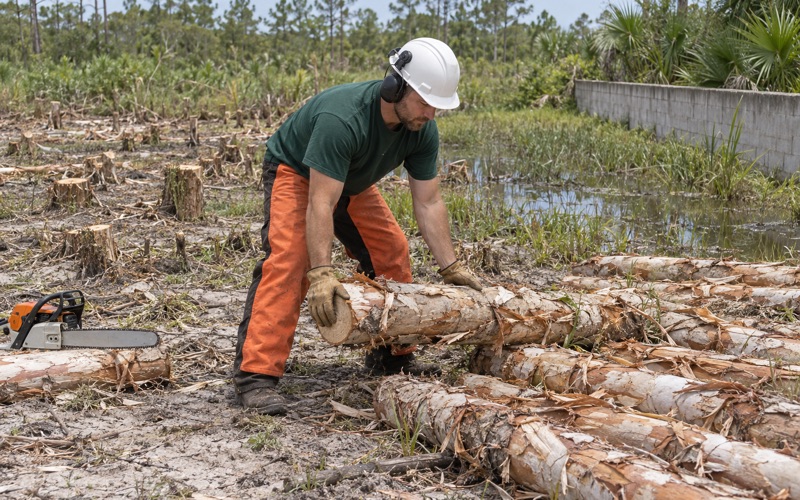
North Port Tree Removal Pros has handled tree removal in Plantation for more than twenty years, and every job here starts by settling which Plantation we are quoting. Two Florida places carry the name. This one is a small unincorporated pocket in Sarasota County on the Gulf side of the state. The other is an incorporated city in Broward County, a hundred miles away on the far side of the peninsula.
That distinction is not trivia, it is the whole problem. Most of what is published under the words “Plantation, Florida” — permit steps, protected species lists, fee schedules, the department to call — describes the other place, and it describes it completely, consistently and with total confidence. A homeowner here who follows one of those pages is following a procedure that does not exist at their address.
So we wrote this page the other way around. Every rule below is tied to the authority that actually governs a parcel on this ground, and where the answer differs from the answer a few minutes up the road, we say which is which.
Two Florida Plantations, and four ways to tell them apart
The 2024 Census Gazetteer carries both places as separate rows, and this one is row 1257450, Plantation CDP, with an internal point at 27.068279, -82.370468. The population was 5,034 at the 2020 census, up from 4,919 in 2010, inside the North Port, Bradenton and Sarasota metropolitan statistical area. The other row is a city of roughly 90,000 people, and it is the one the search results hand back.
Four independent geographies, one county
We check a place like this against several unrelated public datasets rather than one, because a single source can be misread and the cost of misreading this one is an entire quote. The Gazetteer row above puts it on the Gulf coast. A point query against the National Weather Service interface at that internal point returns county zone FLC115, Sarasota, and names the relative location Plantation.
A soil survey point query at the same coordinates returns area symbol FL115, the Sarasota County soil survey area. And the encyclopedia article on this community is titled Plantation, Sarasota County, Florida. Four geographies, one county.
Why the wrong answer reads like the right one
Searching for this community’s own golf club during our research returned the other city’s published material in the same list of results as the correct one. The wrong answer is not garbled, it is polished, internally consistent and confidently written, which is exactly why it survives a quick read.
Our working rule is blunt: if a document does not name Sarasota County, it is not about this address. We cross three counties and five city halls on one service map, and the first thing we owe a caller is a plain answer about which tree rule their own lot sits under.
Looking for tree-removal closer to Englewood? See Englewood Tree-Removal.
Chapter 54, Article XVIII is the tree code that reaches this address
There is no city commission here and no municipal tree ordinance, because the place is unincorporated. The governing document is the Sarasota County tree ordinance: Chapter 54, Environmental and Natural Resources, Article XVIII, Trees, consolidated out of three predecessor ordinances by Ordinance 2011-023 and amended again in 2016. Its jurisdiction clause at Section 54-583(6) reads, “The provisions of this article shall be effective throughout the unincorporated area of Sarasota County, Florida.”
Across most of the ring we work, unincorporated ground means a deed restriction is the only tree rule that will ever reach a homeowner. Plantation is the exception on our map. That same clause, which elsewhere explains why the county article stops short of an address, is the clause that carries it onto this one.
Section 54-582 names the decision-maker as the Sarasota County Administrator or a designated official, and Section 54-586(3)(c) gives single- and two-family lots a review within four working days of a complete application.
The neighboring codes that stop at the line
Two municipalities next door run their own tree chapters and neither one governs a parcel here. Venice has administered its own Chapter 118 since 1 January 2020, when Ordinance 2019-29 ended the arrangement under which the county handled tree permitting inside the city; its residential exemption at Section 118-7(h) reaches single-family zoned lots of one half acre or less. North Port regulates under its own unified land development code, Chapter 45. A crew that carries the half-acre rule across the line into Plantation is quoting the wrong code with a straight face.
What the code counts as a tree
Section 54-582 sets the general floor at any one stem measuring four and one-half inches diameter at breast height, taken at 54 inches above the ground. Two groups drop below that floor: the scrub oaks — sand live oak, myrtle oak, bluejack oak and chapman oak — are protected from two inches, and every palm with more than four and one-half feet of clear trunk is a protected tree in its own right. Section 54-585(a) goes the other way and exempts the Florida Exotic Pest Plant Council Category I list outright, naming Brazilian pepper, melaleuca, Australian pine, carrotwood and Chinese tallow.
Section 54-585(e) exempts the lot, and five carve-outs still bite
The residential exemption here is the broadest one in this part of the state. Section 54-585(e) opens, “The prohibitions in Section 54-584(1) shall not apply to owner-occupied residential Lots of five acres or smaller, after a certificate of occupancy has been issued for the residential dwelling(s) on that Lot.”
Read that for what it does not ask for: no arborist letter, no hazard finding, no risk assessment, no documentation of any kind, and no waiting period once the certificate of occupancy is issued. Every residential lot in this community is a fraction of an acre, so the exemption covers the whole of it.
That is wider than the state route most of Florida argues about. Florida Statutes section 163.045 preempts local permitting for a hazardous tree on a detached single-family property, but it still wants documentation from an ISA-certified arborist or a Florida licensed landscape architect. Here the county has already stepped aside without asking for paper, which makes the statute the belt rather than the braces.
The five that survive the exemption
Five things survive it, and they are the whole job: a conservation or preservation area, a tree planted or relocated under an earlier tree permit, a lot where the dwelling is coming down to be rebuilt, any tree inside a Canopy Road Protection Zone, and a Grand Tree, which the exemption excludes “on all properties.”
A Grand Tree is determined by the Administrator rather than by a diameter, so it is not something a tape settles in the driveway, and development applications submitted since October 2002 have had to be designed to protect one.
The second item is the one that is easy to miss on ground like this. The code’s definition of a tree expressly includes any tree planted or relocated under the article, and this is a community landscaped to approved plans since 1981, so a specimen with a permit history behind it is a different animal from a volunteer of the same size.
Pruning, and the cuts we will not make
Section 54-585(h) requires no permit to prune or maintain a tree on a private lot, with three exceptions: a Canopy Road Protection Zone, a right-of-way, and a Grand Tree pruned below the Section 54-588 standard. The code defines pruning narrowly and ties it to ANSI A300, listing cleaning, thinning, crown raising, reduction and restoration — and thinning expressly includes opening a vista, which is a common request on a lot that backs a fairway or a lake.
Topping is defined separately, which puts it outside pruning and outside the exemption. We refuse topping and hat racking here, on oaks and on palms, however the job is asked for.
Irreparable Injury is its own prohibition and it reads like a list of ordinary site practices: root damage from heavy machinery, a grade change over the root plate or against the trunk, canopy work inconsistent with A300. On a lot where the exemption has already removed the permit question, that is the live exposure on the trees we are not removing.
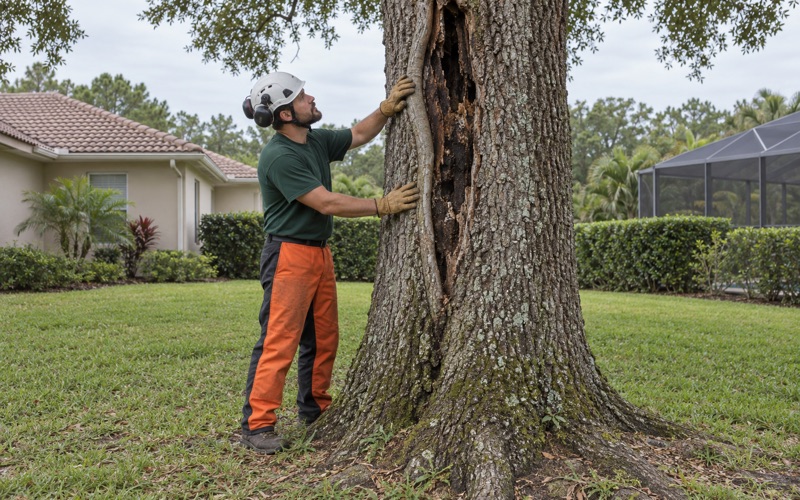
When a tree should stay, we quote the crown reduction, the directional pruning or the cabling and bracing instead, and anything we do recommend removing carries a written, dated condition report, so the reasoning exists before the saw does.
Quoting a pocket with private streets and no city hall
The ground a grinder has to cut
A soil point query at this place’s internal point returns map unit 10, EauGallie and Myakka fine sands, poorly drained, non-hydric, with an annual minimum water table at 31 inches. The taxonomy is the tell: an Alfic Alaquod is a spodosol, and the published EauGallie profile puts the spodic horizon from 22 to 35 inches.
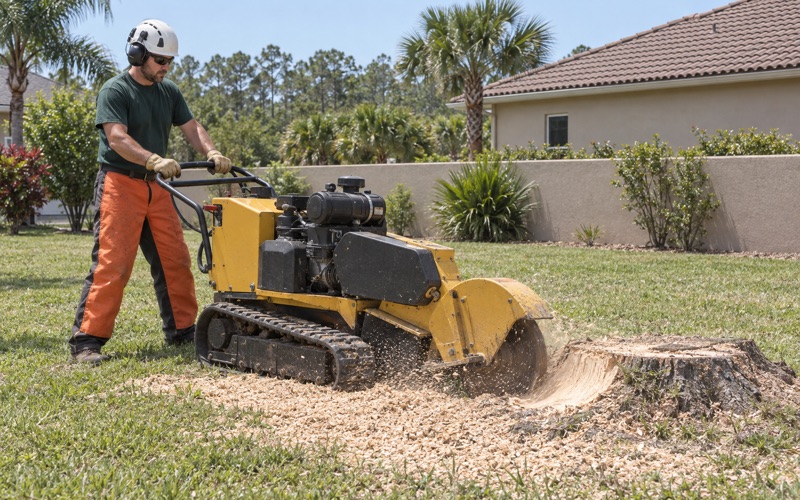
A stump grinder’s below-grade cut runs roughly 12 to 25 inches, so the top of that cemented layer sits inside the working band, at the deep end of it. Twenty-plus years on this coast has mostly taught us that a seasonal high water table stops a grind long before any hardpan does; here the order reverses. EauGallie is only 45 percent of the map unit, which is why a test hole is worth more than a map on any particular lot.
Palms are quoted as palms
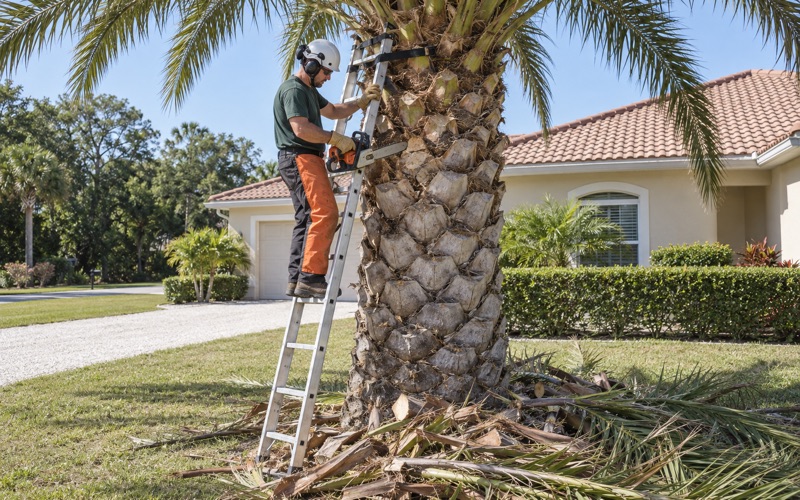
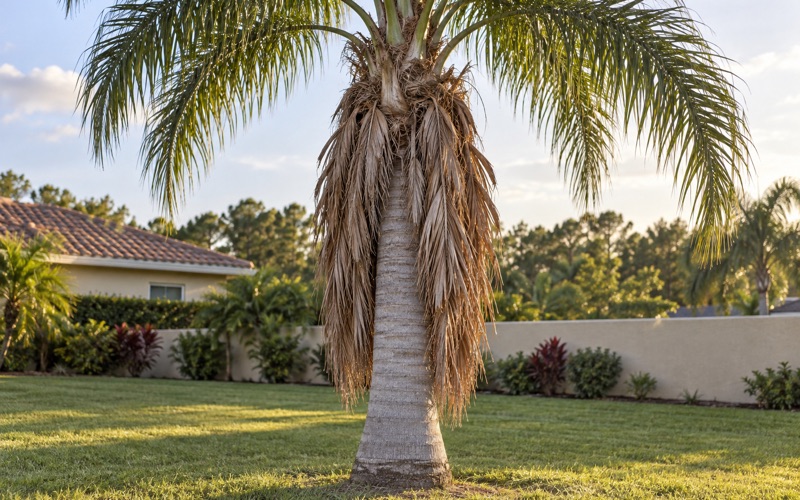
A palm has one growing point, no branch collar and no cambium, so the trunk standing today will never put on another inch. That changes the rigging, the cut and the stump, and it is why palm work is priced on its own basis rather than as a small hardwood. It also changes the paperwork, because the clear-trunk rule makes a mature sabal palmetto a protected tree on a street lined with specimen palms.
Debris, private roads and the gate
Development of this golf community began in 1981 on more than 1,300 acres, and it now holds close to 2,700 homes across roughly 20 neighborhoods, most of them on streets the associations own rather than the county. County guidance is explicit about what that means after a storm.
Residents on a private road must grant the county the right to enter the roadway before any debris removal happens, using a notarized Right-of-Entry and Hold Harmless form signed by the road’s legal owner or a legal representative such as the association, recorded with the Sarasota County Clerk at the owner’s expense, with a copy then provided to county solid waste. That chain runs through a volunteer board and it takes days.
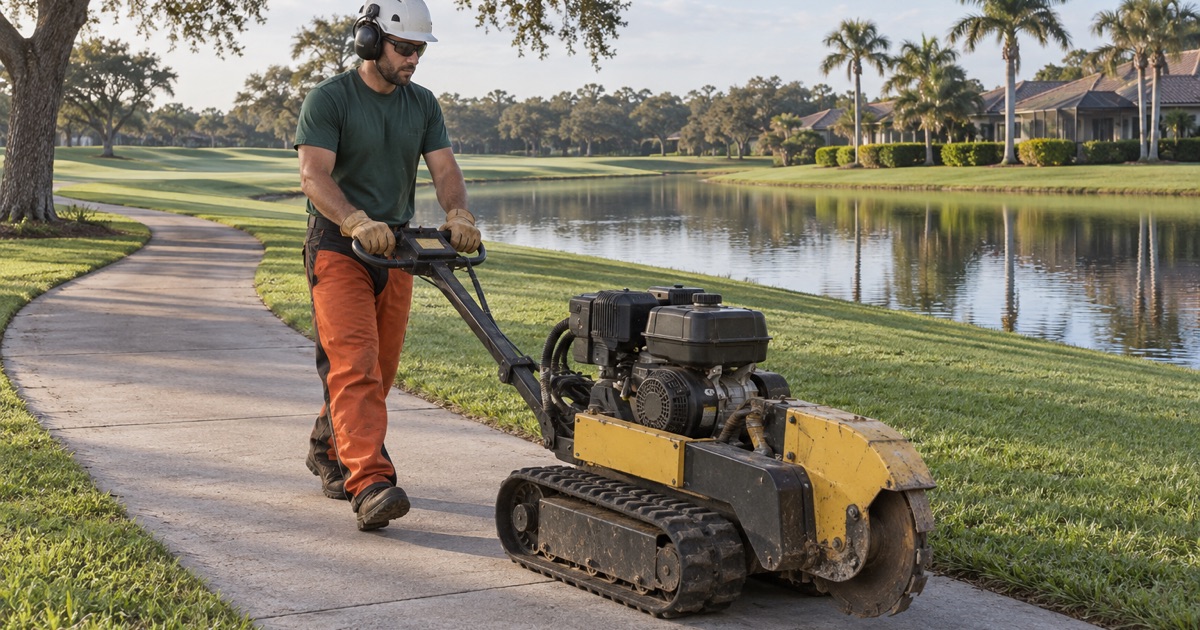
Ordinary curbside yard waste in the unincorporated area is capped at four feet and 40 pounds per piece, with branches, limbs and stumps held under 16 inches in diameter, and unprepared material is left behind. Anything past those limits leaves on our truck. Haul-away and the horticultural waste gate rate at the county’s disposal complex on Knights Trail are itemized on their own line of the quote, because the tipping rate changes at every county line we cross.
Who is actually home when a tree fails
The 2024 five-year American Community Survey puts 932 of this place’s 1,173 vacant units in the seasonal, recreational or occasional-use column, against 2,606 occupied units. Roughly one home in three is not a year-round residence.
That is an operational fact rather than a demographic one. The owner is often out of state on the day a limb comes down, access runs through a neighbor or a property manager, and the hazard on an unoccupied lot still belongs to the owner and is still noticed first by the people next door.
One last thing worth saying plainly. Florida issues no arborist or tree contractor license at all, and Florida Statutes section 163.211 preempts a local government from creating one, so there is no such credential for anyone working on this street to hold. We would rather tell you that than print a word that would mean nothing here.
- 20+ Years on This Coast
- Free Written Estimates
- Dated Condition Reports