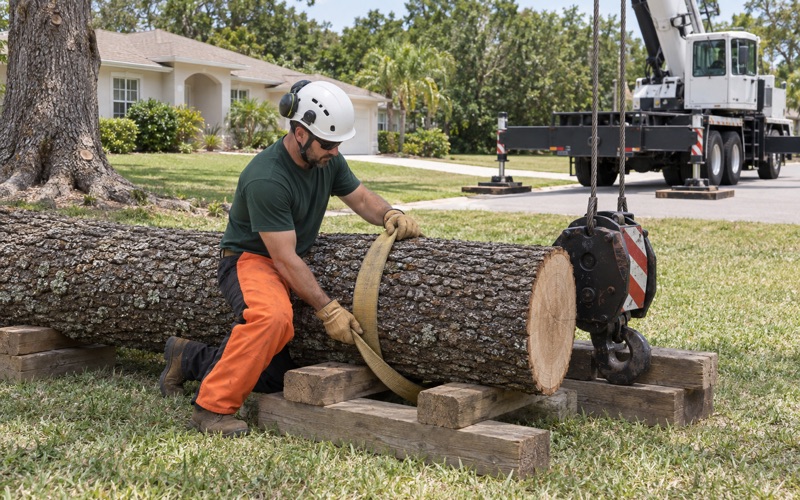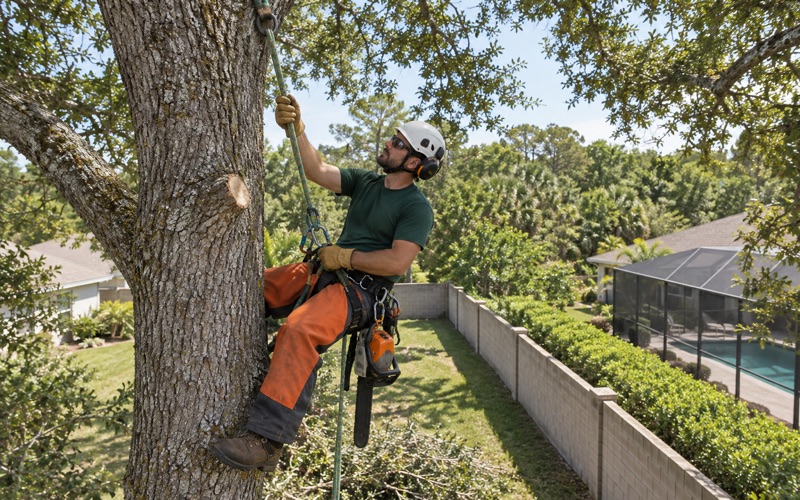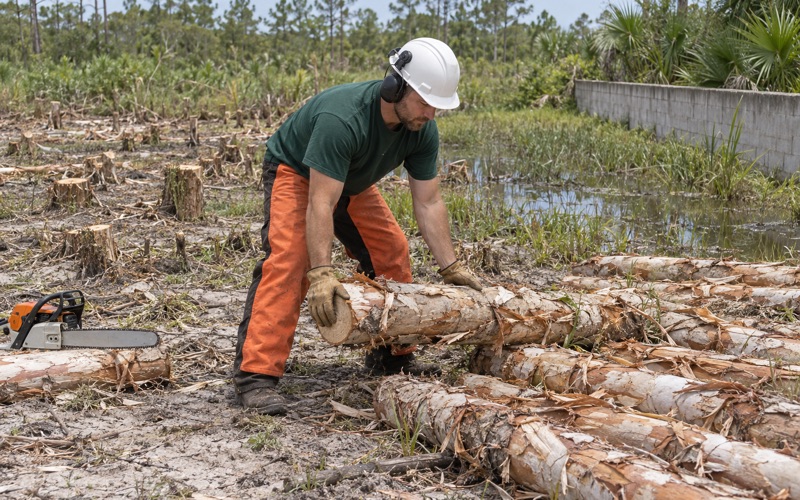
North Port Tree Removal Pros has been handling tree removal in Port Charlotte for more than twenty years, and the job here starts with a tape measure held twelve inches off the ground. That is not a habit of ours. It is how the rule that governs this address is written, and getting it wrong means either filing a permit nobody needed or skipping one the county expected.
Port Charlotte is unincorporated. There is no municipal tree ordinance to look up and no city counter to call, so every tree question at this address is answered by Charlotte County out of the Charlotte County Code. We will tell you which side of the county’s threshold your tree sits on before we put a number on it.
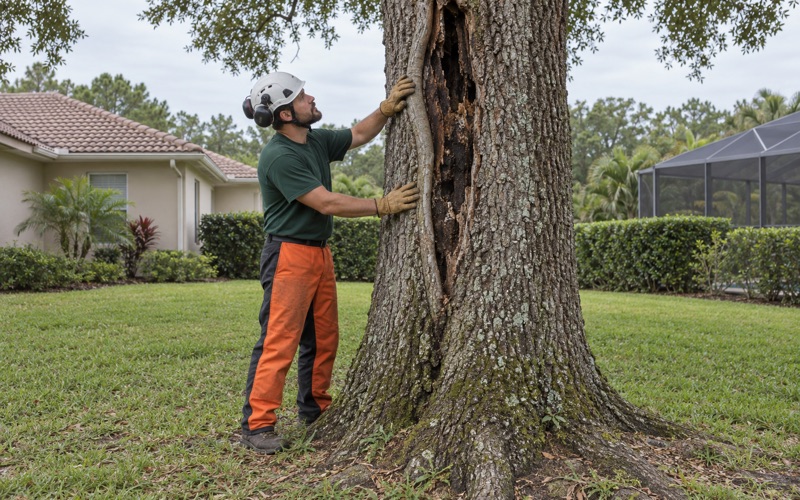
Coming out to look is free, and where we recommend taking a tree down you get a written, dated condition report explaining why, so the reasoning exists before the saw does. Where the answer is pruning, a cable, or leaving the tree alone for another five years, that is what the estimate says instead. Haul-away and gate fees go on their own line, because the tipping rate changes at every county line we cross.
Unincorporated ground, and the county office that actually answers
Port Charlotte is a census-designated place rather than an incorporated one. It has no charter, no commission and no municipal code of its own, which is why there is no local tree ordinance anywhere to find. Land development, trees, vegetation, solid waste, fire and EMS are all county functions here.
The governing text is the Charlotte County Code, Part III, Chapter 3-9 — Sec. 3-9-100, “Buffers, landscaping, and tree requirements,” and Sec. 3-9-100.3, “Tree requirements.” Heritage-tree protection sits at 3-9-100.3(e) and the fee exemptions at 3-9-100.3(h). County handouts still in circulation cite Section 3-2-193 for the same material under an earlier numbering.
The counter is the Charlotte County Community Development Department at 18400 Murdock Circle, 941-743-1964. Barricade inspections are booked separately at 941-743-1204, and anything standing in a right-of-way belongs to Public Works at 941-575-3600.
The two wrong answers we hear constantly
The first is borrowing the rules of Punta Gorda, the incorporated city across the Peace River. It is a separate municipality with its own land development regulations, its own permit counter and its own thresholds, and none of it reaches a Port Charlotte address. A county facility carrying that city’s mailing address — the landfill out on Zemel Road does exactly that — is a postal fact, not a jurisdictional one.
The second is a search error rather than a legal one. Look up a Charlotte tree ordinance or Charlotte yard waste rules and you will also pull documents from a much larger, same-named city in another state. They are internally consistent, confidently written and completely inapplicable. Every county rule quoted here came off a charlottecountyfl.gov document naming Charlotte County, Florida.
A deed restriction is not a permit, in either direction
Charlotte County states plainly that it does not enforce deed restrictions, and that a dispute with an association is a civil matter. Read that both ways. An association’s approval is not a county permit and will not stand in for one, and a county permit does not override your deed.
Looking for tree-removal closer to Plantation? See Tree-Removal Services in Plantation.
Four inches, measured twelve inches from grade
Charlotte County’s published guidance is short and specific: a tree permit is required to remove a tree four inches in diameter or greater, and no permit is required to trim or prune a tree on your own property. The measurement method is where this county parts company with its neighbors. Trees are measured by their caliper, which the county defines as the diameter of the trunk measured twelve inches from grade.
Twelve inches from grade, roughly ankle height, and not the fifty-four inches that diameter at breast height means in most Florida codes. The same tree yields two different numbers, and only one of them is the number Charlotte County asks for.
Why a flared trunk crosses the line here and clears it next door
Trunks are not cylinders. A live oak, a laurel oak or a slash pine with a buttressed base is measurably wider at ankle height than at chest height, and the gap widens with age. A tree that would sit under a four-and-a-half-inch floor measured at breast height in a neighboring jurisdiction can be over the four-inch caliper trigger here without having grown an inch.
So we measure where the county measures and we write the number down. If nothing on the property reaches four caliper inches, the county’s route is a No Tree Affidavit, and it wants a notary signature on it, which catches people out. If something does reach it, the permit is the path, and we would rather establish that with a tape than with an inspector.
Worth knowing before you assume caliper everywhere: the heritage-tree threshold goes back to diameter at breast height. A heritage tree is a cypress, oak or pine at thirty inches DBH, and the prohibition on damaging one is flat. Removal needs the Zoning Official’s authorization, decline can be documented by a certified arborist while structural damage needs a qualified engineer of record, and unreplaced inches are priced at $150.00 per DBH inch into the Native Tree Replacement Fund.
Palms are measured by clear trunk, and the number here is six feet
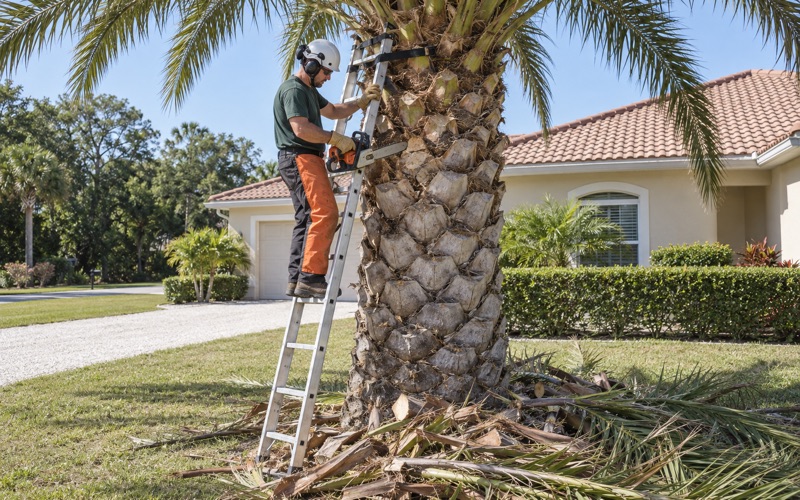
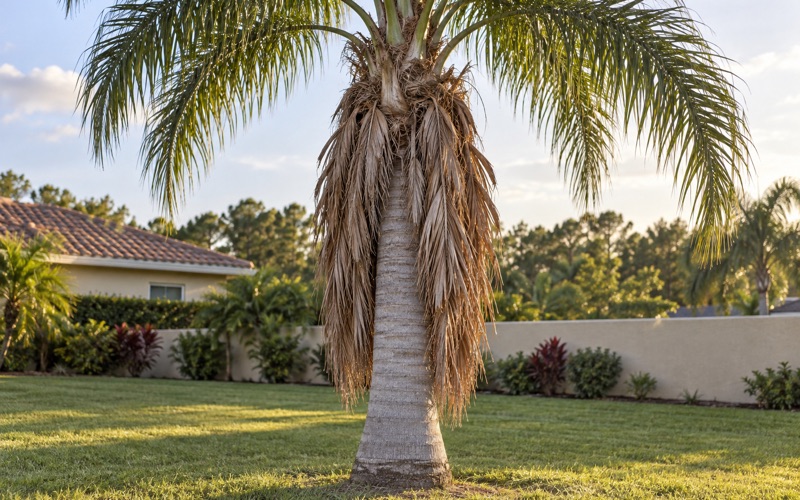
Palms are their own class. A tree removal permit covers trees four inches or greater in diameter and palms with six or more feet of clear trunk, six rather than the four and a half written into the neighboring county’s code. Clear trunk is measured below the fronds, so two palms of the same overall height can land on opposite sides of the trigger depending on how much bare trunk each one carries.
We price palms as palms for the same reason the county measures them separately. One growing point, no branch collar, no compartmentalization of decay, and a trunk that will never put on another inch of diameter. A cabbage palm is a monocot, and neither the removal nor the stump behaves like a hardwood of the same apparent size.
Tree points rather than tree counts, and what that does to a quote
The permit fee has two parts, and the second one is measured. The county publishes a review fee of $70.00 for single-family and duplex sites and $80.00 for commercial and multi-family sites, both plus one dollar per caliper inch removed. Environmental inspections, required for all lot clearing applications, are $55.00, a resubmittal is $50.00, and a review runs anywhere from one day to five days.
Because the removal fee is a dollar per caliper inch, that measurement at twelve inches from grade is not paperwork. It is the price. There is also a Memorandum of Exemption of Fees path for trees meeting the county’s exemption criteria, exotics and trees inside the proposed development footprint or within six feet of it, which exempts them from the per-inch fee only and not from the permit.
Points survive the removal
Compliance is scored in tree points rather than in trees. One tree point is required for every 2,000 square feet of development site, or fraction thereof. The minimum size that counts toward points is two caliper inches with a minimum height of eight feet from grade, citrus trees do not count at all, and the county says the rest of it outright: removal of trees would not exempt a property from meeting the tree point requirement.
That is the line that changes a quote. Taking trees out does not reduce the obligation, so a clearing job can arrive with a planting obligation attached, and preservation is usually the cheaper route where it is available. Preserved trees get barricaded at the drip line before any clearing starts, that barricade gets inspected, and it stays up through construction.
The gate has one rate, and it is not a yard-waste rate
Charlotte County’s published tip fee schedule carries a single in-county line, $39.28 per ton with a $5.00 minimum, and no yard-waste, horticultural, vegetative or clean-wood rate anywhere on it. A chip load and a log load are billed as solid waste at the same rate as household trash. Oversized items, which the county defines as those that cannot be weighed on the landfill scales, are priced per item instead, and that is where a whole-trunk section off a large oak can land.
The gate is the landfill on Zemel Road, across Charlotte Harbor from here. We itemize haul-away and disposal on their own line rather than folding them into one number, because the rate changes the moment a load crosses a county line.
Trimming needs no permit, and the places that stops being true
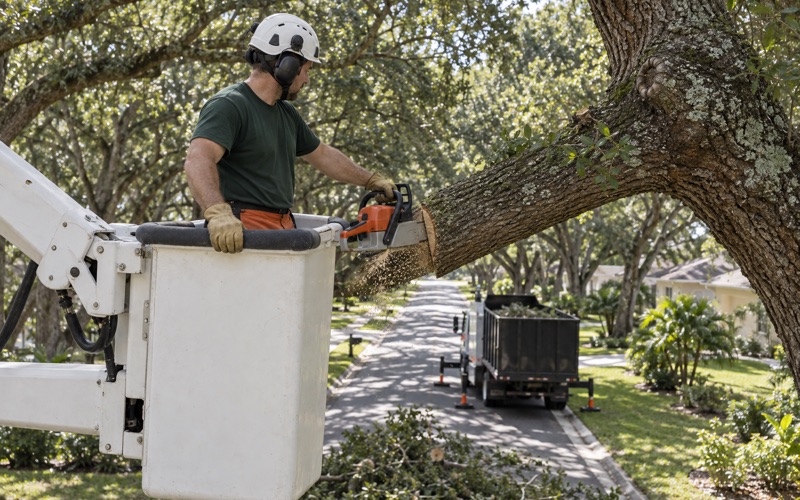
For trees on your own property, no permit is required to trim or prune. The technique is regulated even though the permit is not. All pruning is to be done to standard, and the county’s handouts are blunt about the prohibition: topping and lollipopping are strictly prohibited. The live standard is ANSI A300, and we work to it, with ANSI Z133 governing how the crew works around the drop zone.
That prohibition matches a line we hold regardless. Hurricane cuts, hat racking and topping get refused here, on oaks and on palms, however the job is asked for. A hat-racked oak is a liability with a five-year fuse, and a palm stripped past what it sheds on its own is not tidier, just weaker.
Equipment is its own permit trigger
Independent of the four-inch rule, the county gates the machinery. Hand tools may be used to clean up vegetation without a permit provided no live trees greater than four inches in diameter are removed, while removing trees over four inches, or using machinery greater than a standard lawn mower, requires one. The same language covers invasive vegetation: Brazilian pepper, melaleuca, Australian pine and carrotwood come out by hand without a permit, and under permit once a mulcher is involved.
So two identical-looking lot cleanups sit on opposite sides of a permit line depending on what comes off the trailer. Settle that before a crew arrives with a skid steer.
Storm-felled trees, stumps, and the line at the root system
The storm exemption is unusually clean, and it has two conditions that both have to hold. The tree must have been felled by the storm, already down, and it must be on developed property with existing structures. A leaning, cracked or hung-up tree still standing is not a felled tree, and the ordinary criteria still apply to it. A felled tree on a vacant platted lot is not on developed property either.
The county’s own advice is to document the felled tree before removal, and on a plat with thousands of interspersed vacant lots that photograph is worth taking. We take it as a matter of course.
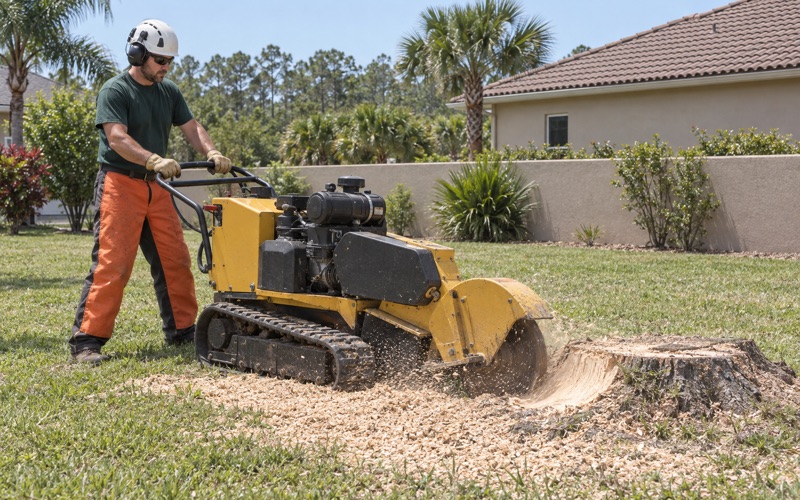
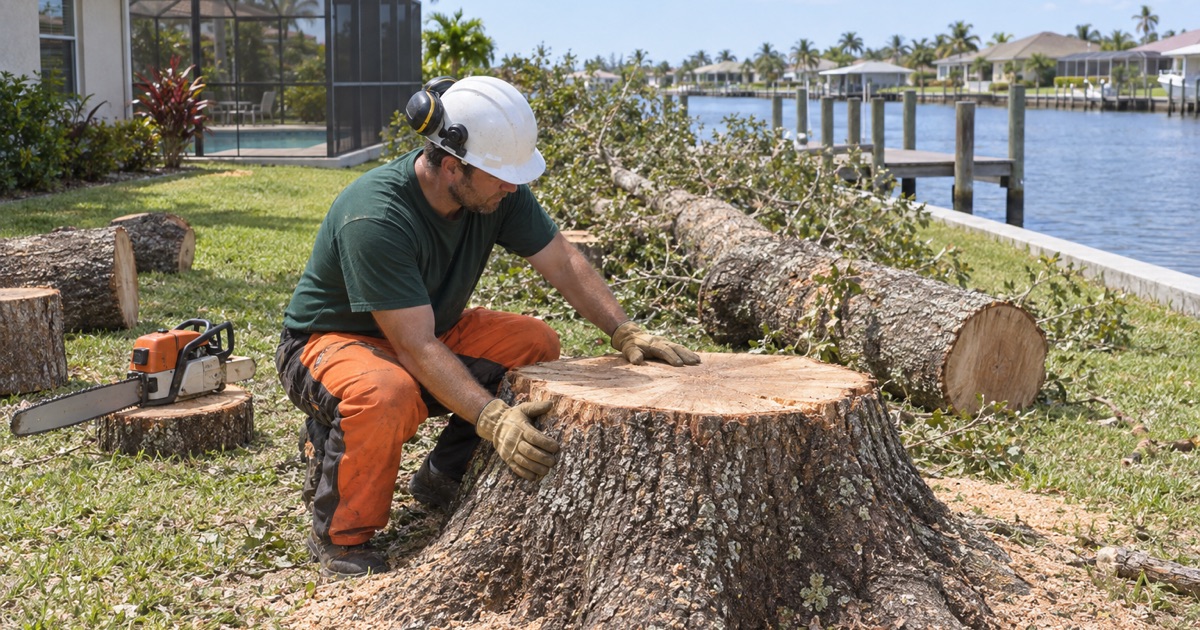
Stumps sit on a line the county has drawn in writing. Mulching is a maintenance activity that stays above the surface and expressly allows stump grinding but not removal of the root system, while speculative clearing involves grubbing and root removal and is prohibited outright. Grinding a stump down is inside the envelope. Excavating it and pulling the root plate is not.
What limits the grinder here is water rather than rock. The soil at this community’s mapped internal point is Pineda fine sand, poorly drained and hydric, with a seasonal high water table around fifteen inches and no hardpan, spodic horizon or limestone anywhere in the twelve to twenty-five inches below grade where a stump grinder’s cut actually works. The wheel loads, spoil will not stack, and a rubber-tired machine ruts. Twenty years on this coast is mostly knowing which weeks that matters.
One last thing about who you hire. Florida preempts local occupational licensing under Florida Statutes section 163.211 and issues no state tree or arborist credential at all, so a word some companies print about tree work here names nothing that exists. What can be verified is general liability and workers’ compensation coverage. Florida Statutes section 163.045 cuts the other way on a single-family detached home: where documentation from an ISA-certified arborist shows a tree presents an unacceptable risk under ISA Best Management Practices, local removal permitting is preempted and no replanting can be required.
- 20+ Years on This Coast
- Free Written Estimates
- Dated Condition Reports