North Port Tree Removal Pros treats tree removal in Punta Gorda as a two-part question, and only the second part has a price attached to it. The city charges nothing for a tree removal permit. What it can ask for afterward is a replacement tree, and that is the line item almost nobody budgets for.
More than two decades of work along this coast has taught us that the shape of that answer is what catches people out. Homeowners brace for a fee at a counter, then get approval at no charge and a planting obligation they never priced.
So our quotes name the approval route for the address, say plainly whether a replacement is in play, and keep haul-away and gate fees on a line of their own. Where we think a tree should stay, that is what the estimate says instead, with the reasoning written and dated either way.
A chartered city that writes its own tree rule
This is not unincorporated ground. Punta Gorda is a chartered city and the seat of Charlotte County, with its own Land Development Regulations, a Planning Commission serving as the local planning agency, its own Zoning Official and its own Development Review Committee. City offices sit at 326 West Marion Avenue.
That distinction does real work. The county tree code most of this coast runs on governs unincorporated county land and stops at the city line, so a quote built on it has answered a different government’s question.
Chapter 26, Article 12, and the office that takes the permit
The governing text is the City of Punta Gorda Code, Chapter 26, the Land Development Regulations, and within it Article 12, Landscaping Standards. Chapter 26 is organized by article and section rather than by a hyphenated municipal number, which is why the citations read as Section 12.3(k), Section 12.14 and Section 12.15, and a hyphenated section number quoted for a city tree question came out of the county’s book instead.
The counter is the City’s Urban Design Division at (941) 575-3372. The City also publishes an online tree removal permit request form, where most residential requests begin.
Twelve inches at breast height, and a different system past the city line
The City states the trigger in its own words: no person shall cut down, destroy, damage, remove or poison any native or approved non-native tree twelve inches or larger in diameter at breast height without an approved tree removal permit, cited to Chapter 26, Section 12.3(k). Breast height means chest level on the stem, not down near the soil.
Charlotte County, outside these limits, measures a trunk far lower on the stem and scores compliance in a point system rather than by counting trees. A crew carrying the city’s twelve-inch figure onto county ground, or the county’s arithmetic onto a city lot, is quoting a rule that does not govern the address.
Looking for tree-removal closer to Venice? See Venice Tree-Removal.
The permit costs nothing, and three stated grounds decide it
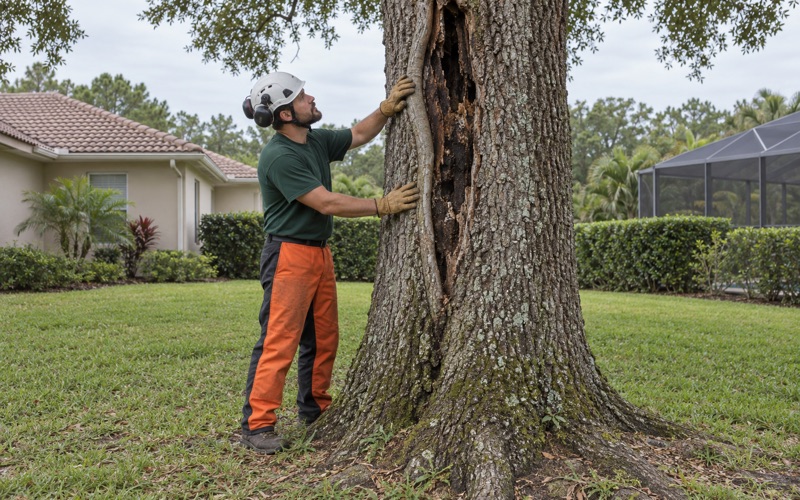
The City publishes that a no-charge tree removal permit may be approved if one or more of three circumstances exist: the tree is a hazard to life or property which cannot be mitigated without removing it, the tree is dying or dead so that restoring it to a sound condition is not practicable, or it has a disease which can be transmitted to other trees. No application fee attaches to any of the three.
Read that list for what it actually is. It is a condition finding rather than a preference, so a healthy tree standing in an inconvenient place satisfies none of it. That is the most common reason a request stalls.
What each ground asks you to show
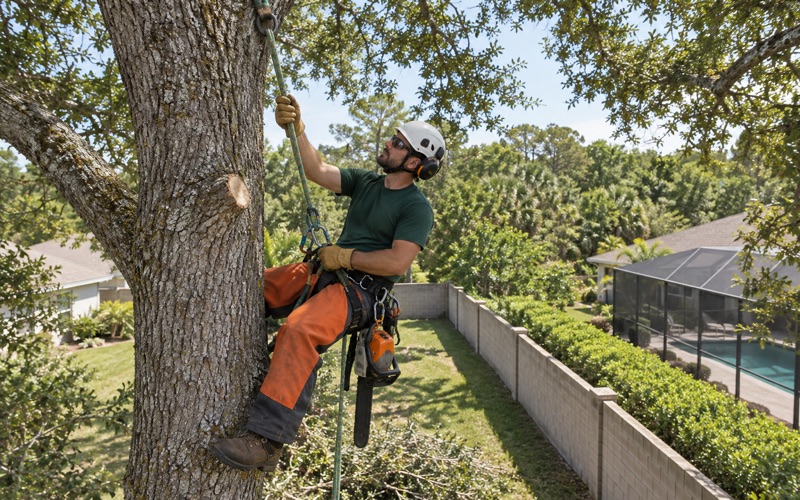
The hazard ground turns on four words: which cannot be mitigated. If the risk comes down far enough with a crown reduction, a cable, or taking the single limb that overhangs the roof, then the tree is not yet a tree that has to go. We quote that work when we see it, because it is the answer the ground itself points toward.
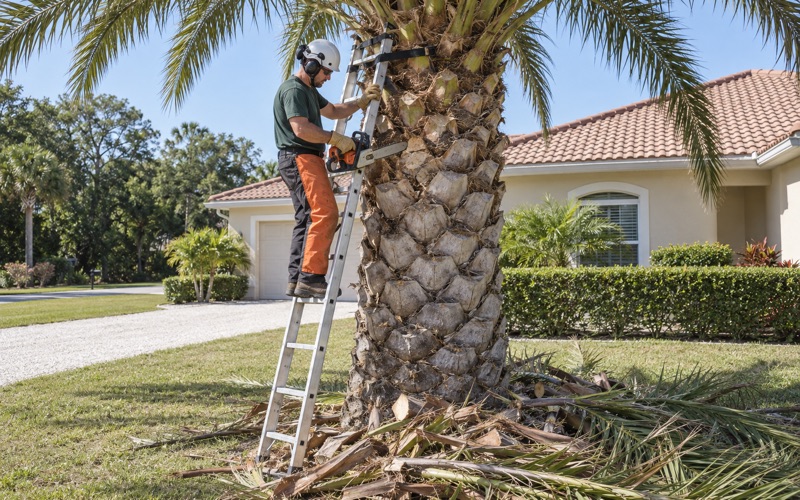
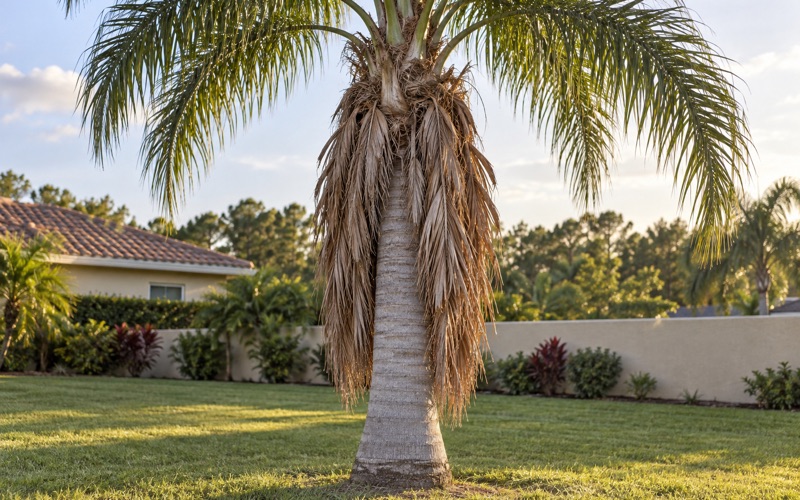
Dying or dead is a judgment about practicable restoration, not about appearance, and a palm answers it differently from an oak. Spear leaf collapse, a lethal bronzing presentation, or Ganoderma butt rot at the base of a cabbage palm are not conditions a palm comes back from, because a palm grows from a single apical bud and cannot compartmentalize decay the way a hardwood does.
The transmissible-disease ground rewards naming the organism. Laurel wilt in a redbay, lethal bronzing in a palm, Thielaviopsis trunk rot at a wound site: these are specific and documentable, and a request that names the pathogen reads differently from one saying the tree looks unwell.
Every removal we recommend carries a written, dated condition report, setting out what we saw, where on the tree we saw it, and why it points at removal rather than at pruning. That report is the substance behind a permit request, and it is produced before anything is cut.
More than three trees leaves the online form behind
The City’s online request form has a stated limit on it. A removal of more than three trees does not use that form and has to go to the Urban Design Division directly. On a lot cleanup or a post-storm job that is a routing decision worth making on the first visit.
Section 12.14 is where the money actually is
The City states that tree replacement shall be required under Chapter 26, Section 12.14 should the removal cause the property to fall below minimum requirements. That is a conditional, and the conditional is what a quote turns on. A property still above the minimum once the tree is gone owes nothing further; a property pushed under it owes planting, and planting into a finished landscape is not cheap.
What the code will and will not accept as replacement stock
Section 12.15 is headed Native and Approved Non-Native Trees and Palms, and it sets a floor in plain terms: trees or palms with a diameter at breast height of less than two and one-half inches and below 10 feet in height, and trees or palms diseased or weakened by age or injury, do not qualify as approved stock for the purpose of replacement. Palms sit in that section alongside trees as a co-equal category, so whether a palm counts as a tree is settled here by the code rather than the botany.
The state route that skips the replanting, and who it reaches
Florida Statutes section 163.045 bars a local government from requiring a notice, application, approval, permit, fee or mitigation to prune, trim or remove a tree on residential property where the owner already holds documentation from an ISA-certified arborist or a Florida licensed landscape architect that the tree poses an unacceptable risk to persons or property. Unacceptable risk is defined: removal must be the only means of practically mitigating the risk below moderate, assessed under the ISA Best Management Practices Tree Risk Assessment, Second Edition, 2017, with the risk categories the Tree Risk Assessment Qualification defines. Subsection (3) then bars a local government from requiring replanting of a tree removed that way.
Three limits decide how much of that lands inside this city. The statute’s residential property is a single-family detached building on a lot actively used for single-family residential purposes, which is 5,732 owner-occupied units here out of 13,756 housing units, and it reaches no condominium, no attached unit, no mobile home and no multifamily building.
It is a risk finding and not a convenience exemption, so it does nothing for a sound tree an owner simply wants gone. The documentation also has to be in the owner’s possession before the work, not assembled afterward. A condition report and that statutory documentation are different instruments with different authors, and we say which of them a job actually relies on.
What the work looks like on a Punta Gorda lot
A canopy tree is not permitted in a waterfront yard
Section 12.15(b), the canopy tree table, carries a restriction in a single line above the species list: not permitted in side yards when less than 20 feet of clearance is available, or yards abutting a waterway. Chapter 26, Section 8.5 adds the companion rule on the water side, allowing a hedge of any height in a rear yard abutting a waterway while permitting no hedge or other vegetation except sod within 6 feet of the seawall.
In a city whose residential canal system reaches Charlotte Harbor and whose seawalls a City Canal Maintenance Division looks after, those two sentences decide what can legally stand on the water side of a great many lots. A removal there is often a code-compliance job rather than a landscaping choice, and the replacement, where one is owed, has to find a home somewhere other than the hole the tree came out of.
A pruning spec written into the zoning code
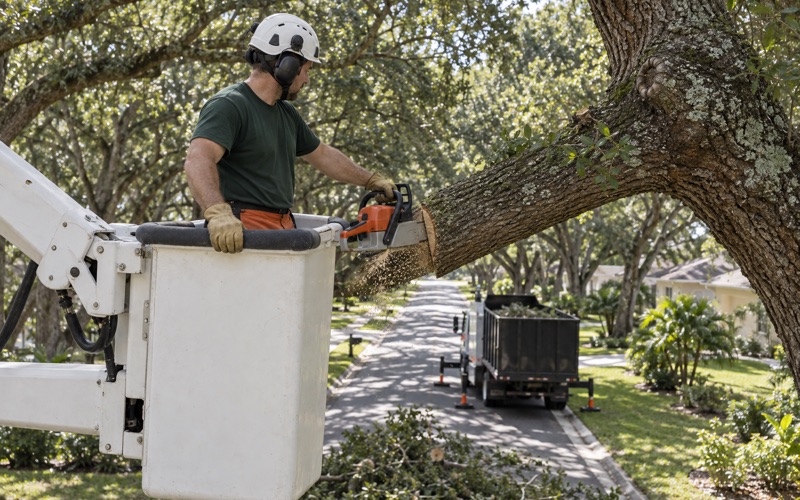
Section 8.5 permits a tree in a visibility triangle provided foliage is cut away between three and eight feet above the average grade of the road, measured at the centerline, and bars multiple trees that impair visibility there at all. None of that is advice, and all of it is enforceable against a tree already standing.
The ground, the grinder and the gate
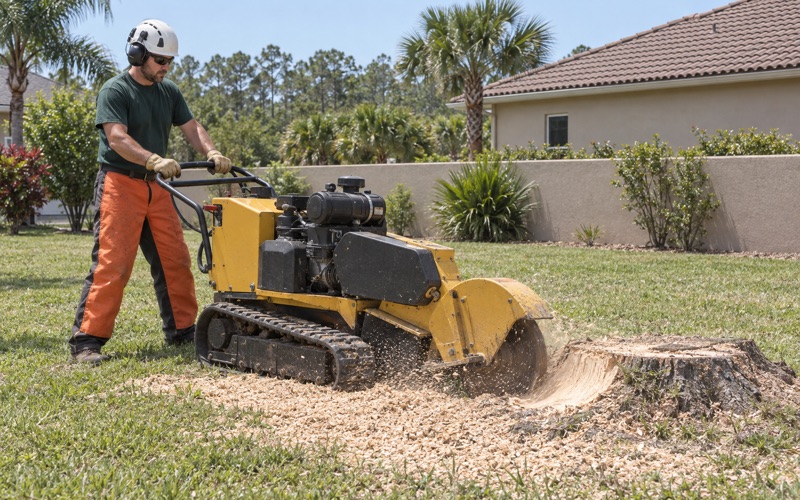
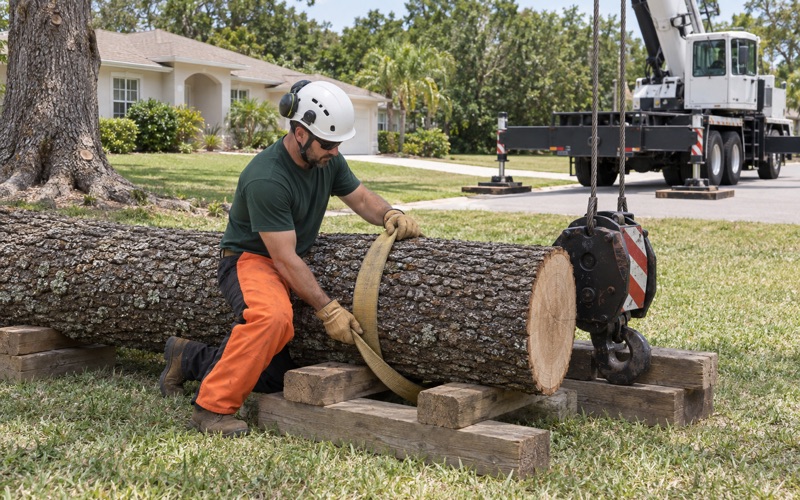
The soil series carrying this county’s name makes its own argument. The USDA description for the Punta series, type location Charlotte County, Florida, puts the cemented spodic layer around 57 inches below grade, three to four times deeper than a stump grinder’s rated cut of 12 to 16 inches, so the hardpan story that holds on other profiles along this coast never enters the job on this one. The constraint here is water instead: the same description records saturation at roughly 6 to 18 inches below the surface for one to three months of the summer rainy season, and at 18 to 40 inches for most of the rest of the year, which is when a grind comes up as slurry. Which series is mapped on a particular parcel is a question about that parcel, and we do not assert one off a map.
Disposal is a county gate, and it publishes no vegetative rate at all. Waste generated in county is posted at $48.90 per ton with a scale usage fee of $11.55, and the schedule carries no separate row for yard trash, brush, land clearing debris or mulch. A grapple load of trunk rounds crosses the scale at the same per-ton price as household garbage, which is exactly why haul-away and gate fees are itemized on their own line instead of folded into the removal price.
Height near the airfield is a zoning question first
Florida Statutes chapter 333 reaches a tree through a single clause: its definition of obstruction covers anything exceeding the federal obstruction standards in 14 CFR Part 77, subpart C, and expressly includes any object of natural growth. Punta Gorda Airport is a commercial-service field run by the Charlotte County Airport Authority, and the county has adopted an airport protection and land use compatibility overlay code whose text and height triggers we have not read at primary grade. So near the airfield we put tree height to the authority before a climber leaves the ground, rather than publishing a threshold we cannot source.
One last thing about hiring. Florida issues no arborist or tree contractor license of any kind, and under Florida Statutes section 163.211 the grandfather window for local occupational licensing closed on July 1, 2025, so neither Charlotte County nor the City of Punta Gorda may create such a credential either. What an owner can verify instead is current general liability and workers’ compensation coverage, plus the standards the work is held to: ANSI A300 for pruning and ANSI Z133 for crew safety. Hurricane cuts, hat racking and topping are refused here on oaks and on palms alike, however the job is asked for.
- 20+ Years on This Coast
- Free Written Estimates
- Dated Condition Reports