North Port Tree Removal Pros has been doing tree removal in Rotonda for more than twenty years, and the first thing we do on a quote here is not measure the tree. It is find out which recorded plat the address sits in, because the answer changes who has to approve the work.
The statistical name for this place is Rotonda, and nobody who lives here uses it. The community is Rotonda West, its association is the Rotonda West Association, and the deed restriction that governs a yard tree is the Amended Restatement of Restrictions for Rotonda West. There is no City of Rotonda, no council and no municipal tree ordinance here at all.
What that leaves is unincorporated Charlotte County and a private covenant sitting on top of the county code, which is why our estimates name both approvals and keep haul-away and disposal on their own line. Anything we recommend taking down carries a written, dated condition report. When the answer is that the tree should stay, we say so and price the pruning or the cabling instead.
The Census Name and the Name on the Deed
Rotonda is a census-designated place rather than a city, a statistical boundary covering a little over ten square miles of the Cape Haze peninsula, with a 2020 population of 10,114, up from 8,759 in 2010. That boundary and the community’s recorded plats are not the same polygon, which is why a jurisdictional question here gets answered out of the Charlotte County Property Appraiser’s parcel record and not out of the place name.
Seven recorded plats, and the ones the covenant never reached
The Amended Restatement of Restrictions for Rotonda West was recorded on November 10, 2020 as Instrument #2871018, at Official Records Book 4659, Pages 1394 and following, in the Public Records of Charlotte County. The original Declaration of Restrictions sits at Official Records Book 767, Page 721.
The instrument names the plats it covers and cites each one: Rotonda Pinehurst, Rotonda Pebble Beach, Rotonda Oakland Hills, Rotonda Pine Valley, Rotonda White Marsh, Rotonda Broadmoor and Rotonda Long Meadow, all in Plat Book 8 of the county’s public records, with a further portion of Oakland Hills at Plat Book 10, Page 3.
Seven plats, and only those seven. The Rotonda prefix is reused across separate platted subdivisions on this peninsula, including Rotonda Lakes, Rotonda Meadows, Rotonda Villas, Rotonda Sands and Rotonda Heights, and each of those carries its own association and its own deed restrictions. A restriction read out of the Rotonda West instrument does not bind a lot in Rotonda Lakes, and telling an owner that it does is the sort of error a neighbor corrects before the crew is off the street.
Why a quote built on the wrong instrument gets caught
Owners here are not casual about the document. Section 30 makes the covenants run with the land, in force for fifty years from January 1, 1970 and then automatically extended in ten-year periods, and Section 35 places enforcement under Chapter 720, Florida Statutes, with fines, injunctive relief, lien filing and attorney’s fees. A recorded encumbrance with a lien behind it is something people have actually read.
It also means our reading is not the one that counts. We name the instrument we believe covers the address and where it is recorded, so the owner can check it against their own closing paperwork.
Looking for tree-removal closer to Punta Gorda? See Tree-Removal Services in Punta Gorda.
Two Approvals Stacked on the Same Tree
Section 6 of the Restrictions states the relationship in a single sentence: ‘In addition to these Restrictions, property usage shall conform to all Ordinances, Resolutions and Rules and Regulations of Charlotte County, Florida, as amended from time to time.’ The covenant sits on top of the county code rather than instead of it, so a job can satisfy one of them and still be in breach of the other.
The committees, and what Section 19 reaches
Approvals run through two named bodies: the New Construction Committee for new dwellings and the Residential Modification Committee for alterations to existing improvements. Section 19 puts vegetation squarely inside that review on the Common Areas. No portion may be cleared of vegetation or in any way altered without prior written Board approval, and no improvement, ‘including but not limited to trees, shrubs, bushes, or other vegetation,’ may be placed there without it either. Replacement planting that spills into Common Area is therefore a covenant question, not only a landscaping choice.
Section 19(f) gives the Association a self-help right to carry out the removal at the adjacent owner’s expense, secured by a lien foreclosed the same way as an assessment lien. Section 16 does something comparable on unimproved lots, naming Brazilian pepper and melaleuca and reserving the right to clear the vegetation and charge the cost back. The effect is that the Association is a buyer of vegetation work here in its own right and not merely a gatekeeper for someone else’s job, so boards and property managers call us about as often as households do.
The county counter underneath the covenant
The county side is a tree removal authorization, required before removing any tree of four caliper inches or greater, or any palm with six feet or more of clear trunk. Caliper is measured twelve inches above grade, which on many species is inside the root flare, so a trunk reading under four inches at chest height can sit over the threshold at the county’s own measuring point. Review for single-family and duplex sites is published at $70.00 plus $1.00 per inch removed, and the county states it takes one to five days.
Trimming a tree on your own property needs no county permit at all. What the county does regulate by name is method: topping and lollipopping are prohibited outright, and trees in the right of way go to the Public Works Department rather than through the tree permit process.
The strip between the lot line and the water
On a canal lot, Section 20 makes the owner finish grade, sod and mow the area between the property line and the water’s edge, to the Association’s published canal-front grade guideline or Charlotte County’s requirements, whichever is more restrictive. The Association keeps the right to remove anything standing in that strip that blocks its own canal maintenance, at the owner’s expense. Mangroves are not a county matter here at all: Charlotte County holds no delegated authority from the Florida Department of Environmental Protection, so trimming or alteration at a Rotonda address is a state permit under the Mangrove Trimming and Preservation Act.
What We Check Before Anything Is Cut
A written, dated condition report
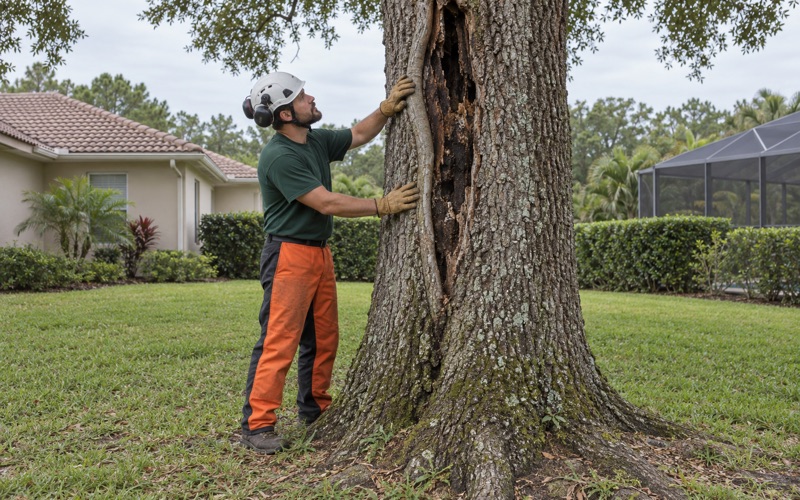
Every removal we recommend comes with a written, dated condition report: what we saw, where on the tree we saw it, and why it leads to removal rather than to pruning. The reasoning exists before the saw does, which earns its keep twice in a deed-restricted community, because a committee reviewing a request is reading a document and an owner approving work from out of state is reading the same one.
Seasonal ownership is a real share of the housing stock here. ACS 2024 five-year figures record 2,209 of 8,120 units held for seasonal, recreational or occasional use, a little over a quarter of everything built, set against a covenant standard that lawns not exceed a height of eight inches including weeds. A tree that failed in a June storm is frequently first seen in November, and a dated report is what lets an absent owner decide without standing under it.
The word Florida does not issue
Florida issues no arborist or tree contractor license of any kind, and Florida Statutes section 163.211 preempts local occupational licensing on top of that. We would rather explain that than print a word that would mean nothing here. What an owner can verify instead is general liability and workers’ compensation coverage, plus the written standards the work is held to, which are ANSI A300 for the pruning specification and ANSI Z133 for crew safety.
One related trap is worth stating plainly. Florida Statutes section 163.045 can preempt a local residential tree removal permit on a single-family detached home where documentation from an ISA-certified arborist or a Florida licensed landscape architect shows the tree presents an unacceptable risk under the ISA Best Management Practices standard.
Our condition report is not that documentation, and we do not let it be mistaken for it. The preemption reaches a local government permit only, so the Association’s approval is untouched by it.
What we will not do to an oak or a palm
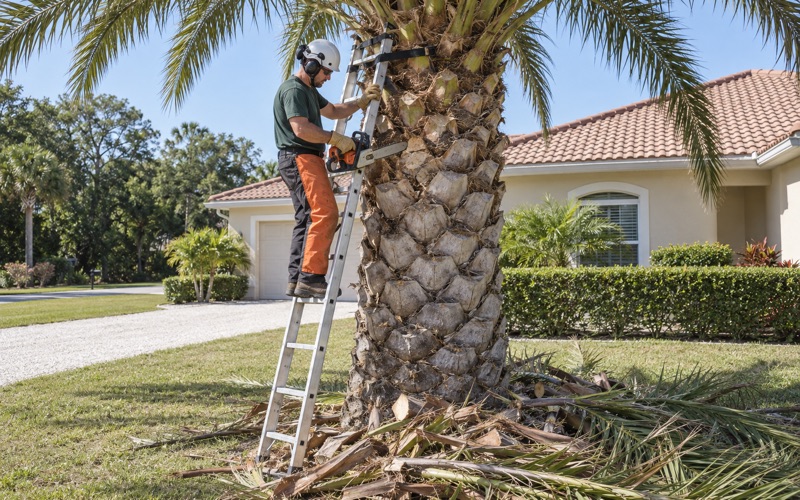
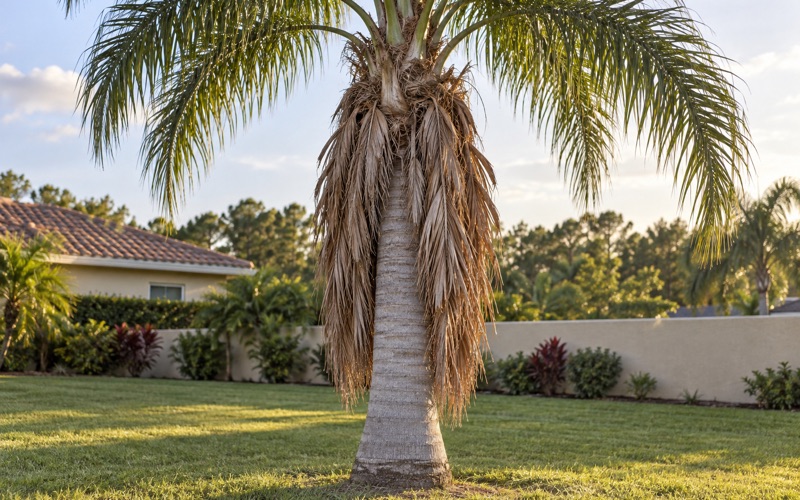
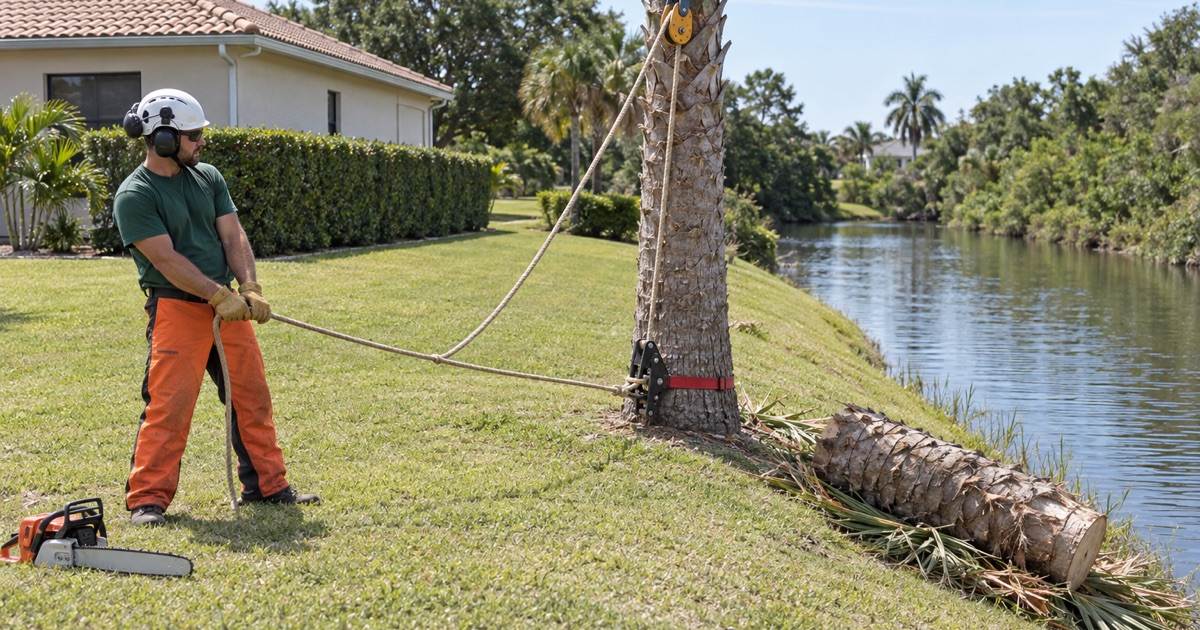
Hurricane cuts, hat racking and topping are refused here however the job is asked for, on oaks and on palms alike. Palms are priced as palms rather than by trunk diameter: one growing point, no branch collar to cut back to, and a trunk that will never put on another inch, so clear trunk feet and access are what the number is built from.
Moving Equipment and Debris on the Wheel
Pie-shaped lots and circular roads
Rotonda West was laid out from 1970 by Cavanagh Communities Corporation on land held as a cattle ranch until 1969, in a wagon-wheel plan: Parade Circle, Rotonda Circle and Boundary Boulevard as concentric rings with radial streets between them, dividing the wheel into eight segments, seven of them named and the eighth left undeveloped. Only 196 of 8,120 housing units predate 1970, so what stands here is a planted landscape roughly five decades old rather than a remnant woodland.
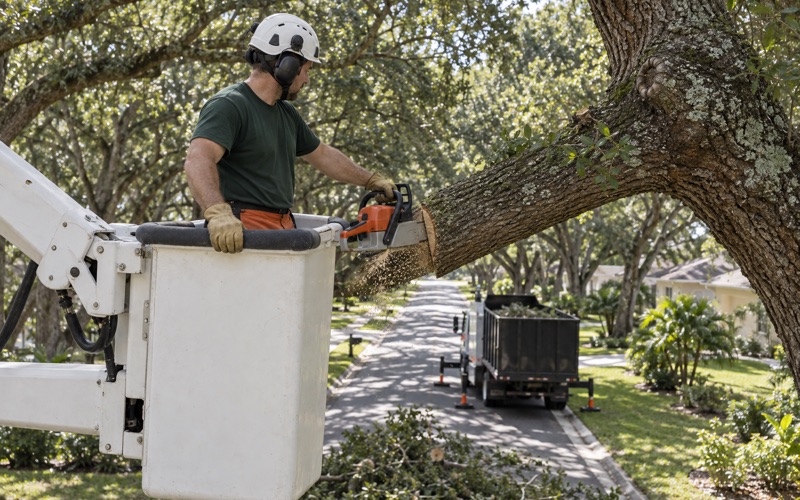
The geometry is an access fact before it is a curiosity. Lots on a circular road are pie-shaped, narrow at the street and wide at the rear, so a bucket set in the driveway works at its shortest reach exactly where the frontage is tightest while the tree sits at the wide back corner. Radial streets meet the rings at acute angles, there is no grid to detour onto when one of them is blocked, and the same road name recurs at different radii, which is why we confirm the segment and the plat before a chipper truck leaves the yard.
Made ground, shell, and the grinder
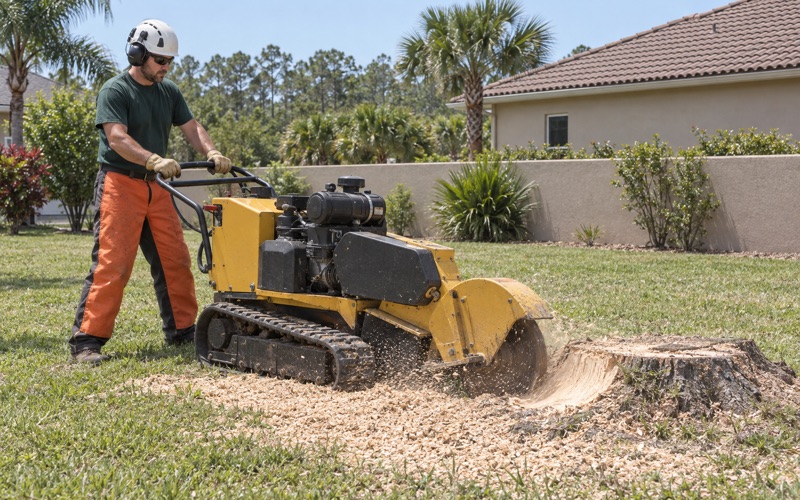
The residential ground inside the wheel is fill. The soil survey maps it as Matlacha gravelly fine sand, classifies it as a human-transported soil and describes it as fills on flats on marine terraces, somewhat poorly drained, with the water table at roughly 18 to 42 inches and no restrictive layer at all. For stump grinding that is an unusual answer on this coast, because nothing stops the wheel at depth.
What the machine does meet is shell and limestone gravel at 15 to 30 percent through the upper horizon. That is a tooth-wear and abrasive-discharge problem rather than a depth limit, the spoil comes out as a sand and shell mix instead of clean sand and chip, and a crew pricing this ground on a flatwoods-sand assumption is under-pricing its own consumables. We price it on what is under the stump.
Where the debris actually goes
Not to the curb. Charlotte County’s residential yard-waste program caps limbs at six feet long and ten inches in diameter with bundles under forty pounds, which is a brush allowance rather than a tree-removal one, and construction debris from home improvement is prohibited outright. Removal material goes to the Zemel Road landfill, where waste generated in county is posted at $48.90 per ton plus an $11.55 scale fee, with no separate vegetative rate published at all, so tree debris pays the general per-ton price despite being bulky and light. Gate hours end early enough that a long job has to be unloading rather than arriving before the cutoff, which is why the haul-away and the gate fee are itemized on their own line of our estimate instead of buried in the removal price.
- 20+ Years on This Coast
- Free Written Estimates
- Dated Condition Reports