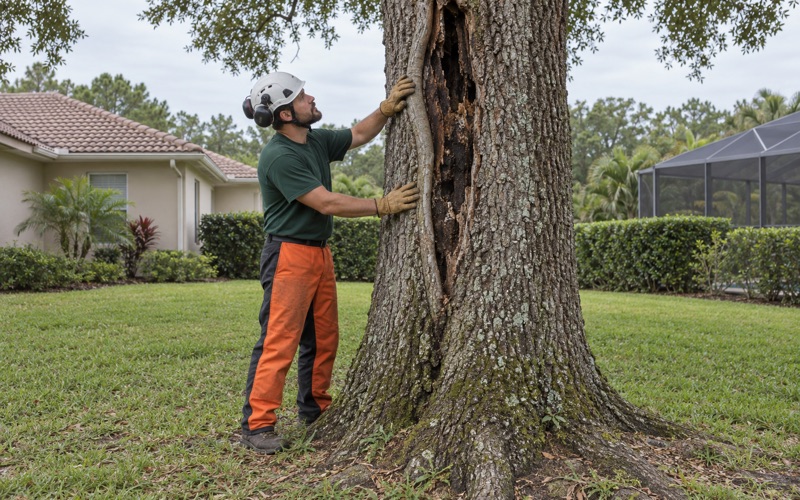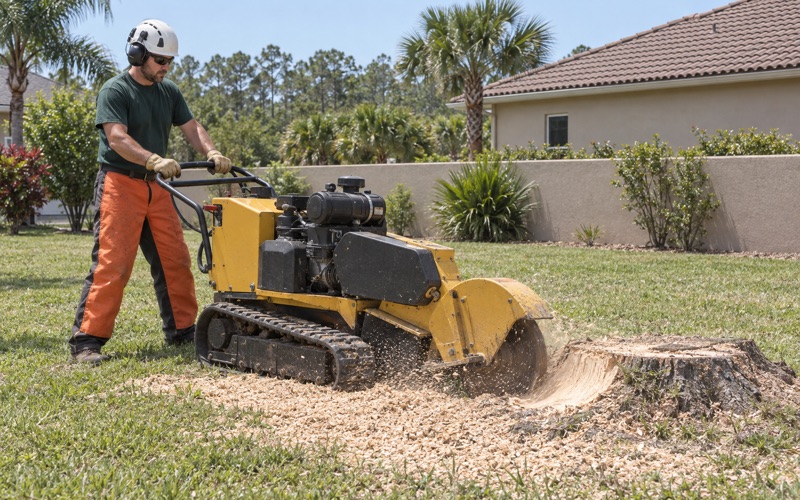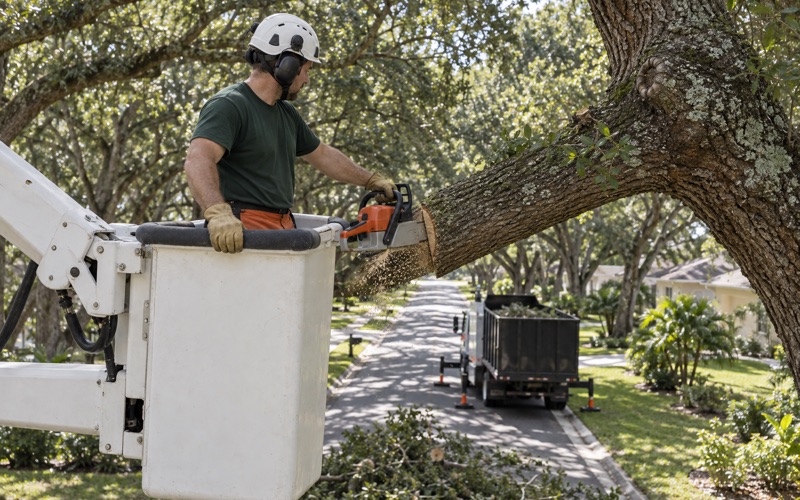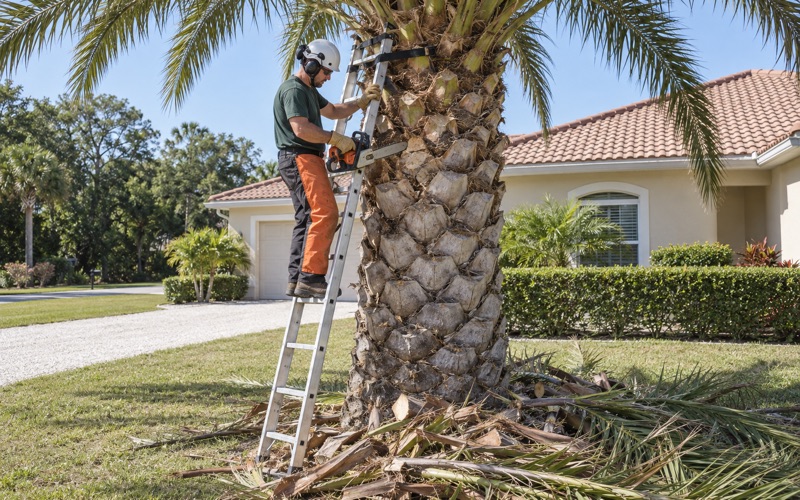
North Port Tree Removal Pros quotes tree removal in Sarasota against the city’s own book, because the county seat writes and enforces its tree rules rather than borrowing anybody else’s. More than twenty years on this coast has taught us that the first question at a city address is not the tree. It is which government gets to measure it.
That answer decides the numbers on an estimate. The trunk diameter that triggers a permit, the amount of bare trunk that makes a palm protected, the species and ratings a large oak is read against, and the desk that signs the approval are all set inside city hall here, and none of them matches what an address a mile outside the line answers to.
Three counties and five separate city halls sit inside the area we cover, so we establish which rule reaches your lot before anything gets measured or priced. Where removal is the right call, our reasoning goes out in writing with a date on it. Where it is not, we say so and quote the pruning or the cabling instead.
The County Seat Permits Its Own Trees, and Not Under County Rules
Sarasota is an incorporated Florida city and the seat of Sarasota County, run by a City Commission and City Manager under its own Home Rule Charter. For tree work, that charter has a specific consequence. Sarasota County’s Land Development Regulations and its tree code govern the unincorporated ring around this city, and neither one reaches inside the city limits for zoning or tree permitting.
The document that does reach a City of Sarasota address is the city’s Zoning Code, 2002 Edition, at Article VII, Division 3.1, Tree Protection, running from Section VII-309 through Section VII-332. The Director of Neighborhood and Development Services administers it, and a City Arborist does the technical review behind it.
Search results do not reflect that split. County material is thorough, confidently written and about the ring outside this city, so an owner can read the wrong thresholds carefully and reach a number that was never going to apply. We check the address against the city boundary first, since half a block changes the answer.
Section II-201, and a Protected Tree the City Defined for Itself
A protected tree here is any self-supporting live woody plant of at least four and one half inches measured at diameter at breast height, of a species with a main stem or cluster of main stems that commonly exceeds ten feet in height and carries an average mature crown spread greater than 15 feet. That is the definition at Section II-201, and it sets a low floor.
Two consequences come out of wording it that way. Trunks an owner would call a young tree are already inside the ordinance, and the test turns on what a species does at maturity rather than on a fixed list, so identification in the yard carries more weight than the tape.
The same sentence does something most tree codes do not, classifying all species of red, white and black mangrove and buttonwood as trees. No city removal permit issues for any of the four unless the state has already permitted the removal or alteration, with a copy of that permit filed alongside the city application. The city holds no delegated mangrove authority, so the state permit comes straight from the Florida Department of Environmental Protection South District, and mangrove work is not work we take on.
Looking for tree-removal closer to Port Charlotte? See Tree-Removal in Port Charlotte.
Eight Feet of Clear Trunk, With No Diameter in It
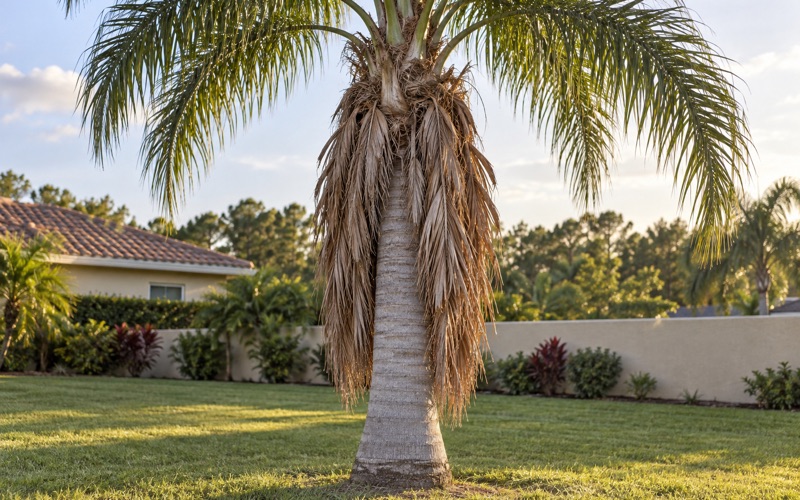
Palms are where this code parts company with the way people assume a tree gets measured. A Sabal palmetto, the cabbage palm, is classified as a tree once it carries more than eight feet of clear trunk, and Serenoa repens, the saw palmetto, once it carries at least four feet. Neither threshold mentions a diameter.
Clear trunk is the bare column standing free below the crown, which is not the palm’s height and not the portion still holding dead fronds. An owner guessing from the driveway tends to be wrong in both directions, and on a cabbage palm the frond skirt is usually what hides the answer. So we take the measurement before saying whether the ordinance is involved at all.
The code also names the palms it expects to find, Queen, Pindo, Reclinata, Date, Coconut, Washingtonia and Royal among them, so a permit question here can attach to something an owner put in as landscaping.
Why a Palm Gets Its Own Line on the Quote
Nothing about a palm behaves like a hardwood. The growing point sits at the very top of the trunk, there is no branch collar anywhere to prune back to, and the trunk will never add another ring of wood. The figure we quote is built out of clear trunk feet, rigging and access instead of a diameter class.
Two requests we decline here are hat racking and topping, however the work is described and whichever species is in the yard. On a palm the objection is anatomical rather than aesthetic, since a single growing point and no reserve of dormant buds leaves nothing to rebuild a crown from.
Grand Trees, Where the Rating Counts as Much as the Tape
Section VII-310 puts a much stronger layer above that floor, and it turns on species, size and condition together. A Live Oak or Sand Live Oak becomes a grand tree at a DBH of 24 inches or greater, a Slash Pine, Longleaf Pine or Southern Red Cedar at 20 inches or greater. Each also needs a City Arborist determination that the tree rates Good or Moderate.
That last requirement runs in the direction owners least expect. A tree rated Poor, which the code describes as carrying significant structural defects that treatment cannot mitigate, is not a grand tree at all regardless of how large it has grown. A declining specimen and a sound one of identical diameter are two different permitting problems.
Removal of a grand tree on public or private property is prohibited unless the Director makes one of four findings: advanced decline verified by a certified arborist or state-registered landscape architect, with a resistograph or similar test unless the tree is obviously dead or diseased; a structure or infrastructure improvement sited where the tree stands, after reasonable relocation efforts; that keeping it would render at least 25 percent of the parking or buildable area unusable; or an imminent safety hazard that removal would mitigate.
A Dated Example Out of the City’s Own File
The Marie Selby Botanical Gardens master plan shows how that review runs in practice. City staff reported the Phase 2 site plan removing 102 of 241 documented trees, 79 of them standing in garden display areas the code exempts as an institutional botanical garden. Seven grand trees came out as well, five of them found in poor condition after Hurricanes Helene and Milton.
The Development Review Committee and the City Arborist passed it before the Planning Board approved it four to nothing on August 7, 2025, with nearly 200 replacement trees planted under the plan. The sequence is the instructive part: findings first, mitigation inside the approval.
The Report We Write, and the One the Rules Ask For
Anything we recommend removing leaves with a written, dated record of what we found and why it points at a saw rather than at a cable or a crown reduction. We are equally careful about what that document is not. The documentation the ordinance and the statute both ask for carries the signature of an ISA-certified arborist or a Florida licensed landscape architect, and getting it is a separate engagement with somebody holding that qualification.
Old Housing, Tower Addresses, and an Exemption Narrower Than It Reads
This is the county’s historic center rather than a postwar subdivision, and the housing table says so. Of 32,324 units counted, 58.4 percent predate 1980, and the single largest decade in that table is 1970 to 1979. The canopy planted alongside that housing is mature now, close to structures, on lots platted narrow.
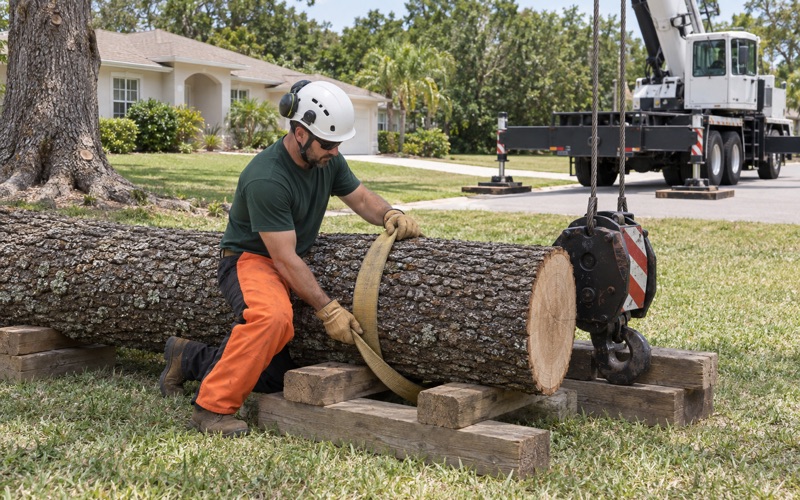
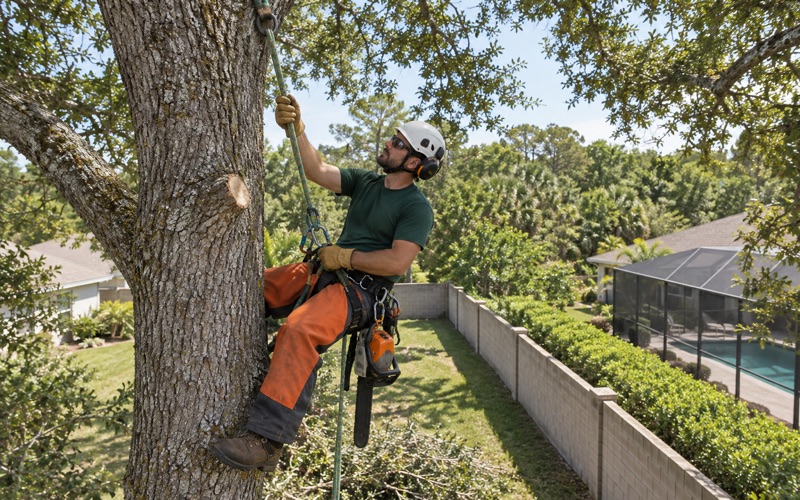
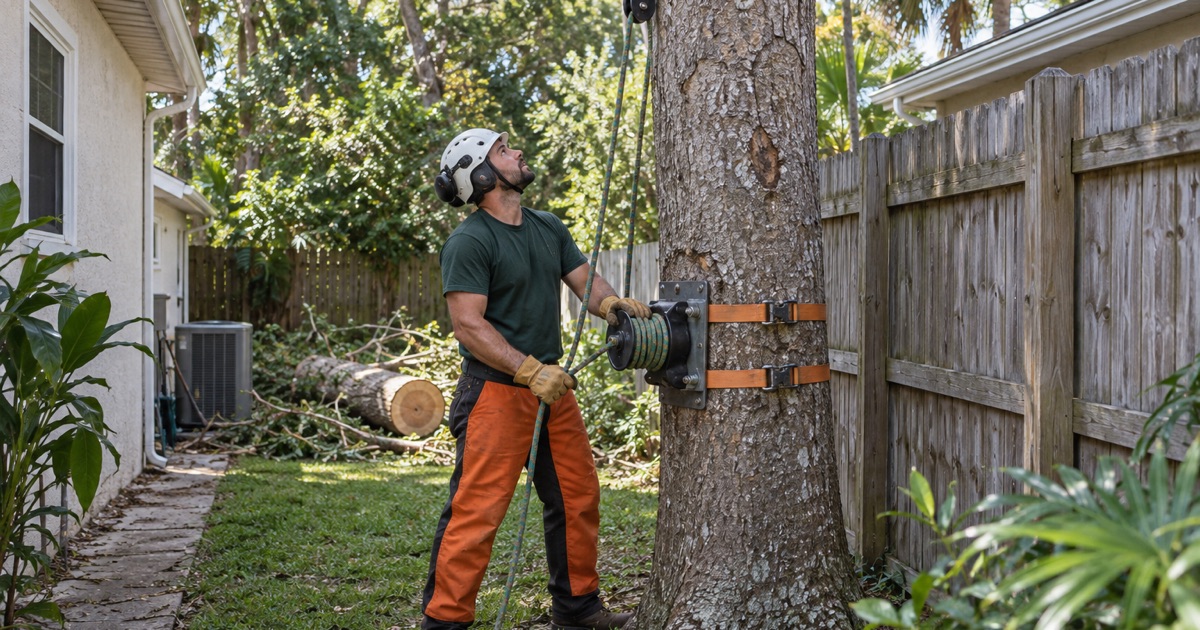
Downtown supplies the other operational half, because a bayfront condominium tower has no yard to drop anything into. Sectional dismantling over a pool deck, a parking structure or somebody else’s roof is a different job from felling the same tree in the open, and access decides the machine: a spider lift through a gate, a grapple saw truck at the curb, or a crane pick where one can be set.
Those frontages also carry a standing duty that has nothing to do with removal. Section VII-313 requires an owner or occupant to keep trees trimmed to 10 feet over a public sidewalk and 14.5 feet over any street or public right-of-way, permit or no permit.
The Subsection the City Has Not Rewritten
This is the detail to get right at a Sarasota address, because a competitor ranking for it has it wrong. The city wrote the state residential exemption into its own ordinance twice, at Section VII-310(e) and again at Section VII-320(1)(n), and both copies say the city requires no notice, application, permit, fee or mitigation where an owner obtains documentation from an ISA-certified arborist or a Florida licensed landscape architect that the tree presents a danger to persons or property.
Those two phrases are the pre-2022 statute. Florida Statutes section 163.045, as amended by chapter 2022-121, Laws of Florida, instead asks whether the owner possesses documentation that the tree poses an unacceptable risk to persons or property, a term the statute defines against the ISA Best Management Practices Tree Risk Assessment Second Edition 2017, where removal is the only practical way to bring the risk below moderate.
The ordinance settles its own conflict in the opening words of that subsection, which apply the exemption notwithstanding the rest of the division and in accordance with State law. The state law being deferred to is the statute as amended, not the sentence frozen in the city’s text. Quoting the stale wording as though it were the operative test is how an owner ends up holding a letter about danger while the statute asks about unacceptable risk.
A citation copied out of the ordinance carries one more hazard, since its own cross-reference to the mangrove act reads 303.9333 where the statutory range is Florida Statutes 403.9321 through 403.9333. The city’s public tree protection page has the opposite gap, covering permit steps, the grand tree definition and orange ribbon marking without mentioning the state exemption at all.
Where the Exemption Stops, and What You Can Verify Instead
The exemption only ever reached a single-family detached building on a lot actively used for single-family residential purposes. Here that is the minority case, since owner-occupied detached housing is about 26.8 percent of the stock, leaving condominiums, apartments, townhomes, duplexes and every commercial or institutional parcel inside the ordinary Division 3.1 permit process whatever letter an owner holds.
What the city does require of the crew is concrete. Section VII-317 requires a contractor pruning, planting, trimming or removing trees inside the city to hold a valid local business tax receipt and current proof of workers’ compensation, public liability and property damage insurance.
Notice what is missing from that list. Florida issues no state license for tree work or arboriculture, and Florida Statutes section 163.211 keeps the city from inventing one, so a company printing that word at a Sarasota homeowner is pointing at nothing. We hold no license and no certification, and we would rather name the written standards the work answers to: ANSI A300 for the pruning specification and ANSI Z133 for how a crew operates around a drop zone.
- 20+ Years on This Coast
- Free Written Estimates
- Dated Condition Reports