North Port Tree Removal Pros prices tree removal in Siesta Key as two different jobs, because the rule that governs a tree here depends on which way the lot faces. Twenty-plus years on this coast have taught us that Gulf frontage and bay frontage on the same narrow island answer to different agencies, under different statutes, with different permits behind them.
For a homeowner that lands in one practical place. The approval that decides your tree may not be a county approval at all, and the county has no power to waive the one sitting above it. A crew that knows only the tree ordinance will quote the wrong process, and on a dune that is an expensive kind of wrong.
So our estimates name the authority that actually signs off at your address, say plainly where we think a tree should stay instead, and keep haul-away and gate charges on their own line rather than buried inside a single number. Anything we recommend taking down gets a written, dated condition report first, so the reasoning exists before the saw does.
The mail reads Sarasota, and the authority is the county
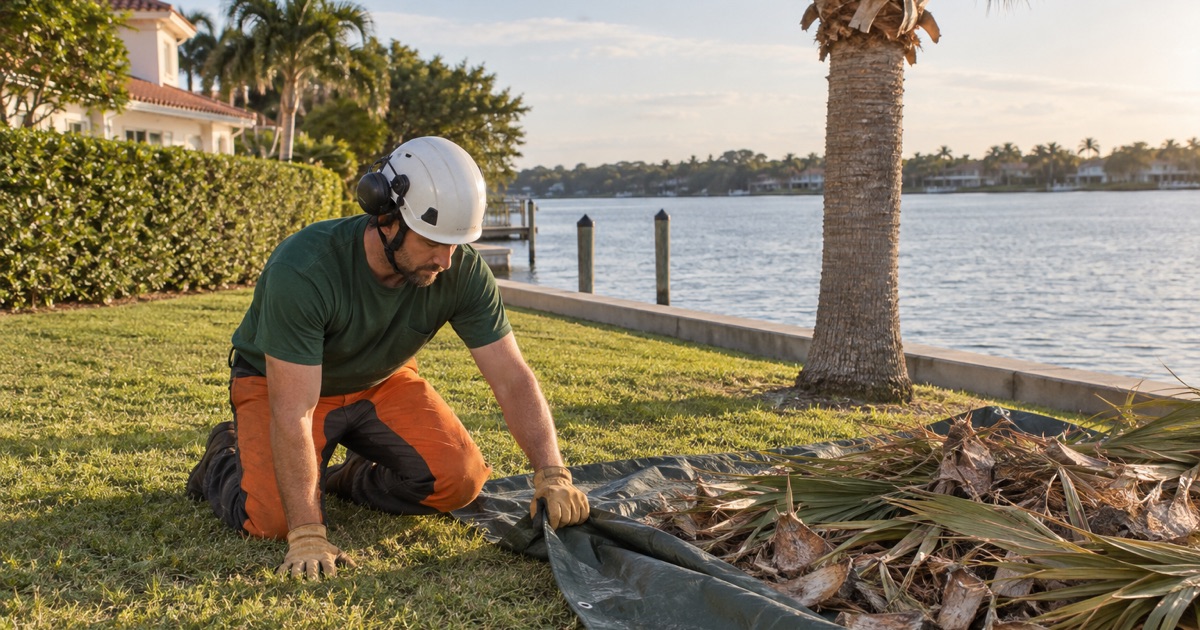
Most of this key is unincorporated, which means there is no island government of any kind: no council, no municipal arborist, no local tree ordinance to look up. A portion of the key does lie within the city boundary of Sarasota, but the majority is a census-designated place that the Sarasota County Board of County Commissioners administers directly. A mailing address out here carries a Sarasota city name for postal purposes, and that is all it carries.
That one fact settles where every question goes. Zoning, land clearing, tree permitting and coastal vegetation are answered out of county offices rather than at a city counter. Our service map covers three counties and five city halls, so working out which of them holds a given address is something we do before we price anything.
Chapter 54, Article XVIII, landward of the lines
Where a lot sits entirely landward of the coastal lines described below, the book that reaches it is Sarasota County’s Chapter 54, Article XVIII. Its permitting criteria sit at Section 54-586, adopted under Ordinance 2008-041, with a species-and-point schedule for Grand Trees at the same section and the exemptions listed at Section 54-585. That is ordinary county tree code, and on much of this island it is not the document that decides the job.
Why the residential exemption is a narrow door here
Florida Statutes section 163.045 is the provision homeowners find first, and statewide it reads broadly. On a single-family detached home actively used as a residence, a local government may not require notice, a permit or a fee where the owner possesses documentation from an ISA-certified arborist or a Florida licensed landscape architect that the tree poses an unacceptable risk to persons or property, judged against the ISA Best Management Practices Tree Risk Assessment Second Edition 2017, and no replanting may be required.
Two things narrow that door on this key. The statute expressly does not apply to specifically delegated mangrove authority, and it does nothing at all about the state dune-vegetation rule seaward of the coastal control line. On an island where most of the land area fronts either the Gulf or the bay, and where owner-occupied detached houses are a minority of the housing stock, it is an exception rather than the usual route.
Florida issues no state arborist or tree contractor license, and Florida Statutes section 163.211 bars local governments from licensing the trade, so there is no license for a tree company here to print. We hold no credential of any kind, we do not write the arborist risk documentation that statute calls for, and obtaining it is a separate engagement with somebody who holds the qualification.
Looking for tree-removal closer to Kensington Park? See Kensington Park Tree-Removal.
Where the county code stops and a state vegetation rule takes over
A property with any portion seaward of the state Coastal Construction Control Line is not governed by the county tree ordinance alone. Florida Statutes section 161.053(2)(a) bars any person, firm, corporation or government agency from damaging sand dunes or the vegetation growing on them seaward of a control line without a permit from the Florida Department of Environmental Protection, and the department’s own control line rules, Florida Administrative Code Chapter 62B-33, implement it. That regime runs independently of the county article, and above it.
The consequence is an order of operations. The first question at a Gulf-front address is not what the tree is or how thick it has grown, it is where the control line crosses the lot, because that answer decides which agency is involved and whether the work is permittable at all. Nobody settles it from the driveway, and where a lot’s position is unclear we say so and route the question to the county rather than guessing.
Three lines drawn across the same Gulf-front lot
The state line is not the only one out there. Sarasota County’s Land Development Regulations in Chapter 74 add a county Gulf Beach setback line and a Barrier Island Pass Twenty Year Hazard Line, and a development plan touching land seaward of them has to depict all three. A lot that used land seaward of those lines to satisfy its minimum area must still hold adequate buildable area landward of them.
The bay side is a separate program again
The eastern, Intracoastal shoreline of this key is a different regulatory picture from the Gulf beach entirely. Mangroves there fall under the Mangrove Trimming and Preservation Act, Florida Statutes sections 403.9321 to 403.9333, which Sarasota County has administered under a delegation from the department since 2017, so for an unincorporated address here the county rather than the state holds that file.
The act routes trimming and alteration to a professional mangrove trimmer as it defines one, working under its own permit structure. We hold no such designation, we do not trim or remove mangroves, and we say so on site rather than quoting work we are not the right party to perform. The residential exemption is no help here either, because it carves delegated mangrove authority out expressly: an arborist’s risk letter clears nothing on a mangrove.
Sea oats and sea grapes, protected by species name
Beyond the general dune rule, Florida Statutes section 161.242 adds protection naming two plants outright: sea oats, Uniola paniculata, and sea grapes, Coccoloba uvifera. On a frontal dune those are frequently the only things growing, and they are also the plants a homeowner is most likely to read as overgrown landscaping rather than as regulated vegetation.
The department’s Dune Plant Maintenance Guidelines, issued in March 2022, draw the line between maintenance and damage rather than between small work and large. Trimming, shearing, pruning, dead heading and other accepted horticultural practices do not damage native dune plants and need no control line permit. Damage means a material reduction in a plant’s health from trampling, crushing, chopping, breaking, digging up or excessive cutting of roots, stems, trunks, branches or leaves. Excessive cutting is measured against published standards, ANSI A300 Part 1 among them, which is what our pruning specifications are written to anyway.
The sea grape carve-out, and what it does not allow
Sea grape earns a named mention in the department’s own guidance, which notes that certain coastal plants adapted to recover from storm-force breakage, sea grape among them, tolerate heavy pruning or coppicing. That is a genuine difference from how we would treat a less storm-adapted species. It is not permission to take one out, because outright removal, or cutting that crosses into damage, still needs a permit.
Maintenance aimed at ornamental or introduced non-native species is exempt as well under section 161.053(11)(c)2, provided it damages no native beach-dune vegetation and involves no excavation. Brazilian pepper on a dune edge and a sea grape two steps away are therefore not the same job, and we quote them differently.
Sea turtles set the calendar for equipment
Work seaward of the control line carries a second obligation that has nothing to do with trees. Removing beachfront vegetation increases artificial light reaching the sand, which draws and disorients hatchling sea turtles, so maintenance that increases beach lighting has to comply with the Marine Turtle Protection Act at Florida Statutes section 379.2431, enforced by the Florida Fish and Wildlife Conservation Commission.
The guidance reaches our equipment directly as well. Operating, transporting or storing skid steers, cherry pickers and similar machines on the beach or frontal dune must be scheduled outside nesting season, or coordinated with control line and commission staff if proposed during it, which can mean engaging a state permitted biologist. That is a scheduling constraint rather than paperwork, and it is why a Gulf-front job here gets booked around a season.
What salt, saturated sand and one island road change about the work
The buffer that keeps salt off the oaks
The department’s own zone diagram repays a homeowner’s attention here. A typical beach-dune system runs from a pioneer zone at the water, where sea oats, sea grape, beach elder and bitter panicum colonize the sand, through a low scrub zone of saw palmetto, inkberry and yaupon, to a forest zone further inland where live oak, red bay and cabbage palm grow protected from salt spray by everything seaward of them.
That last clause is a service condition, not botany. When a storm or an unauthorized clearing strips the pioneer and scrub vegetation off a lot, the forest-zone trees behind it begin taking salt exposure they were never adapted to, and the decline tends to show months later rather than that week. We plan follow-up visits on that basis after any beachfront vegetation loss.
This island is not hypothetical about storms. The National Hurricane Center recorded the eye of Hurricane Milton making landfall near Siesta Key in Sarasota County on the evening of October 9, 2024, as an extremely dangerous Category 3 hurricane with maximum sustained winds of 120 mph. The regional post-storm report carries no canopy-loss figure, so we quote none.
What follows a storm is usually a request for a hurricane cut. We do not do them, on oaks or on palms, and we will not hat rack or top a tree however the work is described to us. Where a tree can be kept we quote the pruning, or cabling and bracing, and say why.
Saturated sand, and what actually stops a grinder
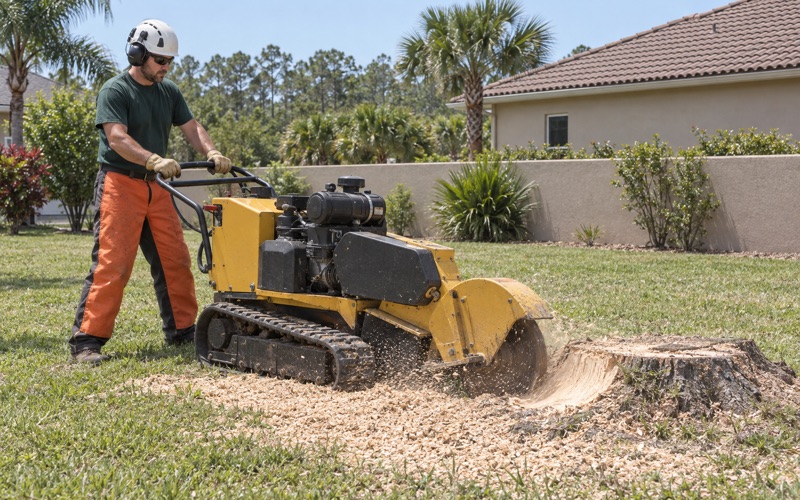
Inland in this county the thing that stops a stump grinder is a spodic hardpan under flatwoods soils like Myakka and EauGallie fine sand. On this island the soil survey returns Pompano fine sand, depressional, a very poorly drained hydric sand with no clay or organic hardpan layer anywhere in the profile. The binding constraint out here is water instead: a seasonal high water table within 12 inches of the surface for part of most years, and ponding in the depressional phase. Wet sand loads a grinder differently and the spoil is heavier to move, which is what changes the price of a below-grade cut here.
Getting equipment onto the key, and the wood off it
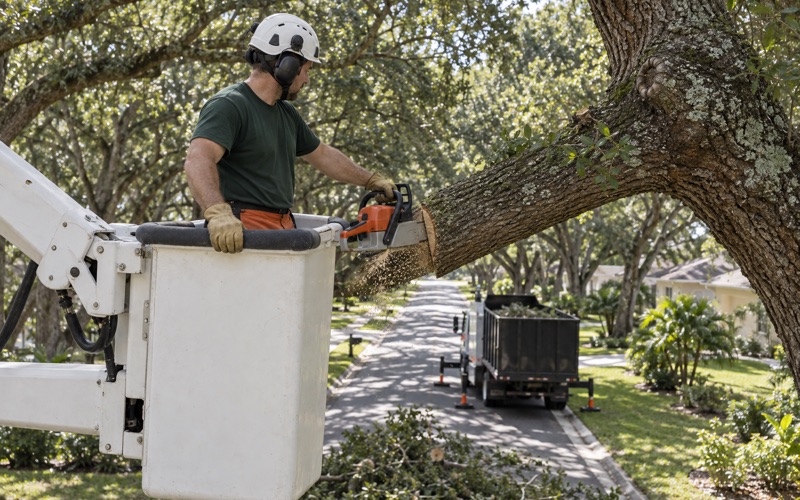
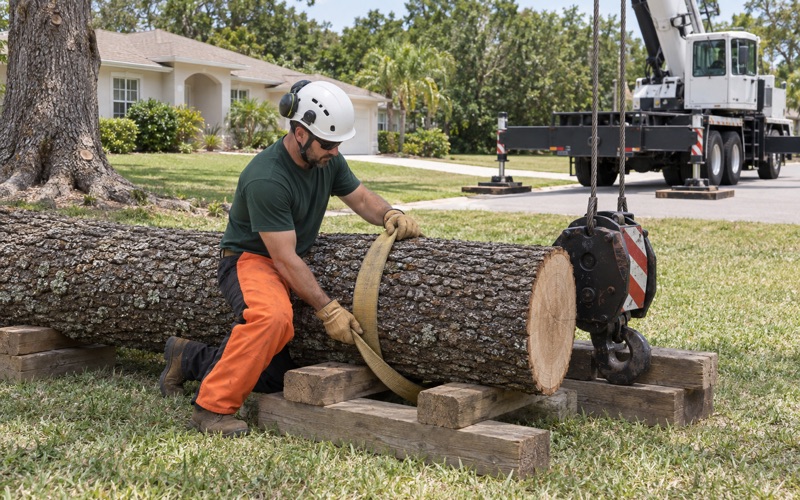
Access has been this island’s constant since development began under the Siesta Land Company in 1907. A single bridge reached the mainland from 1917, a second was added at the south end in 1927, and that is still the shape of it. Narrow beach-road frontage, tight drives and limited staging mean the right machine is often a spider lift or a grapple saw truck rather than the biggest thing we own.
Debris is the other half of the quote. Haul-away and gate fees sit on their own line because the tipping rate changes at every county line we cross, and an island address adds travel an inland one does not. FPL also states that it is the customer’s responsibility to have trees within 10 feet of a power line trimmed by a qualified tree trimmer, which out here is often the exact tree the conversation started with.
- 20+ Years on This Coast
- Free Written Estimates
- Dated Condition Reports