North Port Tree Removal Pros handles tree removal in Venice under the city’s own tree chapter, which is not the book that governed this ground when we started working this coast more than twenty years ago. Permitting authority here changed hands, on a date the ordinance itself names. A crew that never noticed is quoting from a rule set that stopped applying.
The change matters in four practical places: which office answers the question, what trunk diameter triggers a permit, how much bare trunk makes a palm protected, and whether a tree in the yard carries a designation that takes the decision out of the owner’s hands. All four are settled inside city hall now, and very little of what a search returns for this address reflects that.
Five city halls and three county governments sit inside the area we cover, so we fix the jurisdiction before the measurements. Where we recommend removal, the reasoning goes out written and dated ahead of the work. Where a tree should stay, we price the pruning or the cabling and say that instead.
Venice Took Its Tree Permitting Back From the County in 2020
Ordinance 2019-29 is unusual in that it explains itself. Its background section states, “Prior to the enactment of these regulations, all tree permitting and enforcement within the city was administered and enforced by Sarasota County through interlocal agreement and incorporation by reference of Sarasota County Ordinance 83-44, as amended.” The next section is just as plain: “the city is enacting its own permitting regulations for the preservation, protection and replacement of trees in the city.” Section 5 of the ordinance sets the switch, taking effect on January 1, 2020.
What the Council Actually Decided
The recitals put the reasoning on the record. Council determined that the regulations to implement tree preservation, protection and replacement should be city regulations, administered by the city.
So the chapter that reaches a Venice address today is the city’s own: Chapter 118, Tree Preservation, Protection, and Replacement, in the Land Development Regulations. Tree and vegetation questions at a city address are answered by city staff, not at a county environmental permitting counter.
Why a Page About County Tree Permits Is Describing Your Address in the Past
The county’s own tree article says where it stops. Its jurisdiction provision reads that the article “shall be effective throughout the unincorporated area of Sarasota County, Florida,” and that it reaches an incorporated municipality only “to the extent that those municipalities adopt the same provisions and provide by interlocal agreement for enforcement by the County.” Venice ended exactly that arrangement when it adopted its own chapter.
Our test is short. If a document routes a Venice address to a county permitting office, it is describing the arrangement that closed, and the thresholds it quotes are not the ones your tree will be measured against.
Looking for tree-removal closer to Nokomis? See Tree-Removal in Nokomis.
What the City Counts as a Protected Tree
The floor in Chapter 118 sits lower than most owners expect. It is also written in two different units, depending on the kind of tree.
Four Inches, and the Carve-Out for Invasives
A protected tree under the city’s definitions is any tree over four inches in diameter at breast height, unless the species is invasive. Four inches is a small tree, and the floor catches trunks an owner would call a sapling.
The invasive carve-out is where species identification earns its money, because that exemption turns on what the tree is rather than on how big it got. Brazilian pepper, melaleuca, Australian pine, carrotwood and earleaf acacia are the ones we pull out of yards on this coast, and a volunteer from that group in a hedge line is a different permitting question from a laurel oak of the same diameter. We settle the identification before anyone argues about the tape.
Six Feet of Clear Trunk on a Sabal Palm
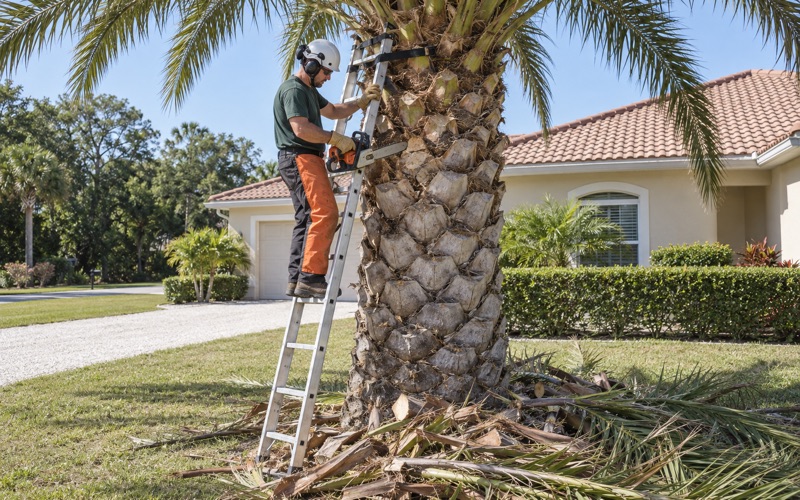
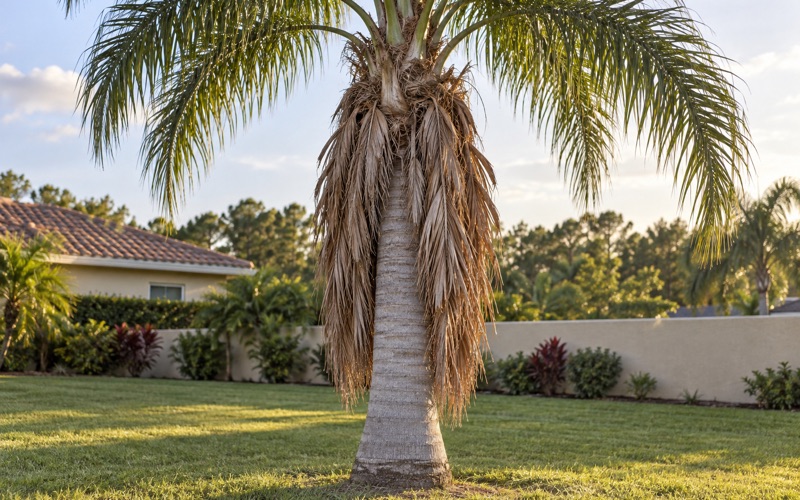
Palms are not measured by diameter here at all. A sabal palm carrying at least six feet of clear trunk is a protected tree inside the city, and clear trunk means the bare trunk below the fronds rather than overall height. Height tells you little about it: a self-cleaning palm that drops its old fronds can show six feet of bare trunk while a taller one still wearing a frond skirt does not.
That measurement is also why we quote palms as their own category. A palm has a single growing point, no branch collar anywhere on it, and a trunk already at the diameter it will die at, so the rigging, the cut and the stump all behave unlike a hardwood of similar size. Clear trunk feet is the figure the ordinance asks for, and it is the figure our estimate carries.
The Two Categories the Chapter Hands to the State
Venice includes what locals call Venice Island, a portion of the mainland reached by bridges over the artificially created Intracoastal Waterway, and on that frontage the question is often mangroves rather than trees. Chapter 118 routes them out of itself, to the state Mangrove Trimming and Preservation Act, and sends seagrape work waterward of the coastal construction setback to the Beach and Shore Preservation Act.
The state’s roster of governments delegated mangrove trimming authority names seven jurisdictions and this city is not one, and the county’s delegation stops at its unincorporated area, so a mangrove job at a Venice address is no city or county tree permit at all.
Heritage Trees, and the Registry the Council Writes
Two categories sit above the four-inch floor and they work in opposite directions. One is measured with a tape and the other is voted on.
Thirty Inches on a Single Trunk, Forty-Five Across Several
The city defines a heritage tree as any native tree at thirty inches in diameter at breast height on a single trunk, or forty-five inches multi-trunk, where the city arborist determines it carries the characteristics the chapter sets out. The definition also reaches any tree designated a Florida State, United States or World Champion by the Florida Forest Service or the American Forestry Association.
Two details there do real work. The multi-trunk threshold is the higher one, which matters on laurel oaks with co-dominant stems and included bark, because the figure the chapter wants is not the one an owner would take off the largest stem. And the native requirement means a large exotic can stand well past thirty inches without being a heritage tree.
A Venetian Tree Is Designated, Not Discovered
The city’s other category has no measurement in it at all. A Venetian Tree is defined as a tree of a native or non-native species that has significance, desirability, or utility to the community, nominated by the property owner, designated by City Council, and placed on a registry the city arborist maintains.
That sequence is the whole point, and it is the thing we will not guess at. A tree does not become a Venetian Tree by being old, large or locally admired, and none is one until the council has acted and the registry shows it. We check the registry for the address rather than telling an owner what their tree probably is, in either direction.
The two categories are also separate. A heritage tree is not automatically on the registry, and a registered tree need not meet the heritage diameters, which is why a tape reading and a registry search are two different findings on one site visit.
What Either Designation Changes in Your Own Yard
The Half-Acre Exemption, and What It Never Reaches
Chapter 118 exempts residential zoned lots from the permit requirement in only two situations: where the work is done pursuant to Florida Statutes section 163.045, or where the lot is single-family zoned and a half acre or less. Most city lots clear that second branch on size alone, so the exemption is the first thing we check.
Then come the carve-outs, and on this page they are the point. Heritage trees, Venetian Trees and trees in the Canopy Road Protection Zone are not exempt under the small-lot branch unless the state statute itself applies, and trees in conservation areas or easements are never exempt under either branch. An owner on a larger lot, or one whose registered or heritage tree does not meet the statute’s own risk-documentation test, still needs a city permit for an otherwise ordinary removal.
The chapter also updates itself, providing that where it refers to another statute or rule it means the most current version, renumbering and amendments included. Ordinance 2019-29 predates both the narrowing of Florida Statutes section 163.045 to single-family detached buildings and the substitution of the ISA Best Management Practices unacceptable-risk standard for the older danger language, so neither limit is printed in the chapter and both reach through it anyway.
The protection zone in that carve-out list carries the lowest trimming threshold in the chapter: a branch larger than two inches on a tree whose trunk sits inside the zone needs a permit and certified-arborist supervision, and the zone reaches up to fifteen feet from the right-of-way onto private property. Council designates those roads by resolution, so we verify rather than assume.
Pruning a Designated Tree, and the Paper a Removal Needs
Pruning crosses into permit territory at a stated size. A permit is required for pruning a designated heritage or Venetian tree branch ten inches in diameter or larger, measured twelve inches from the branch union, and the chapter ties the work to ANSI A300 with penalties for pruning done outside it. The fee for that pruning permit is waived, which is a deliberate nudge toward the permit rather than around it.
Removal is heavier. Unless the work is exempt, the chapter wants documentation from a Professional Landscape Architect or a Certified Arborist justifying the removal, and replacement runs tree inch for tree inch, with payment into the city’s tree mitigation fund for inches a site cannot absorb. That arithmetic is a real number on a thirty-inch tree and it belongs in the estimate before the job is booked.
Our written condition report is not that documentation and we do not let it pass as such. It is our reasoning, dated, so an owner can see why we recommend removal instead of a crown reduction or a cable, and so a record exists of what the tree looked like the day we stood under it.
What the Ground Does, and the Word Florida Does Not Issue
The soil at the city’s mapped reference point is Pople fine sand, which behaves unlike the flatwoods sand most of this ring sits on. It carries no spodic hardpan at all: loose sand near the surface, a leached layer under it, carbonate accumulation from twenty-five to thirty inches, then a clay horizon deeper than a stump grinder’s below-grade cut reaches.
What limits a grind here is the water table rather than anything solid. The series carries a seasonal high water table at six to eighteen inches below grade for one to three months, and at eighteen to forty inches for two to six months, in most years, which makes saturated ground and spoil handling the wet-season constraint. Twenty-plus years here is largely scheduling around that.
Florida issues no state license for tree work or arboriculture, and Florida Statutes section 163.211 bars the city from inventing one, so it cannot license this trade even while it runs its own tree chapter. What an owner can verify instead is ISA certification, a Tree Risk Assessment Qualification, and current general liability and workers’ compensation coverage read off the certificates. That matters twice over here, because an ISA-certified arborist or a Florida licensed landscape architect is the only signature the statute and the city’s own removal provision will take.
Two things we refuse however the request arrives, on oaks and palms alike: hat racking and a hurricane cut. Where the tree should stay, we quote the pruning, the crown reduction or the cabling and bracing instead, and say so.
- 20+ Years on This Coast
- Free Written Estimates
- Dated Condition Reports